
Car Boom Brings Gridlock Misery To 'Green And Happy' Bhutan

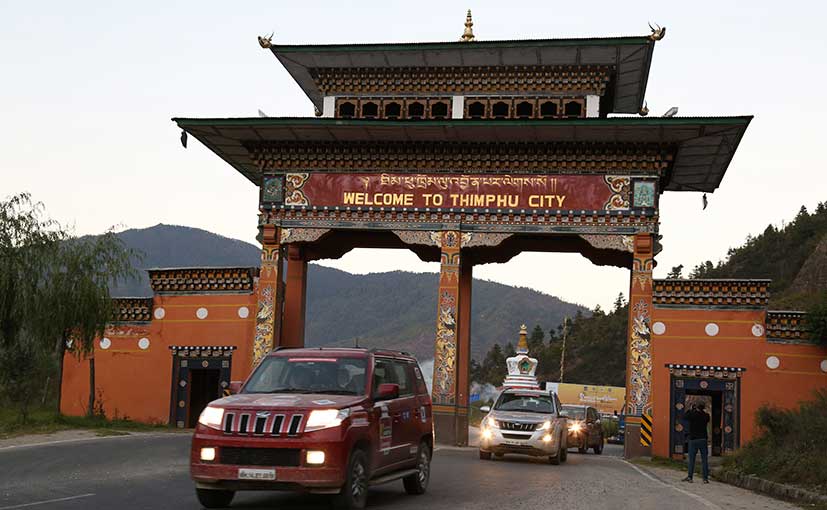
Famed for valuing Gross National Happiness over economic growth, Bhutan is a poster child for sustainable development.
But booming car sales may impact efforts to preserve its rare status as a carbon negative country -- and an increase in traffic is testing the good humour of its citizens.
Bhutan has seen a more than five-fold increase in cars, buses and trucks on its roads in the past two decades, according to transport authority director general Pemba Wangchuk with capital Thimphu hardest hit by the influx of vehicles.
Phuntsho Wangdi, a media consultant, says the congestion and lack of parking now makes driving stressful in the tiny Himalayan kingdom where there are no traffic lights.
"I wish there were fewer cars. It wasn't like this before," he adds of life in Thimpu, which is home to half the cars in the country.
The nation's economy has grown 7.5 percent each year in the past decade, according to the World Bank. Officials estimate there is now one car for every seven people in Bhutan, which has a total population of 750,000.
But the nation's narrow country lanes and outdated city roads can barely cope. A lack of infrastructure, along with poor driving etiquette -- some simply leave their cars parked in the middle of the road -- compounds the problem.
"Every year the number of cars and the number of people are increasing, and the roads have remained the same, and it's a problem for us," Lhendup, a taxi driver, tells AFP.
- Gridlock misery -
Morning rush hour journeys that once took five minutes now take more than half an hour.
This may seem a small figure compared to the hours of gridlock faced by commuters in Manila, Jakarta, and Bangkok, but it is a step-change for the Bhutanese who say the situation has rapidly deteriorated in the past year.
"Its chaotic. I eat my breakfast in the car now to save time," says Kuenzang Choden, who drops her four-year-old daughter at school every day before heading to work.
The traffic jams are a sign of the wider economic changes the nation is facing. Bhutan is renowned for prioritising Gross National Happiness over GDP, and has captured tourists' imagination as a tranquil, idyllic land, but there are signs of malcontent.
According to the World Bank's 2018 report, the youth unemployment rate is high, as is rural to urban migration, which puts a strain on the resources of towns and cities. And despite it's reputation as a place where well-being is prioritised -- it ranked 95th out of 156 countries in the 2019 UN World Happiness Report.
The proliferation of the internet and smartphones are fuelling modern desires, while dealers are filling their showrooms with new brands and models from Japan and South Korea to lure buyers.
And while taxes have increased and restrictions put on vehicle loans, car buyers are not discouraged.
Local financial institutions gave 3.2 billion ngultrum ($46 million) in car loans in 2015, but by last year the amount had reached 6.7 billion ngultrum ($96 million).
The figures please local businessmen but worry environmentalists keen to ensure Bhutan remains one of the world's greenest countries.
Environmental activist Yeshey Dorji explains: "As a nation that prides itself on being a carbon-negative country, the increase in the number of fossil fuel vehicles speaks poorly of our leadership position in environmental conservation."
- Radical measures -
Bhutan and Suriname, both with lush forests, are the only two countries to claim they are carbon negative, absorbing more carbon pollution than they give off.
Methane from cows, the burning of crops and other farm activities used to be Bhutan's main source of greenhouse gases. But that has changed in recent years to industry and cars.
Bhutan's constitution dictates that at least 60 percent of the country must be forest and the figure is currently above 70 percent.
But Bhutan is now importing more in fossil fuels than it exports in hydropower to India -- the country's biggest revenue earner.
Public transport is poor, particularly in Thimpu, which is home to 100,000 people but barely 40 buses.
The capital's mayor Kinlay Dorji plans to introduce bus-only lanes on city roads and wants to buy more buses.
"Its time for radical measures," he says.
"We have to make public transport more attractive and discourage owning cars," he adds, warning that unless action was taken Thimphu risked grinding to a standstill.
To ease congestion, the city is also constructing its first two multi-storey car parks that will each take about 600 cars.
The National Environment Commission insists Bhutan is still carbon negative despite the traffic jams and vehicle boom, but wants to stop things worsening.
Commission secretary Dasho Sonam P. Wangdi explains: "We cannot stop people from buying cars, but we can introduce alternative, less polluting cars such as the hybrid and electric ones to reduce carbon footprint."
Related News


Latest Cars


Upcoming Cars


Latest News


 car&bike Team | Jul 6, 2026350 cc Triumph 400 Models Prices Hiked Yet AgainThis is the second price hike since the new 350 cc platform was introduced in April 2026.1 min read
 Jaiveer Mehra | Jul 6, 2026Upcoming Bentley Electric SUV Named Torcal; Debut On September 23Bentley’s first EV is named after the El Torcal de Antequera limestone rock formations in Spain.1 min read
 car&bike Team | Jul 6, 2026Ducati Desmo450 SM Revealed At World Ducati WeekDucati marks 100 years with the new Desmo 450 SM which was unveiled at the global World Ducati Week celebration in Misano.1 min read
 car&bike Team | Jul 6, 2026MG Windsor EV Sales Cross 75,000 Units In Under 2 YearsWindsor sales crossed the 50,000-unit wholesales mark in November 2025.2 mins read
 Jaiveer Mehra | Jul 6, 2026FADA Sales June 2026: Passenger Vehicles, Two-Wheelers Post Over 20 Per Cent GrowthThe Federation of Automobile Dealers Associations said that sales in June 2026 were the highest ever for the month.1 min read
 car&bike Team | Jul 6, 2026Oben Rorr Evo Deliveries BeginOben Electric has received more than 25,000 bookings for the Oben Rorr Evo.2 mins read
 Seshan Vijayraghvan | Jun 29, 2026Renault Kiger vs Toyota Urban Cruiser Taisor: Which Underdog Deserves Your Money?Both the Kiger and the Taisor promise strong performance, solid features, comfortable cabins and everyday usability, all without breaking the bank. But which of these underrated subcompact SUVs deserves your money? Let's find out.1 min read
 Seshan Vijayraghvan | Jun 29, 2026Skoda Kodiaq RS Review: The Best Kodiaq Yet?The Skoda Kodiaq RS is finally here, and it's every bit as exciting as I expected. But was it worth the wait?7 mins read
 Bilal Firfiray | Jun 28, 2026BMW X6 M60i Review: It’s Back And HOW!The BMW X6 M60i blends a 530bhp twin-turbo V8, with its unmistakable coupe-SUV styling. There’s plenty of character, but is it worth your money?6 mins read
 Janak Sorap | Jun 25, 2026350cc Bajaj Dominar 400 Review: Same Character, Lower PriceA slightly lower displacement engine, a significantly lower price tag and nearly the same performance — the Bajaj Dominar 400 aims to be smarter rather than faster.6 mins read
 Preetam Bora | Jun 25, 20262026 Bajaj Pulsar NS400Z First Ride Review: Smaller Engine, But Should You Buy It?The Bajaj Pulsar NS400Z won our Two-Wheeler Upgrade of the Year. Then new tax slabs happened. Smaller engine, same badge – but does it still deliver?6 mins read