
Elon Musk Expects Neuralink's Brain Chip To Begin Human Trials In 6 Months


Elon Musk said on Wednesday he expects a wireless brain chip developed by his company Neuralink to begin human clinical trials in six months, after the company missed earlier timelines set by him.
The company is developing brain chip interfaces that it says could help disabled patients to move and communicate again, with Musk adding on Wednesday it will also target restoring vision.
Based in the San Francisco Bay Area and Austin, Texas, Neuralink has in recent years been conducting tests on animals as it seeks approval from the U.S. Food and Drug Administration (FDA) to begin clinical trials in people.
"We want to be extremely careful and certain that it will work well before putting a device into a human," Musk said during a much-awaited public update on the device.
Speaking to a crowd of select invitees in a presentation at Neuralink headquarters that lasted nearly three hours, Musk emphasized the speed at which the company is developing its device.
"The progress at first, particularly as it applies to humans, will seem perhaps agonizingly slow, but we are doing all of the things to bring it to scale in parallel," he added. "So, in theory, progress should be exponential."
The FDA said it cannot comment on the status or the existence of any potential product applications.
The first two human applications targeted by the Neuralink device will be in restoring vision and enabling movement of muscles in people who cannot do so, Musk said. "Even if someone has never had vision, ever, like they were born blind, we believe we can still restore vision," he said.
The event was originally planned for Oct. 31 but Musk postponed it just days before without giving a reason.
Neuralink’s last public presentation, more than a year ago, involved a monkey with a brain chip that played a computer game by thinking alone.
Musk, who also runs electric vehicle manufacturer Tesla, rocket firm SpaceX, and social media platform Twitter, is known for lofty goals such as colonizing Mars and saving humanity. His ambitions for Neuralink, which he launched in 2016, are of the same grand scale.
He wants to develop a chip that would allow the brain to control complex electronic devices and eventually allow people with paralysis to regain motor function and treat brain diseases such as Parkinson's, dementia and Alzheimer's. He also talks of melding the brain with artificial intelligence.
Neuralink, however, is running behind schedule. Musk said in a 2019 presentation he was aiming to receive regulatory approval by the end of 2020. He then said at a conference in late 2021 that he hoped to start human trials this year.
Neuralink has repeatedly missed internal deadlines to gain FDA approval to start human trials, current and former employees have said.
Musk approached competitor Synchron earlier this year about a potential investment after he expressed frustration to Neuralink employees about their slow progress, Reuters reported in August.
Synchron crossed a major milestone in July by implanting its device in a patient in the United States for the first time. It received U.S. regulatory clearance for human trials in 2021 and has completed studies in four people in Australia.




Latest News


 car&bike Team | Jun 30, 2026Delhi EV Policy 2.0: New Petrol Two-Wheeler Registration Banned in Delhi from April 2028With Delhi's new EV policy approved, new financial incentives for buyers will be introduced while setting a clear roadmap towards an all-electric future for new vehicle registrations.1 min read
 car&bike Team | Jun 30, 2026Tata Sierra EV: Variants, Features, Prices ExplainedThe Sierra EV is offered in six variants and two battery pack options.1 min read
 Hansaj Kukreti | Jun 30, 20262026 Tata Sierra EV: In PicturesThe much-awaited Tata Sierra has finally been launched in its all-electric avatar. Let's take a closer look at it.3 mins read
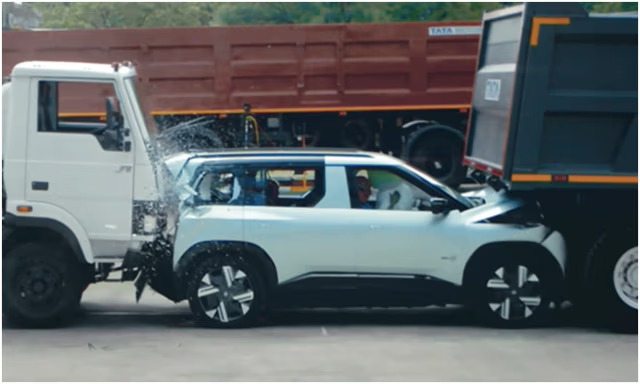 Amaan Ahmed | Jun 30, 2026Tata Sierra EV Sandwiched Between Two Trucks In Novel Crash Test: Watch VideoNobody saw Tata's latest crash test coming -- not even the Sierra EV it was conducted on2 mins read
 Jaiveer Mehra | Jun 30, 2026Tata Sierra EV Launched In India At Rs 18.79 Lakh: 5 Variants, 63 & 75 kWh Battery Options, 500+ km RangeElectric derivative of the Sierra is based on the Acti.ev+ platform and is offers over 500 km of range in real-world use.4 mins read
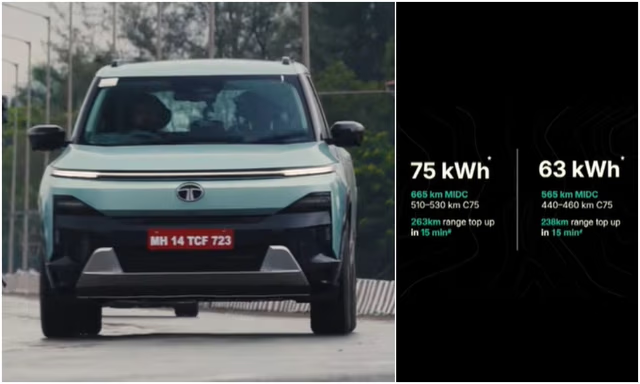 Amaan Ahmed | Jun 30, 2026Tata Sierra EV Real-World (C75) Range Figures RevealedUnlike what you may have seen on social media in recent days, the Sierra EV will not cover 700 kilometres, not even on the forgiving Indian Driving Cycle test2 mins read
 Seshan Vijayraghvan | Jun 29, 2026Renault Kiger vs Toyota Urban Cruiser Taisor: Which Underdog Deserves Your Money?Both the Kiger and the Taisor promise strong performance, solid features, comfortable cabins and everyday usability, all without breaking the bank. But which of these underrated subcompact SUVs deserves your money? Let's find out.1 min read
 Seshan Vijayraghvan | Jun 29, 2026Skoda Kodiaq RS Review: The Best Kodiaq Yet?The Skoda Kodiaq RS is finally here, and it's every bit as exciting as I expected. But was it worth the wait?7 mins read
 Bilal Firfiray | Jun 28, 2026BMW X6 M60i Review: It’s Back And HOW!The BMW X6 M60i blends a 530bhp twin-turbo V8, with its unmistakable coupe-SUV styling. There’s plenty of character, but is it worth your money?6 mins read
 Janak Sorap | Jun 25, 2026350cc Bajaj Dominar 400 Review: Same Character, Lower PriceA slightly lower displacement engine, a significantly lower price tag and nearly the same performance — the Bajaj Dominar 400 aims to be smarter rather than faster.6 mins read
 Preetam Bora | Jun 25, 20262026 Bajaj Pulsar NS400Z First Ride Review: Smaller Engine, But Should You Buy It?The Bajaj Pulsar NS400Z won our Two-Wheeler Upgrade of the Year. Then new tax slabs happened. Smaller engine, same badge – but does it still deliver?6 mins read