
Honda QC1 Review: India’s E-Scooter Buyer Deserves Better


- Honda QC1 feels built to a cost in every sense – in the way it looks, feels and performs.
- Small battery means performance is severely restricted in order to achieve respectable range.
- QC1 highlights how well-priced its established rivals from Bajaj and TVS are.
PHOTOGRAPHY: PAWAN DAGIA
You would imagine that in 2025, the perception of the average Indian vehicle buyer looking for something ‘cheap’ would be history. After all, buyers across categories have evolved over the years to seek value, and not just a shockingly low price tag. If that wasn’t the case, customers wouldn’t be buying the Honda Activa – which now costs nearly Rs. 1 lakh on-road in Mumbai, in even its most basic form – in droves. And yet, the maker of the Activa has come up with a new scooter that seems to have been developed with just one clear goal – make it cheap.
Affordable mobility is always welcome, but the Honda QC1’s approach to attracting entry-level electric scooter buyers is one that feels outdated in this day and age. Over the course of the next few minutes (and paragraphs), I will explain why it feels so out of touch with ground realities in 2025.
Also Read: Honda Activa E Review – Well-Rounded E-Scooter Needs Strategy Swap
Honda QC1: Design and styling
It’s true that Honda’s scooters are revered for their bulletproof reliability and frugality, and not so much for their looks. And to my eyes, there’s nothing wrong with a simple-looking scooter. The QC1, however, adopts the appearance of a cut-price vehicle. It shares its face with the considerably more expensive Activa E, but lacks the cowl-mounted LED daytime running light of its fancier sibling.
In profile, the QC1 is closer to a budget electric scooter from China, with its 12-inch alloy wheel at the front, and a 10-inch rear wheel with a hub motor, giving it an unbalanced stance. The tail section also feels entirely disconnected from the front, with a small LED tail-light, and the red-painted dual shock absorbers look out of place, and definitely nowhere close to being “premium” or even aspirational.
There are also no Honda emblems anywhere on the scooter. You’ll have to look closely to find the discreet Honda wordmark inside the headlight enclosure, and at the rear base of the seat – almost like Honda is somewhat hesitant about people finding out who the maker of the QC1 is.
Bland, staid, unremarkable are the words that come to mind when you spend a few minutes gazing at the QC1. It looks almost like something that was created not by a design team, but by a ChatGPT prompt containing the words “Simple. Cheap. Scooter. For. India.”
Honda QC1: Practicality, Quality and Features
The feeling of this scooter being built to a strict cost target becomes clearer once you get on it. The quality of the switchgear is ordinary, and in operation, the switches feel average at best; the cluttered multi-function lock looks like it has been borrowed from a decade-old Honda scooter, and the negative LCD cluster is inexplicably basic.
While it is legible for the most part, it has lots of blank spaces, and still lacks a distance-to-empty readout, which you’d imagine would be a bare minimum for an electric scooter today. Also, there is no Bluetooth connectivity, not even as an option. It’s doubly perplexing when you realise the entry-level Activa, too, now gets a colour TFT display – but somehow, the similarly-priced QC1 isn’t good enough to get that.
In terms of practicality, the QC1 fares better than the Activa E. It has a single, but large, front pocket, with a USB-C charge port located right above it. The floorboard is reasonably spacious, but there is just one bag hook on the QC1, as the space beneath the seat is reserved for the scooter’s charge port. It must be noted the QC1 does not adopt a widely-used charging standard, so you will be restricted to using the charger bundled with the scooter.
The seat is long enough to accommodate the rider and pillion in reasonable comfort, and under the seat you will find 26 litres of storage, which is decent, but not quite as good as the TVS iQube’s 32-litre space. It’s also not flat, so fitting bigger items under the seat will be a challenge. Also, the underseat space is not illuminated, and there are practically no other features to speak of.
Honda QC1: Performance, Ride and Range
Where the QC1 truly falters is out on the road. Equipped with a hub motor that produces a continuous output of 1.2 kW (1.6 bhp) and a peak output of 1.8 kW (2.4 bhp), the QC1's performance is as weak as the numbers would suggest.
There are two ride modes to choose from, using the switch on the right cube – Econ and Standard. When you start the scooter, you are by default in Econ, which limits you to a piffling top speed of 30 kmph. Not only is that woefully slow, but it also takes quite some time to achieve that speed. Throttle response is utterly lazy, and even when you whack it open, the scooter shows absolutely no urgency to get anywhere quickly. Even in the city, Econ feels downright unusable.
Switching to Standard doesn’t make much of a difference. It permits a higher top speed, and during my ride, I noted a speedo-indicated speed of 53 kmph, but once again, progress is glacial. Honda quotes a 0 to 40 kmph time of 9.4 seconds – more than twice the time a TVS iQube takes – and it feels as painfully slow as the numbers on paper suggest.
Throttle response remains dull, and once you get to 50 kmph, the scooter runs into an invisible wall. On the highways, you will have to sit with the throttle wide open, which taxes the wrist after some time, and while the QC1 will gingerly climb flyovers, it isn’t happy doing so. On the QC1, you simply have to accept that you will be left eating dust by practically every other two-wheeler on the road.
At its top speed, the QC1 is reasonably planted, but then, which scooter isn’t, at 50 kmph? That said, it is super light at 89.5 kg, so it is easy to flick into gaps, but it also sways more when a heavy vehicle passes you. Ride quality is on the firmer side and can get lumpy on broken surfaces. Grip from the tyres is decent, and while the drum brakes (no front disc brake available) aren’t the most powerful, going as slowly as you are on the QC1, you’ll rarely find any room for complaint. This is not a scooter you can ride in a spirited manner even if you wanted to, so talking about handling in this case is somewhat futile.
The biggest reason for the QC1’s weak performance is its small battery and resultingly limited range. At 1.5 kWh, this is the tiniest battery we’ve seen on an electric scooter from a big-ticket OEM so far, and it utilises Ampace’s ‘Boost Power’ cell, which is said to combine NMC and LFP chemistries. The claimed range is up to 80 kilometres, but I spent almost 75 per cent charge to cover around 47 kilometres, riding solo, mostly in Standard mode, so you can expect a real-world range of not more than 60-65 kilometres on a full charge – a figure that will drop sharply if you have a pillion rider. And when the battery runs out, charging it to full will take nearly seven hours – despite it being as low-capacity as it is – because the bundled charger is rated at a mere 330W.
Honda QC1: Verdict
Given its basic configuration, you would imagine the Honda QC1 would also have a shockingly low price – but it doesn’t. You’ll have to pay Rs 90,000 (ex-showroom) for the QC1, which is available in a single variant, and that is an introductory price, so it will almost certainly go up in the time to come. Not too far off sit the Bajaj Chetak 2903 (Rs 96,000) and the TVS iQube 2.2 kWh (Rs 1.02 lakh), not only offering better range and more features than the QC1, but already having found widespread acceptance in the market.
Even when it comes to warranty, the QC1 doesn’t set any new benchmarks – 3 years or 50,000 kilometres (for battery, motor and vehicle, whichever comes earlier), which is only par for the course, and not industry-leading, which you would expect from a company that is so utterly dominant in the scooter market.
The QC1 feels like an opportunity missed, because if Honda wanted to take the electric scooter market by the scruff of its neck, it could very well have done that. Unfortunately, the QC1 simply doesn’t have what it takes to make a positive first impression. The tragic part is, this is the Honda e-scooter that will be sold pan-India, and not the capable and likeable Activa E.
This will be the scooter that the masses will associate with Honda, and for many, the QC1 won’t even figure in the consideration set just because it feels at least three steps behind every other electric scooter on the market today. Honda would do well to rather reposition the QC1 as an ultra-affordable mobility solution and come up with another competent product that can at least match, if not significantly better, the value-for-money options currently available to the Indian buyer.
Honda QC1: Tech specs
Battery: 1.5 kWh
Motor: BLDC hub motor
Power: 1.8 kW
Weight: 89.5 kg
Wheelbase: 1275 mm
Ground clearance: 169 mm
Seat length: 704 mm
Underseat storage: 26 litres
Charging (0 to 100%): 6 hours, 50 minutes
Wheels: 12-inch (front), 10-inch (rear)
Top speed: 53 kmph (indicated)
Range: 60-65 km (estimated, real-world)
Price as tested: Rs 90,000 (introductory, ex-showroom)
Related News



Research More on Honda QC1

Popular Honda Models


Latest Cars


Upcoming Cars


Latest News


 Jaiveer Mehra | Jun 28, 2026Nissan Tekton Spied Undisguised Ahead Of July 9 DebutSole image of the SUV showcases the rear design of the SUV.1 min read
 Carandbike Team | Jun 28, 2026Renault Kwid Facelift India Launch On July 3Latest facelift marks the second major update for the entry hatchback since its launch in 2015.1 min read
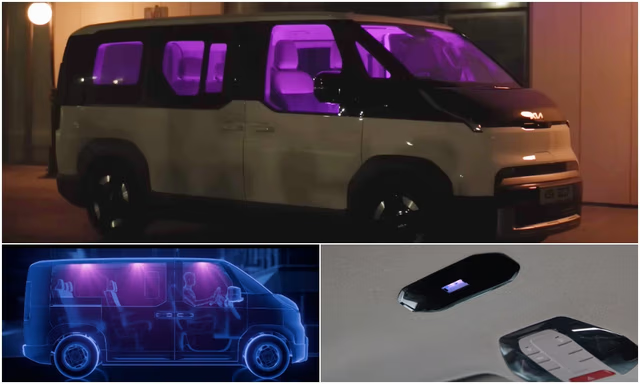 Amaan Ahmed | Jun 27, 2026Future Hyundai, Kia Cars May Feature In-Built UVC SanitiserHyundai Motor Group has unveiled 'Plasma Care UVC' technology, which utilises plasma lamps to safely and effectively destroy bacteria and viruses present inside a car.1 min read
 Amaan Ahmed | Jun 27, 20262026 Maruti Suzuki Brezza Facelift To Be Launched On July 23Launched back in 2022, the current generation of the Brezza subcompact SUV is expected to gain a new engine option, along with a longer list of features.2 mins read
 Jaiveer Mehra | Jun 26, 2026New Hyundai Elantra Makes Global Debut: Boxy Styling, Hybrid Powertrain & Pleos InfotainmentNew generation of the Elantra – sold as the Avante in South Korea – adopts Hyundai’s Art of Steel design language.1 min read
 car&bike Team | Jun 26, 2026TVS NTorq 125 Launched With New Colours From Rs. 82,500TVS Motor Company has introduced three new colours for the NTorq 125 Race Edition and two colour options for the disc variant of the scooter.1 min read
 Bilal Firfiray | Jun 28, 2026BMW X6 M60i Review: It’s Back And HOW!The BMW X6 M60i blends a 530bhp twin-turbo V8, with its unmistakable coupe-SUV styling. There’s plenty of character, but is it worth your money?6 mins read
 Janak Sorap | Jun 25, 2026350cc Bajaj Dominar 400 Review: Same Character, Lower PriceA slightly lower displacement engine, a significantly lower price tag and nearly the same performance — the Bajaj Dominar 400 aims to be smarter rather than faster.6 mins read
 Preetam Bora | Jun 25, 20262026 Bajaj Pulsar NS400Z First Ride Review: Smaller Engine, But Should You Buy It?The Bajaj Pulsar NS400Z won our Two-Wheeler Upgrade of the Year. Then new tax slabs happened. Smaller engine, same badge – but does it still deliver?6 mins read
 Preetam Bora | Jun 25, 2026Triumph Tracker 400 First Ride Review: What's It Really Like?The Triumph Tracker 400 is here, now with a downsized 349 cc engine. We spent a couple of hours with it to share our first impressions. Is it worth your attention?1 min read
 Preetam Bora | Jun 15, 20262026 Yezdi Scrambler Review: The Update That Changes EverythingThe Yezdi Scrambler gets a comprehensive update with an updated engine, revised chassis, reduced weight and proper features list. Does it deliver? Here’s our take.10 mins read