
Why Some Cars Develop Cabin Rattles Faster Than Others

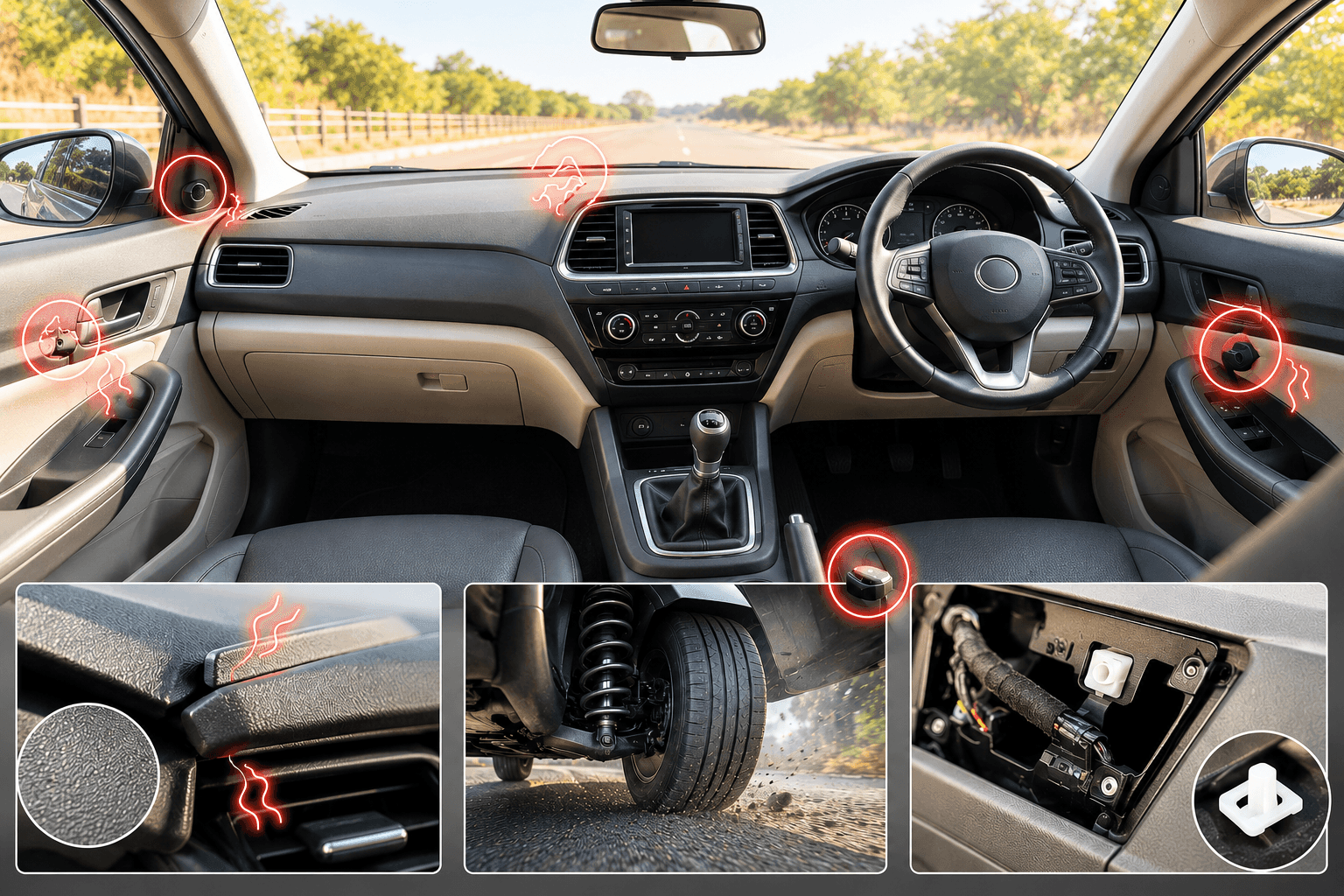
- Hard plastics rubbing against each other create squeaks due to temperature changes
- Stiff suspension setups lead to road impact on the dashboard and door panels' fittings
- Installing aftermarket accessories also breaks factory clips that keep the interior secured
Driving a brand-new car off the showroom floor feels quite satisfying. The engine is smooth, the air conditioning works without any issues, and the cabin feels completely silent. But after a few months, you might start hearing a faint buzz near the dashboard or a squeak coming from the rear doors. These cabin rattles are honestly annoying since they ruin the peaceful atmosphere inside the car. The actual reasons behind a noisy cabin usually come down to how the car is built, how it is driven, and the materials used on the inside.
Also Read: Best Diesel SUVs Under Rs 25 Lakh In India
The Main Causes of a Noisy Car Cabin
A modern car interior is put together using hundreds of individual pieces. These include dashboard panels, air conditioning vents, door cards, and seat rails. How these pieces interact with each other and the road below determines how quiet your journey will be.
Suspension Tuning and Tyre Choices
The suspension system does a lot more than keep the car stable around corners. It acts as a massive filter between the road and the cabin. Cars designed with a highly sporty focus usually feature very stiff suspension springs. This setup gives the driver excellent handling on smooth highways. However, when you hit a pothole or drive over a rough patch of tarmac, that stiff suspension fails to absorb the impact completely. The shock travels straight through the metal frame and into the plastic dashboard. Over thousands of kilometres, these constant sharp shocks cause the screws and internal clips holding the dashboard together to work themselves loose slowly.
Also Read: What Exactly is E85 Fuel? A Complete Breakdown Of India's New Rs. 82/Litre Petrol Alternative
The tyres you choose also play a massive role. Vehicles equipped with large alloy wheels and low-profile tyres look fantastic on the road. But the thin rubber sidewall provides very little cushioning. Switching to a tyre with a thicker sidewall adds a layer of air that absorbs minor bumps before they even reach the suspension.
Material Quality and Assembly Techniques
The actual materials used inside the cabin also dictate how parts behave when they rub together. Budget-friendly cars usually rely heavily on hard plastic for the dashboard and door trims. When two pieces of hard plastic are joined together without any padding, they tend to squeak whenever the car goes over uneven ground. Manufacturers producing premium vehicles tackle this by using soft-touch materials. They also place thin strips of felt tape or rubber between overlapping panels to prevent plastic-on-plastic friction.
How the car is bolted together matters as much. Factory robots use exact pressure measurements to push plastic retaining clips into the metal frame. If a manufacturer uses cheap, brittle clips to save money during production, those clips will eventually crack under the stress of daily driving. Once a clip cracks, the panel it was holding becomes loose and starts vibrating against the metal door frame.
India's Unique Driving Conditions
You cannot talk about car rattles without mentioning the daily driving environment. Indian roads are full of deep potholes, poorly constructed speed breakers, and sudden patches of broken surfaces. A vehicle driven primarily on smooth city highways will naturally stay silent for years. On the other hand, a car that constantly tackles rough rural roads or dug-up city streets is subjected to heavy vibrations every single day. These continuous vibrations act like a mini earthquake inside the car, slowly backing out screws and loosening the weather seals around the windows.
Also Read: How Driving Habits Affect Clutch Life In Manual Cars
Extreme Temperature Changes
The climate takes a heavy toll on car interiors as well. When you park your car under the hot afternoon sun, the interior temperature can easily exceed 50-degree Celsius. This intense heat causes the plastic dashboard panels to expand. Later in the evening, when you start the car and turn the air conditioning on full blast, those same panels rapidly cool down and shrink. This constant expanding and shrinking process causes the plastic parts to shift slightly from their original factory positions. Over time, the gaps between the panels widen, giving them enough room to vibrate and rattle when you are driving.
Aftermarket Modifications
Third-party modification is arguably one of the most common reasons a relatively new car suddenly develops interior noises. Many buyers purchase a base variant of a car and immediately take it to a local accessory shop to install upgraded speakers or a new touchscreen. To install these items, the mechanics have to pull off the factory door panels and dashboard trims.
Factory clips can actually be used only once. When a mechanic opens up a door panel forcefully, these clips snap. If they aren't replaced, or if they're replaced with cheaper aftermarket options, then the panel will never sit as tightly as before. The heavy bass from upgraded speakers will then cause the loose plastic door card to vibrate heavily, creating a constant buzzing noise.
Tracking Down and Fixing Common Noises
If your car has started making annoying sounds, you do not necessarily have to live with it. Finding the exact source of the noise is usually the hardest part because sounds tend to bounce around the enclosed cabin. Having a friend sit in the passenger seat to listen closely while you drive over a rough road is a highly effective way to pinpoint the issue.
The following table lists some ways to find out what might be causing the noise in your vehicle.
Also Read: Ceramic Coating vs Paint Protection Film (PPF): Understanding The Differences
| Type of Noise | Where It Usually Comes From | Likely Cause and Solution |
| High-Pitched Squeak | Door frames or windows | Dry rubber weather seals are rubbing against metal. Wiping a silicone spray on the rubber usually stops the noise completely. |
| Deep Rattle | Inside the door panel | A broken plastic clip or a loose speaker wire hitting the metal frame. Requires opening the door card to tape down loose wires. |
| Plastic Buzzing | Dashboard or instrument cluster | Hard plastics are rubbing together due to temperature expansion. Pushing thin felt tape into the panel gaps usually tightens things up. |
| Metallic Clunk | Under the seats | Loose seat rails or items rolling around underneath. Check for coins or tighten the main bolts holding the seat to the floor. |
| Vibrating Sound | Glovebox or storage bins | Items inside are bouncing against hard plastic walls. Empty the bins or line the bottom with a small piece of rubber matting. |
Also Read: Why Your Car's AC Cools Better While Driving Than At Idle
Keeping Your Car’s Cabin Silent for Years
Overall, maintaining a car's quiet requires you to have some mechanical sympathy as well. When you see a rough patch of road or a sharp speed breaker approaching, slowing down stops those harsh shocks from rattling the cabin. And if you need to install aftermarket accessories, always insist that the technician uses brand-new, manufacturer-approved clips when putting the panels back together.
Additionally, keeping your dashboard clean and using a sunshade when parking outdoors prevents the plastics from baking and turning brittle. Keeping your door pockets free of heavy items is a good practice, and reworking the glovebox's screws is important, too. It needs to be said that no car will remain silent forever, but you can definitely address the small squeaks before they become bigger annoyances.


Latest News


 Jafar Rizvi | Sep 23, 2026Mercedes-AMG G 63 Offroad Pro Launched At Rs 3.80 CroreThe new trim is Rs 6 lakh dearer than the standard counterpart. The difference gets you a few off-road features and equipment.2 mins read
 car&bike Team | Sep 23, 2026Ultraviolette Raises $85 Million To Accelerate Global EV ExpansionUltraviolette has raised $85 million in a new funding to scale up production, develop new EV platforms and expand into international markets.1 min read
 Jafar Rizvi | Sep 23, 2026Mahindra Thar OG: Top 5 Changes Over 2025 Thar 3-DoorThe Mahindra Thar OG gets several changes over the old Thar, including new suspension hardware, more powerful engines and more.3 mins read
 Abhishek Nigam | Sep 23, 20262026 Mahindra Thar OG vs 2025 Thar: What’s New And What’s Changed?The Thar gets a major mechanical and feature overhaul for 2026, while retaining the iconic three-door design and off-road-focused character4 mins read
 Amaan Ahmed | Sep 23, 2026Hyundai Bayon Confirmed As 4.2M-Long Petrol SUV; Bookings OpenYou can now book Hyundai's new segment-splitting SUV -- but you'll have to do it without seeing a single image of the real deal1 min read
 car&bike Team | Sep 23, 20262027 Mahindra Thar OG Colour Options RevealedThe 2027 Mahindra Thar OG is available in eight exterior paint schemes.2 mins read
 Bilal Firfiray | Sep 19, 2026MG Hector Tomahawk EV Review: Play It SafeMG’s new electric SUV has one of the coolest names ever, and the coolest temperament amongst its peers. But is it worth buying?7 mins read
 Preetam Bora | Sep 16, 2026Royal Enfield Himalayan 440 Review: Better Than the 450?The new Himalayan 440 with an upsized engine and gearbox has certainly improved as a touring machine and at an extremely attractive price of Rs. 2.29 Lakh. Is it the better Himalayan to choose for many riders?9 mins read
 Seshan Vijayraghvan | Sep 15, 2026BMW i5 LWB Review: Not The M60, This Is The Proper Electric 5 SeriesThe BMW i5 LWB takes the electric 5 Series formula and puts a stronger focus on rear-seat comfort and long-distance luxury. With a 669 km claimed range, 268 bhp and a more relaxed character, is this the i5 that makes the most sense for India?7 mins read
 Preetam Bora | Sep 14, 2026Ladakh Uncharted: Himalayan Basecamp Off-Road Ride ExperienceA day-long off-road excursion from Royal Enfield’s Himalayan Basecamp event in Ladakh, the Ladakh Uncharted ride by Alpinestars was all about re-discovery!6 mins read
 Janak Sorap | Sep 12, 2026New Bajaj Pulsar 125 First Ride Review: More Tech, Less Weight, Same Pulsar DNAThe new Bajaj Pulsar 125 retains the familiar Pulsar identity but gets a new engine, lighter construction, more features and a sharper riding experience.5 mins read