
Honda Patents Steering Assist Tech For Motorcycles

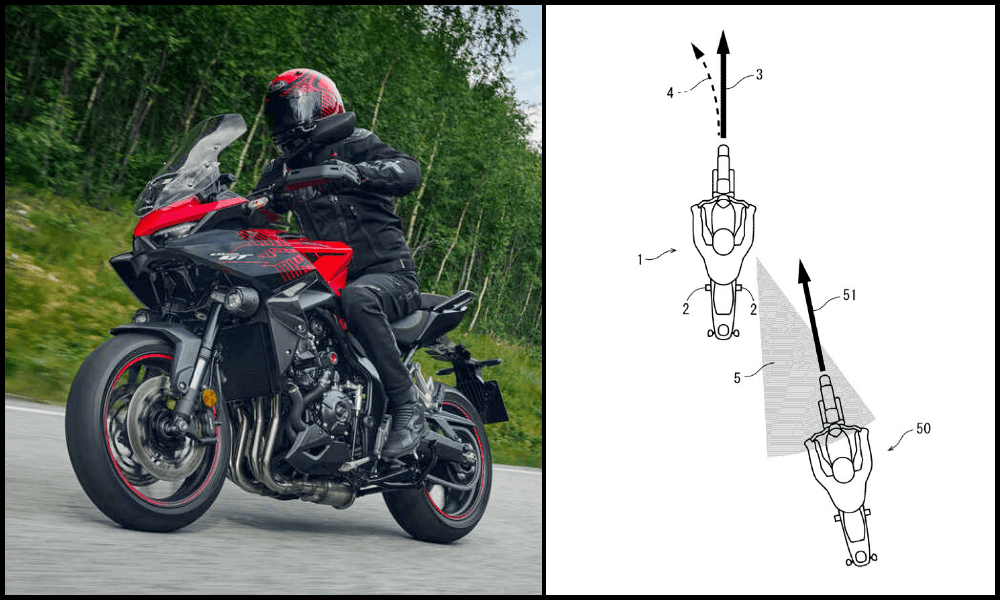
- Camera-based system detects vehicles approaching from blind spots
- Steering assistance adapts to rider inputs like acceleration and braking
- Concept goes beyond warnings by gently assisting steering control
Honda has filed a patent for a motorcycle turn control device that aims to improve rider safety by actively assisting steering inputs when another vehicle approaches from a blind spot. The system is designed specifically around the dynamics of motorcycles, where even small steering corrections can significantly affect stability. Unlike existing rider-assist systems that only warn the rider, Honda’s concept goes a step further by gently intervening in steering to help avoid a potential collision.
Also Read: Honda Motorcycles Unveils New Branding For Flagship, Electric Range
The system essentially uses a camera that continuously monitors the area around the motorcycle. Using this visual data, a blind spot recognition unit identifies vehicles approaching from areas not easily visible to the rider, such as adjacent lanes during a lane change. Once a vehicle is detected in a blind spot, the system evaluates the rider’s current actions before deciding whether and how to intervene.
The steering intervention is managed by a steering control unit, which adjusts its response based on the motorcycle’s riding state. Honda’s patent specifically mentions three rider inputs that influence the system’s behaviour: lane change, acceleration, and deceleration.
Depending on whether the rider is accelerating, braking, or actively steering, the system adjusts the level of assistance accordingly. For example, a gentle corrective input may be applied if the rider begins steering into a lane where another vehicle is approaching, while remaining less intrusive if the rider is already braking or stabilising the bike.
Also Read: EICMA 2025: Honda CB1000GT Sport Tourer Revealed
The second illustration outlines the system architecture and how different sensors feed information into the steering control logic. In simple terms, it demonstrates how Honda integrates rider inputs and environmental data to determine the level of steering assistance.
The system consists of:
- A camera (imaging device) that captures the surroundings
- A steering torque sensor, which measures how much force the rider is applying to the handlebars
- A throttle opening sensor, which detects acceleration input
- A brake pressure sensor, which monitors braking force
All this data is processed by an event detection unit, which determines what the rider is trying to do, such as changing lanes, accelerating, or slowing down. Simultaneously, a blind spot angle recognition unit analyses camera data to identify vehicles approaching from unsafe angles.
Once these inputs are assessed, the information is sent to the steering control unit, which decides whether steering assistance is needed. If required, a rotation actuator subtly adjusts the steering direction to help the motorcycle avoid the approaching vehicle, while still allowing the rider to remain in control.
To put things in perspective, Honda isn’t the only manufacturer exploring this space. Brands like BMW, Ducati, and others are already moving in a similar direction with radar-based safety systems. Whether such technology makes it to production in its current form remains to be seen.


Latest News


 Sarthak Mahajan | Aug 10, 2026Top 5 Major Feature Updates On The New Mahindra Scorpio-NMahindra recently launched the updated Scorpio-N. Here are the top five features to look out for.1 min read
 car&bike Team | Aug 10, 2026New Ducati Monster V2 Launched In India At Rs 13.99 LakhThe updated naked Ducati gets a new 890cc V2 engine in place of the outgoing 937cc unit, along with revised ergonomics and more.1 min read
 Abhishek Nigam | Aug 10, 2026TVS Orbiter Electric Scooter Now Costs Up To Rs 4,000 MoreTVS hikes price of its popular urban EV runabout2 mins read
 car&bike Team | Aug 8, 2026Bugatti Destrier Revealed As One-Off Bolide-Based Hypercar With 1,578 BhpBugatti has revealed the Destrier, a one-off based on the Bolide but with a completely different design brief.3 mins read
 car&bike Team | Aug 8, 2026KTM 160 Duke, RC 160 Prices Hiked By Up To Rs 15,000KTM India has revised the prices of its entry-level motorcycles, with both the 160 Duke and RC 160 getting more expensive.1 min read
 car&bike Team | Aug 8, 2026MG Majestor SUV Prices Hiked By Rs 1.50 LakhAfter the hike, prices for the Majestor now start at Rs 42.49 lakh (ex-showroom) for both 4x2 variants.2 mins read
 Bilal Firfiray | Aug 1, 2026Toyota Hilux Review: The InvincibleMarking it as the ninth generation, the Hilux comes with a major cosmetic overhaul. But is it still relevant enough for the current times or is it getting too long in the tooth?5 mins read
 Bilal Firfiray | Jul 30, 2026Kia Syros EV Review: Best EV To Buy Under Rs 20 Lakh?The Kia Syros EV comes into the game with a modern design, spacious cabin, strong performance, decent range and an aggressive pricing. But could it become the new benchmark under Rs 20 lakh?5 mins read
 Jaiveer Mehra | Jul 27, 20262026 Maruti Suzuki Brezza Facelift Review: Bestseller Joins The Turbo ClubWhile Maruti’s facelifts have always tended to bring subtle updates over the outgoing models, the latest Brezza brings some heavy updates under the skin, including a new 6-speed manual gearbox and, for the first time, a turbocharged petrol engine option.1 min read
 Bilal Firfiray | Jul 24, 2026Honda ZR-V Review: Who Is It For?Honda has brought the new ZR-V to India as their current flagship offering. It’s a CBU, it’s a hybrid, and it’s here for a limited few. Who is it for though?1 min read
 Girish Karkera | Jul 29, 2026Mercedes-AMG E53 4MATIC+ PHEV First Drive Review: Just What The Doctor OrderedThere are luxury cars and there are high-performance cars. But what if you want both for the price of one? Mercedes-Benz has a recommendation that promises to tread a fine line between the two – the second generation E53 with a twist.7 mins read