
Royal Enfield Himalayan ABS Review


- The Royal Enfield Himalayan ABS is priced at Rs. 1.79 lakh (ex-showroom)
- The RE Himalayan gets electronic fuel injection and dual-channel ABS
- The Himalayan's 411 cc engine makes 24.5 bhp of power, 32 Nm of torque
The Royal Enfield Himalayan isn't exactly an all-new bike. It has been around since 2016, when Royal Enfield introduced the company's first adventure-touring motorcycle. The Himalayan also got the first counterbalanced engine on any Royal Enfield, but the first carburetted Himalayan has had its fair share of complaints from owners, particularly about reliability and mechanical issues. Last year, the Royal Enfield Himalayan got two significant updates. First, the Himalayan was introduced with fuel-injection, and late last year, Royal Enfield also introduced dual-channel ABS. And now, we got to spend some time with the new RE Himalayan ABS, to see how much has changed.
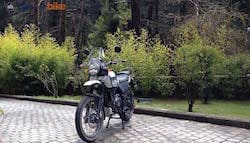
The overall design of the RE Himalayan ABS hasn't been changed; it's a simple, purposeful design, not exactly beautiful, but looks utilitarian
What Has Changed, What Hasn't?
The design and overall silhouette of the Royal Enfield Himalayan remains the same. It's a love it, or hate it, sort of design. We like the functional, and almost industrial, bare-bones design, and it looks built to take on a lot of hard work. The overall design, body panels, cycle parts and even the engine remain the same. The engine also remains the same 411 cc, air-cooled engine, which puts out 24.5 bhp of power at 6,500 rpm and 32 Nm of peak torque at 4,250 rpm.
The 41 mm front fork is non-adjustable, but offers 200 mm of travel. Brakes are now non-switchable dual-channel ABS
The chassis, suspension, wheels and tyres also remain the same, as do the instrument panel and lights. But what has changed as mentioned earlier, is that the Himalayan now gets fuel-injection and standard dual-channel ABS. Those are the only changes, but they have made the bike feel different; the throttle response has improved, and so has stopping power, but we'll get to that in some more detail.
The Himalayan's instrument panel is packed with information, but is busy. The compass seems to have a mind of its own.
Also Read: 2016 Royal Enfield Himalayan Review
How Does It Perform?
The 411 cc, single-cylinder, air-cooled, single overhead cam engine has the same output as before, but what it now gets is electronic fuel injection, and the difference is apparent from the time you press the starter button. The engine idles steadily with reassurance, and what has definitely improved is the acceleration. The fuel-injected engine feels smoother and more responsive than the earlier carburetted engine, and shift quality on the five-speed gearbox also seems to have improved significantly. Although shift quality is precise, it's not exactly slick by modern standards. The clutch though is heavy, and if you're caught in a bumper to bumper situation, working the clutch over and over again won't exactly be a pleasant experience.
The Royal Enfield Himalayan is a relaxed performer; as long as you're not in a tearing hurry to get anywhere, it's got decent cruising ability
So long as the traffic is moving, the Himalayan is a relaxed performer on tarmac. The engine's got a strong low and mid-range, and you don't really need to keep working the gearbox to keep momentum going. But this is not a high revving engine, so the Himalayan still is happiest when you play with the torque and let it pull leisurely, rather than trying to get to triple digit speeds in a hurry. Out on the highway, you will get to around 125 kmph if you push it, but at those speeds, the engine isn't the happiest.
The Himalayan's sweet spot is between 90-100 kmph; anything more than that, the vibrations begin to get bothersome
Despite being a counterbalanced engine, the 411 cc single has more or less the same characteristics as either the Royal Enfield 350 cc or 500 cc engines. The only minute difference is that it revs a little bit more, but that doesn't translate to any real performance gains. Cruising at 90-100 kmph is where the Himalayan's sweet spot is, but at higher speeds, the vibrations on the handlebar, footpegs, seat and fuel tank will begin to get bothersome after sometime.
The Himalayan's handling is predictable and neutral and it's comfortable to ride for long hours
Handling and Braking
Handling on tarmac, for the most part, is predictable and neutral. This isn't a bike to hustle around a set of corners, neither is it designed to be ridden that way. But the traditional double-cradle chassis keeps things taut and predictable, and even when taking on the occasional sweeping turn, the Himalayan feels planted and stable. But more than the motorcycle's ability, it's the lack of feel from the front end which will discourage you from pushing it hard around a corner. Of course, there's the large 21-inch wheel, but the dual-sport Ceat tyres don't offer the confidence to push the bike around a fast corner.
The dual-channel ABS cannot be switched off, even on the rear wheel, so riding off-road, the intrusive ABS becomes disconcerting
One of our grouses with the first generation Himalayan was in the braking department. And now, Royal Enfield has introduced standard dual-channel ABS on the Himalayan. Yes, there's a definite improvement in the braking department, but the two-piston caliper gripping the single 300 mm disc doesn't quite offer the bite or confidence to shave off triple digit speeds in a hurry. And the ABS isn't switchable as well. So when you're riding off-road, over loose surfaces and the like, the intrusive ABS becomes disconcerting, and sometimes downright disturbing. But that small windscreen, upright riding position and easy ergonomics make it easy for a long day in the saddle, and couple that with a sorted ride quality, it's quite the comfortable mile muncher, as long as you're not in a tearing hurry to get anywhere.
With 220 mm of ground clearance, and 200 mm front suspension travel, the Himalayan can take on a lot of hard-core off-road terrain
Off-Road Capability
With an 800 mm seat height, the Himalayan is easily accessible to riders of different heights and build, and reaching the ground with both feet is easy for my near 5 foot 10 inch frame. The low seat height will be helpful to wade across mountain streams with a rocky bed, or across mud and slush when the going gets tough. And the 32 Nm of torque ensures you will chug across most obstacles and rocky or sandy terrain without a care in the world. And speaking of rocky terrain, the Himalayan also offers 220 mm of ground clearance, and a standard engine bash plate, so no worries about oil spilling out of a broken crank case, or getting stranded while tackling such terrain.
The dual-sport Ceat tyres of the Himalayan offer decent grip, even over loose surfaces
The 21-inch front wheel and 17-inch rear wheel combination of spoked wheels is perfect when the road ends and the going gets tough. The tyres which feel somewhat vague around a sharp corner on tarmac now begin to show their purpose. They are nowhere near comparable as more expensive and proper off-road knobby tyres, but grip levels of the Ceat tyres over gravel and sand are quite satisfactory. The 41 mm front fork isn't adjustable, but offers 200 mm travel, and that means there's no bottoming out, even when you are jumping over rocks, ditches and sandbanks. And yes, the rear monoshock also offers 180 mm of travel. With a kerb weight of 191 kg, the Himalayan isn't exactly light, but it's still light by adventure bike standards, so even when you end up dropping it, it's easy to pick up, straddle and ride on. And in case you break something, it won't cost you a fortune to repair, or replace.
The Himalayan's biggest strengths are accessibility, affordability and versatility
Verdict
The Himalayan's performance on tarmac may not exactly be earth-shattering, but once the road ends, and the trail begins, its easy-going performance makes things a lot simpler. Even riders with limited or no exposure to dirt riding will find the Himalayan's stability and off-road capability a whole lot of fun. At Rs. 1.79 lakh (ex-showroom), the Royal Enfield Himalayan is the most affordable adventure touring motorcycle available in the market right now. With a strong sales and service network, and easy availability and cost of spares, it's also easy to live with. And that's the Himalayan's biggest strength.
It's not a performance oriented ADV bike, but it does most things expected of it quite satisfactorily
The Royal Enfield Himalayan is a simple, bare-bones motorcycle which is affordable, approachable and is built for a leisurely two-wheeled adventure. It's not an out and out motocross bike, or has the performance to make you pull a wheelie in the dirt, or even pull off a proper power slide. If you're looking for a modern, sophisticated and performance-oriented adventure motorcycle, you shouldn't even go looking at the Himalayan, because it may leave you seeking a lot more, because this is no Triumph Tiger or BMW R 1200 GS.
The Royal Enfield Himalayan ABS is a simple adventure tourer which does the job, while being easy on your pocket
But if you're looking for a simple, affordable and easily accessible bike to ride some dirt trails without being overwhelmed with performance or expensive repair bills, the Himalayan is just the right bike for that kind of job. Affordability, accessibility and versatility are its biggest strengths, and with that price tag, there's no other motorcycle on sale right now which offers those qualities. In fact, riding the Himalayan over a couple of days, you begin to appreciate its simplicity and the capability it offers, and those are the main reasons you should consider one.
Related News



Learn more about


Popular Models


Latest Cars


Upcoming Cars


Latest News


 car&bike Team | Sep 16, 2026Kia Announces Lifetime Battery Warranty On Carens Clavis EVThe 15 year lifetime warranty will be applicable only on first ownership of the MPV on cars sold after August 1, 20261 min read
 Jafar Rizvi | Sep 16, 2026Triumph Speed 400, Tracker 400 Prices Slashed By Up To Rs 7,000Just two months after raising prices across its 350cc lineup, Triumph has pulled down prices on two of its models.2 mins read
 Sarthak Mahajan | Sep 16, 2026Volkswagen ID.3 GTI Revealed: 321 bhp Electric Hatch Offers 600 Km RangeVolkswagen has revealed the ID.3 GTI globally, with 321bhp and 545Nm of peak torque.1 min read
 car&bike Team | Sep 16, 20262027 Kawasaki Vulcan S Launched At Rs 8.23 LakhKawasaki's cruiser returns for the new model year with a fresh colour option, a minor torque bump, and a slightly reworked braking setup.2 mins read
 car&bike Team | Sep 16, 2026Yamaha R15 V4 Gains Quickshifter In Two More Colour OptionsThe clutchless upshift option, once limited to Intensity White colour, is now available on the Racing Blue and Matte Pearl White variants as well.1 min read
 Sarthak Mahajan | Sep 16, 2026New Hyundai Bayon Design Previewed In Sketches Ahead Of India LaunchHyundai Bayon’s first sketch reveals the SUV’s fascia and other design elements.1 min read
 Preetam Bora | Sep 16, 2026Royal Enfield Himalayan 440 Review: Better Than the 450?The new Himalayan 440 with an upsized engine and gearbox has certainly improved as a touring machine and at an extremely attractive price of Rs. 2.29 Lakh. Is it the better Himalayan to choose for many riders?9 mins read
 Seshan Vijayraghvan | Sep 15, 2026BMW i5 LWB Review: Not The M60, This Is The Proper Electric 5 SeriesThe BMW i5 LWB takes the electric 5 Series formula and puts a stronger focus on rear-seat comfort and long-distance luxury. With a 669 km claimed range, 268 bhp and a more relaxed character, is this the i5 that makes the most sense for India?7 mins read
 Preetam Bora | Sep 14, 2026Ladakh Uncharted: Himalayan Basecamp Off-Road Ride ExperienceA day-long off-road excursion from Royal Enfield’s Himalayan Basecamp event in Ladakh, the Ladakh Uncharted ride by Alpinestars was all about re-discovery!6 mins read
 Janak Sorap | Sep 12, 2026New Bajaj Pulsar 125 First Ride Review: More Tech, Less Weight, Same Pulsar DNAThe new Bajaj Pulsar 125 retains the familiar Pulsar identity but gets a new engine, lighter construction, more features and a sharper riding experience.5 mins read
 Bilal Firfiray | Sep 10, 2026Mahindra XEV 9S Review: 3 Reasons To Buy It, And 3 Reasons To AvoidEveryone keeps telling me that the Mahindra XEV 9S is not the electric XUV 7XO. I disagree.1 min read