
Airless Tyre Makers Hope For Breakout Moment With Autonomous Driving


Makers of airless tyres such as Japan's Bridgestone Corp. hope driverless cars will herald a breakthrough for their niche technology, which is more than a decade old but underperforms standard tires in every way except resistance to puncture. Autonomous driving - and the eventual introduction of self-driving taxis - could mean greater demand for puncture-resistant tires as greater usage of vehicles exposes them to more flat tyres. "In the past, a car would be driven about 20% of the time and spend the other 80% in the garage," Atsushi Ueshima of Bridgestone said at the biennial Tokyo Motor Show on Thursday.
"In the age of shared, autonomous vehicles, it will be the opposite, and preventing breakdowns will be a top priority."
France's Michelin pioneered the technology, showcasing the first prototype in 2005 on a wheelchair. The commercial launch came in 2012, but uses have so far been mostly limited to ride-on lawnmowers and golf carts, along with construction machinery, where the chance of a puncture is high.
Toyota Group truckmaker Hino Motors Ltd used the motor show to display a vision of the future where electric, modular, people-to-parcel movers run on airless tires of its own design. Toyota Motor Corp showed a hydrogen-powered concept car fitted with Sumitomo Rubber Industries prototypes at the previous event in 2017.
Michelin and General Motors Co have announced a joint research agreement aiming to have airless tires on passenger cars by as early as 2024. Testing starts this year on the Bolt electric vehicle in Michigan.
For electrified vehicles (EV) in particular, the tires' design - a band of rubber encircling polymer spokes around an aluminum hub - allows for motors to be fitted directly inside the wheel, opening up space in the chassis to extend leg room or expand the trunk.
EV manufacturers also hope that airless tires will in the future weigh less than their standard cousins, allowing crucial extra kilometers of driving range given consumer concerns about running out of power far from the nearest charging station.
So far though, making them more lightweight has proved difficult. Sumitomo Rubber says it has been able to reduce weight slightly by changing the shape of the polymer spokes, but the heft of the rubber tread still makes it a little heavier than current conventional tires.
Structurally, too, there are challenges. Sumitomo Rubber has been able to increase the size of its prototypes somewhat since the last motor show, but it is still far from making them big enough and strong enough for a bus or truck.
"There will definitely be demand for airless tires for commercial vehicles in the future, but making something than can support that weight is a really huge obstacle," Hiroshi Ohigashi, of Sumitomo Rubber, said at the motor show.
Manufacturing costs are also a little higher than for pneumatic tires, but both Sumitomo Rubber and Bridgestone expect an eventual move to mass production would solve that.
Related News


Latest Cars


Upcoming Cars


Latest News


 car&bike Team | Jun 30, 2026Delhi EV Policy 2.0: New Petrol Two-Wheeler Registration Banned in Delhi from April 2028With Delhi's new EV policy approved, new financial incentives for buyers will be introduced while setting a clear roadmap towards an all-electric future for new vehicle registrations.1 min read
 car&bike Team | Jun 30, 2026Tata Sierra EV: Variants, Features, Prices ExplainedThe Sierra EV is offered in six variants and two battery pack options.1 min read
 Hansaj Kukreti | Jun 30, 20262026 Tata Sierra EV: In PicturesThe much-awaited Tata Sierra has finally been launched in its all-electric avatar. Let's take a closer look at it.3 mins read
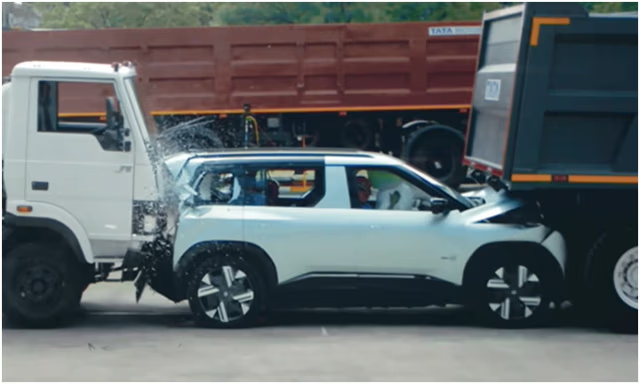 Amaan Ahmed | Jun 30, 2026Tata Sierra EV Sandwiched Between Two Trucks In Novel Crash Test: Watch VideoNobody saw Tata's latest crash test coming -- not even the Sierra EV it was conducted on2 mins read
 Jaiveer Mehra | Jun 30, 2026Tata Sierra EV Launched In India At Rs 18.79 Lakh: 5 Variants, 63 & 75 kWh Battery Options, 500+ km RangeElectric derivative of the Sierra is based on the Acti.ev+ platform and is offers over 500 km of range in real-world use.4 mins read
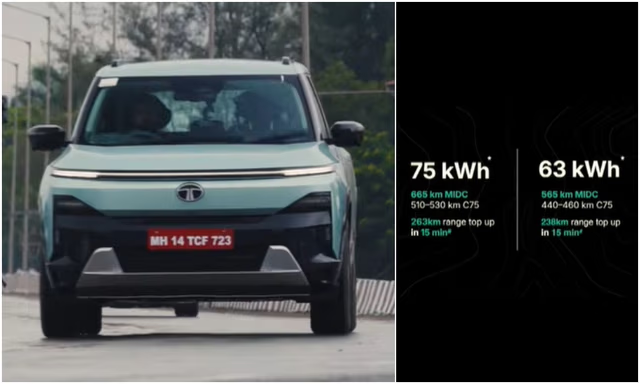 Amaan Ahmed | Jun 30, 2026Tata Sierra EV Real-World (C75) Range Figures RevealedUnlike what you may have seen on social media in recent days, the Sierra EV will not cover 700 kilometres, not even on the forgiving Indian Driving Cycle test2 mins read
 Seshan Vijayraghvan | Jun 29, 2026Renault Kiger vs Toyota Urban Cruiser Taisor: Which Underdog Deserves Your Money?Both the Kiger and the Taisor promise strong performance, solid features, comfortable cabins and everyday usability, all without breaking the bank. But which of these underrated subcompact SUVs deserves your money? Let's find out.1 min read
 Seshan Vijayraghvan | Jun 29, 2026Skoda Kodiaq RS Review: The Best Kodiaq Yet?The Skoda Kodiaq RS is finally here, and it's every bit as exciting as I expected. But was it worth the wait?7 mins read
 Bilal Firfiray | Jun 28, 2026BMW X6 M60i Review: It’s Back And HOW!The BMW X6 M60i blends a 530bhp twin-turbo V8, with its unmistakable coupe-SUV styling. There’s plenty of character, but is it worth your money?6 mins read
 Janak Sorap | Jun 25, 2026350cc Bajaj Dominar 400 Review: Same Character, Lower PriceA slightly lower displacement engine, a significantly lower price tag and nearly the same performance — the Bajaj Dominar 400 aims to be smarter rather than faster.6 mins read
 Preetam Bora | Jun 25, 20262026 Bajaj Pulsar NS400Z First Ride Review: Smaller Engine, But Should You Buy It?The Bajaj Pulsar NS400Z won our Two-Wheeler Upgrade of the Year. Then new tax slabs happened. Smaller engine, same badge – but does it still deliver?6 mins read