
Hyundai i20 Facelift VS Maruti Suzuki Baleno: Comparison Review

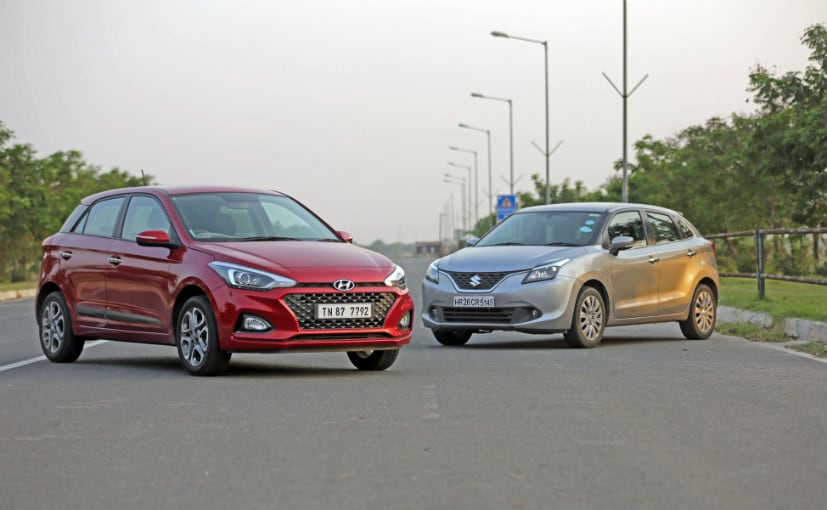
- The Hyundai i20 facelift was launched at the 2018 Indian Auto Expo
- The Maruti Suzuki Baleno sells about 15,000 units a month on average
- The Hyundai i20 Facelift does not get an automatic option yet
The Maruti Suzuki Baleno is the king of the hill in the subcompact premium hatchback segment when it comes to sales figures. Even though the Baleno is sold only through the Nexa outlets, the hatch sells on average close to 15,000 units a month. That said, the benchmark in the segment has always been the Hyundai i20 with its sharp European looks and well made, well equipped package. And now, Hyundai has given the i20 a mid-life facelift with updated exterior bits, minor interior bits and some mechanical upgrades too. So does it help the Hyundai i20's continued benchmark domination of the segment? And can it now take the fight to the Maruti Suzuki Baleno in terms of sales figures too? Read on to find out..
Also See: 2018 Hyundai i20 Facelift Video Review
(Hyundai i20 vs Maruti Baleno)
Hyundai i20 Facelift VS Maruti Suzuki Baleno: Exterior Design
While both the Baleno and the i20 are similarly sized and are both handsome cars in their own right, they are actually very different in terms of design. While the i20 is shaper and all about angles, the Baleno is a lot more curvaceous. That said, with the facelifted version, Hyundai has taken some cues out of Maruti Suzuki's playbook. For example, the front bumper now has a lip like design to it with two pronounced and quite sporty point-like design elements. This adds a bit of sportiness to the i20, which otherwise did look a little more grown up and understated between the two.
Also Read: Hyundai i20 Facelift Review
(Hyundai i20 vs Maruti Baleno)
The rear end of the Hyundai i20 though has had the biggest update. While the Baleno chooses a smaller tail lamp and larger boot area design, the i20, which has always been vice versa now gets even sportier with a new tail light console. The LED lighting pattern too has changed and looks a lot nicer. That said, although we seem to like this new version of the i20 better - even over the Baleno, public sentiment on social media seems to prefer the pre-facelift i20 instead. Strange, as this new one does look a lot smarter.
Also Read: Hyundai i20 Facelift - All You Need To Know
(Hyundai i20 vs Maruti Baleno)
Both cars to however have a number of similarities in terms of features. Both get LED daytime running lights, both get 16-inch alloy wheels on its top spec model and both get projector headlamps too. Both also get LED tail lamps and a generous offering of chrome. Where the i20 edges ahead is with a two-tone paintjob option on the top spec variant, something that Indian audiences seem to now love. This round then, most certainly goes to the Hyundai i20.
(Maruti Baleno Interior)
Hyundai i20 Facelift VS Maruti Suzuki Baleno: Interior and Features
In terms of dashboard design, the Hyundai i20 Facelift and the Maruti Suzuki Baleno are apples to oranges. But while both these fruits are healthy and can be compared, both these cars have a lot in common too. In their top of the line spec, both come with keyless entry and a start-stop button, automatic climate control and a touchscreen infotainment system. The infotainment for both also packs in Apple CarPlay, Android Auto, inbuilt navigation and the regular bluetooth connectivity. The cars also get reverse parking sensors and a reverse parking camera but the Hyundai does score higher in terms of the parking camera interface. While the i20 and the Baleno get a single 12-volt charger, the Hyundai also gets two USB ports up front as compared to the single on the Maruti, and that is always a helpful feature to have.
(Hyundai i20 Interior)
In terms of overall design though, as we mentioned earlier, these two do take a different approach. The Baleno is more out-there with its gloss black surround and silver accents on the centre console as compared to the dark grey and beige combination on the i20. The i20 also gets a matching grey and beige matching interior colour on the cloth trim while the Baleno gets an all-black cloth option. While the Hyundai i20 is 50mm longer than the Baleno in terms of wheelbase, both cars feel pretty spacious and pretty similar on the inside, both up front and in the rear. And both have a similar sized boot.
(Hyundai i20 vs Maruti Baleno)
So which car wins? Well, even though there are a lot of similarities, there is one noticeable difference where one is better than the other - interior quality. The Hyundai i20 is much better built and much nicer to sit in as compared to the Maruti Suzuki Baleno. The i20 feels a lot more plush and the plastics feel a lot better too, an advantage the i20 has always had and is now marginally improved too. And to add, the i20 also gets a fold down centre arm rest, which is a segment first.
(Hyundai i20 vs Maruti Baleno)
Hyundai i20 Facelift VS Maruti Suzuki Baleno: Engine and Gearbox
Although both the Hyundai i20 Facelift and the Maruti Suzuki Baleno are available with a diesel engine. Incidentally, Maruti also offers a more powerful RS version on the Baleno with a turbocharged petrol engine, but since both the Maruti and the Hyundai also get a 1.2-litre naturally aspirated petrol, they are natural competitors. Both engines are also ridiculously close in terms of their specs on paper. While the Baleno makes 83 bhp of peak power at 6000 rpm, the Hyundai makes 82 bhp of peak power at the same 6000 rpm. Torque figures on both cars are identical too at 115 Nm of peak torque at 4000 rpm. But while the two engines are similar on paper, they do have very individual characteristics.
( (Hyundai i20 vs Maruti Baleno)
For starters, the K12 engine in the Baleno feels as rev happy as always, moving swiftly (no puns intended) through the rev range up. The Hyundai on the other hand does feel a little slower to move up through the revs but is as drivable. However, even with the updated tuning on the facelifted i20, which claims to offer 9 per cent more fuel economy, the Maruti Suzuki still come in higher at 21.4 kmpl as compared to the Hyundai's 19.8 kmpl. And yes, if fun factor is all you are looking for, the Baleno's engine still offers that - in spades!
(Hyundai i20 vs Maruti Baleno)
And so does it's gearbox. The Maruti unit is one of the best in the business and with its short throws and well weighed clutch, it feels rewarding. The Hyundai on the other hand, true to form, is easier to drive. Gear shifts are lighter than the Baleno and so is the clutch. And while the Baleno might offer a lot more fun to the enthusiastic driver, the normal human who drives through infuriating Indian traffic everyday might prefer the Hyundai's more comfortable approach. And to top that, Maruti also offers an automatic or CVT option on the Baleno, something that is missing in the Hyundai i20 Facelift as of today.
(Hyundai i20 vs Maruti Baleno)
Hyundai i20 Facelift VS Maruti Suzuki Baleno: Ride, Handling & Safety
Lets get this out of the way. The Baleno out-handles the i20 Facelift every day of the week. It has a better chassis balance, is much lighter and has better steering feedback. If a fun car is what you are looking for, the Baleno will never disappoint. But most people aren't looking for a fun car. Most people are looking for a point A to point B transport from themselves and their families in that same horrid traffic we mentioned earlier. So the difference between the two cars really comes down to what you really want between the two.
(Hyundai i20 vs Maruti Baleno)
In terms of safety though, both are very evenly matched for most part. ABS comes as standard in both cars and on all variants on both models but while the Baleno comes only with two airbags on all variants, the Hyundai i20 facelift gets six airbags on the top of the line variant. All other variants get the two standard driver and passenger airbags. Both also get ISOFIX for the rear seats.
(Hyundai i20 vs Maruti Baleno)
Hyundai i20 Facelift VS Maruti Suzuki Baleno: Price and Verdict
The Hyundai i20 petrol is priced between Rs 5.35-7.90 lakh. Comparatively, the Baleno also starts at Rs 5.35 lakh for the base model Sigma while the top spec Alpha comes in at Rs 7.35 lakh, nearly Rs 55,000 cheaper than the Hyundai. While Maruti does offer the Baleno with an automatic, priced between Rs 7.09-8.40 lakh, the Hyundai i20 does not get an automatic gearbox option just yet. The Baleno diesel prices range from Rs 6.51-8.50 lakh while the Hyundai i20 diesel is priced between Rs 6.73-9.15 lakh. That said, while the Baleno is cheaper to buy, cheaper to run (in terms of fuel efficiency), and is better to drive, the Hyundai i20 with its overall package still scores higher overall and is still the benchmark in the segment.
Related News


Research More on Hyundai Elite i20


Popular Hyundai Models


Latest Cars


Upcoming Cars


Latest News


 car&bike Team | Jul 8, 2026Nissan Tekton SUV To Debut Tomorrow: What To ExpectBased on the Renault Duster, the Tekton gets its own design inside and out while sharing the same platform and engine options.1 min read
 car&bike Team | Jul 8, 2026New Mercedes-Benz GLB EV India Launch ConfirmedSecond-gen electric GLB is underpinned by Mercedes’ new MMA architecture and promises to offer more tech, greater cabin space and more useable range.1 min read
 Bilal Firfiray | Jul 8, 2026One-Off Rolls-Royce Phantom Regatta Unveiled; Inspired By English Sailing HeritageRolls-Royce unveiled the one-off Phantom Regatta, a bespoke Phantom Extended inspired by England's sailing heritage, ahead of its Goodwood Festival of Speed debut.1 min read
 car&bike Team | Jul 7, 2026TVS Apache Range Crosses 70 Lakh Customers GloballyThe milestone comes more than 20 years after the performance-focused lineup was first introduced in 2005.1 min read
 car&bike Team | Jul 7, 2026TVS Leads Electric Two-Wheeler Retail Sales In June 2026According to data released by the Federation of Automobile Dealers Association (FADA), 1.93 lakh electric two-wheelers were sold in June 2026.1 min read
 Jafar Rizvi | Jul 7, 2026Hennessey Venom F5-M Debuts With Gated Manual Gearbox And 2,031 bhpThe Venom F5-M is a manual-equipped version of Hennessey’s flagship hypercar that pairs a six-speed gated shifter with a twin-turbo V8.3 mins read
 Seshan Vijayraghvan | Jul 7, 2026Tata Altroz Petrol DCA Long-Term Review: Intercity & Highway Driving ReportWe tested the Tata Altroz Petro DCA’s highway manners, intercity performance, and real-world fuel efficiency.1 min read
 Seshan Vijayraghvan | Jun 29, 2026Renault Kiger vs Toyota Urban Cruiser Taisor: Which Underdog Deserves Your Money?Both the Kiger and the Taisor promise strong performance, solid features, comfortable cabins and everyday usability, all without breaking the bank. But which of these underrated subcompact SUVs deserves your money? Let's find out.1 min read
 Seshan Vijayraghvan | Jun 29, 2026Skoda Kodiaq RS Review: The Best Kodiaq Yet?The Skoda Kodiaq RS is finally here, and it's every bit as exciting as I expected. But was it worth the wait?7 mins read
 Bilal Firfiray | Jun 28, 2026BMW X6 M60i Review: It’s Back And HOW!The BMW X6 M60i blends a 530bhp twin-turbo V8, with its unmistakable coupe-SUV styling. There’s plenty of character, but is it worth your money?6 mins read
 Janak Sorap | Jun 25, 2026350cc Bajaj Dominar 400 Review: Same Character, Lower PriceA slightly lower displacement engine, a significantly lower price tag and nearly the same performance — the Bajaj Dominar 400 aims to be smarter rather than faster.6 mins read