
Tata Harrier EV Road Test: Big, Bold, and Brilliantly Electric

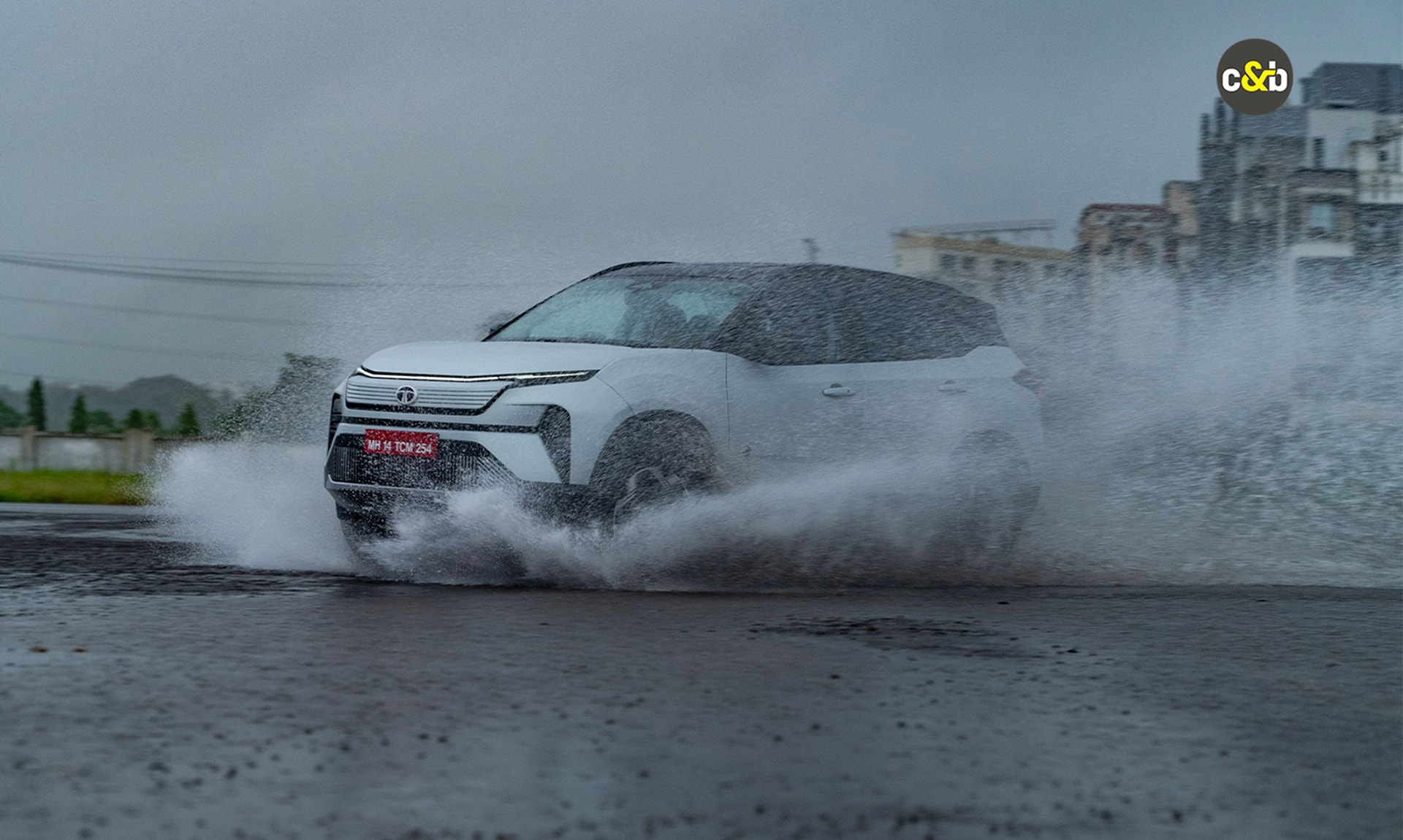
- Real-World Range is matching Tata’s C75 estimate.
- Dual-motor AWD setup with 330 bhp, 0–100 kmph in just over six seconds.
- Has many Land Rover-inspired features
There’s a quiet sense of familiarity and futurism when you first set off in the Tata Harrier EV. It’s familiar because it has a well-seen stance, the silhouette, and the road presence of the standard Harrier. Yet everything about it feels new, be it the way it drives, the features it offers and the online noise it’s creating on the internet. So, naturally, we had to find out what it’s really like to live with — and more importantly, how far it’ll actually go on a full charge.
Variants and Pricing
Also Read: Tata Harrier EV Review: Flagship Electric SUV Breaks Barriers
Just like the new model range, the Harrier EV follows Tata’s new persona-based variant strategy. You can pick from three personas — Adventure, Fearless, and the range-topping Empowered. There are two battery pack options:
- 65 kWh with rear-wheel drive,
- 75 kWh with either rear-wheel or all-wheel drive (or as Tata calls it, Quad Wheel Drive).
In total, there are 11 main variants and 4 Stealth Editions to choose from. Prices start at Rs 21.5 lakh and go up to Rs 30.2 lakh (ex-showroom).
Design and Cabin
Also Read: Tata Harrier EV Stealth Edition Launched: Prices Start At Rs 28.24 Lakh
The Harrier EV isn’t a radical departure from its diesel sibling — and that’s both good and bad. On the plus side, the SUV retains its commanding proportions, sharp LED signatures, and the kind of presence that makes other EVs like the Creta Electric or MG ZS EV look a size smaller.
Inside, it’s classic Tata with a robust, premium, and feature-packed cabin. You sit high, in a commanding position, with a clear view of the road ahead. It’s also noticeably roomier, but the only drawback is that there’s little to distinguish it from the ICE Harrier visually. Elements from the smaller Curvv EV, Nexon EV and even the Punch EV are carried over. For a flagship EV, a more differentiated design or interior identity would’ve been nice.
Performance And Driving Dynamics
Also Read: Hyundai Creta Electric vs Tata Curvv EV Comparison: Compact Electric SUVs Face-Off
Underneath the skin is a dual-motor AWD setup – an AWD for Harrier is a first. Combined output from both the motors is around 330 bhp and 500Nm. Tipping the scales at 2.3 tonnes, the Harrier EV is nearly 300 kg more than the diesel, and yet it’s quick. A 0–100 kmph comes up in just over six seconds, putting it in the same league as some drivers’ cars like the Volkswagen Golf GTI, BMW 330i, or even the Skoda Octavia vRS 245.
What’s more impressive, though, is how effortless it feels to drive. The steering is light, visibility is excellent, and every control feels more refined in EV form. Without the diesel clatter and vibration, the Harrier feels calmer and far more sophisticated in everyday driving.
Ride and Handling
It wouldn’t be a Tata SUV if it couldn’t handle bad roads, right? And the Harrier EV lives up to that legacy without a faze. Over Mumbai’s monsoon-battered roads, it just glides, shrugs potholes left, right, and centre, and the broken patches are barely a jiggle inside the cabin. Go off the tarmac, and the AWD system really shines. There are different terrain modes to choose from, but honestly, even in default settings, the Harrier EV manages to go through the other side, making the driver feel like a hero.
Tech and Features
Also read: Tata Curvv EV Review: 3 Reasons To Buy And 3 Reasons To Avoid
Tata has gone all-in on features, and some of them are genuinely impressive. The digital IRVM with a camera mounted on the shark-fin antenna offers a Range Rover-style live rear feed and can even double up as a rear-facing dashcam. But it’s not perfect. In bright sunlight, the reflective screen can be hard to read. An anti-reflective film or coating might be a good DIY fix.
Then there are the auto park and “Summon” features, which work surprisingly well. The only gripe? You need to press and hold the summon button firmly. Too firmly, actually. Something you’ll get used to, but your thumb might not thank you initially.
Range Test:
Now, the big question — how far will it go on a full charge? The 75 kWh battery pack has a claimed range of 622 km, or 627 km in the RWD version. Tata’s smaller 65 kWh pack promises 538 km. But I am interested in Tata’s C75 figure, which represents what 75 per cent of owners are likely to achieve in real-world conditions. For the Harrier EV QWD, this number ranges between 460–490 km.
In our test, we set the regen at level 1, AC set at 23°C, and City mode engaged as that’s the default setting. We started with an indicated range of 380 km (journalist driving style to blame, not the car). But as the drive settled into a normal rhythm, the numbers began to normalise as well. By the end of the test, the Harrier EV AWD managed a real-world range of 460 km.
For context, that’s around 60 km more than the Curvv EV 55 and Hyundai Creta EV, which puts it among the most usable large EVs you can buy today.
Verdict
The Tata Harrier EV Quad is big, confident, and capable. It’s quick when you want it to be, calm when you need it to be, and tough enough to take on India’s worst roads without breaking a sweat. Sure, it’s not a born-electric platform and doesn’t stand out like a ‘Born EV’ does. But that’s precisely the charm, it’s a familiar SUV that happens to run on electrons.
With its 460 km real-world range, rugged suspension, and surprisingly refined road manners, the Harrier EV feels like the perfect bridge between Tata’s ICE past and its electric future. It’s not just Tata’s biggest EV yet, but also one of the most complete electric SUVs you can buy under Rs 35 lakh mark.
Pictures by Tanmay Varthak
Related News


Learn more about


Popular Models


Latest Cars


Upcoming Cars


Latest News


 car&bike Team | Sep 18, 2026Triumph Speed 400 And Tracker 400 Prices Cut By Up To Rs 7,000Triumph has revised prices of the Speed 400 and Tracker 400 receiving cuts of up to Rs 7,000, while the Scrambler 400 X gets a new colour option.1 min read
 car&bike Team | Sep 17, 2026Kia Carens Clavis Line-Up Expanded With More Accessible Automatic VariantsThe HTE (O) and HTE (EX) variants of the Kia Carens Clavis will now come with a turbo DCT setup, while the former will also offer a diesel automatic version.2 mins read
 car&bike Team | Sep 17, 2026Petrol Dealers Call For Rs 5 MDR Charge Exemption On UPI Payments; Will Consider Going Cash-Only For Payments Over Rs 2,000Dealers say that the Rs 5 charge on UPI payments of over Rs 2,000 will eat into their earnings.1 min read
 car&bike Team | Sep 17, 2026Royal Enfield Flying Flea C6 Gets New Parachute White ColourRoyal Enfield’s electric motorcycle brand Flying Flea has added a new Parachute White colour to the C6, giving the electric motorcycle a third colour option in India.1 min read
 car&bike Team | Sep 17, 2026MG M9, Cyberster Now Offered With BaaS: Prices Start At Rs 69.99 LakhOpting for the BaaS scheme enables buyers to save up to Rs 10 lakh on the upfront costs.1 min read
 car&bike Team | Sep 17, 2026TVS Apache Range Updated With New Variants And Features Ahead Of Festive SeasonTVS Motor has updated its Apache range with new safety and connectivity features for the RTR 160, RTR 160 4V and RTR 200 4V, while the flagship 310s get new Black Diamond editions.2 mins read
 Preetam Bora | Sep 16, 2026Royal Enfield Himalayan 440 Review: Better Than the 450?The new Himalayan 440 with an upsized engine and gearbox has certainly improved as a touring machine and at an extremely attractive price of Rs. 2.29 Lakh. Is it the better Himalayan to choose for many riders?9 mins read
 Seshan Vijayraghvan | Sep 15, 2026BMW i5 LWB Review: Not The M60, This Is The Proper Electric 5 SeriesThe BMW i5 LWB takes the electric 5 Series formula and puts a stronger focus on rear-seat comfort and long-distance luxury. With a 669 km claimed range, 268 bhp and a more relaxed character, is this the i5 that makes the most sense for India?7 mins read
 Preetam Bora | Sep 14, 2026Ladakh Uncharted: Himalayan Basecamp Off-Road Ride ExperienceA day-long off-road excursion from Royal Enfield’s Himalayan Basecamp event in Ladakh, the Ladakh Uncharted ride by Alpinestars was all about re-discovery!6 mins read
 Janak Sorap | Sep 12, 2026New Bajaj Pulsar 125 First Ride Review: More Tech, Less Weight, Same Pulsar DNAThe new Bajaj Pulsar 125 retains the familiar Pulsar identity but gets a new engine, lighter construction, more features and a sharper riding experience.5 mins read
 Bilal Firfiray | Sep 10, 2026Mahindra XEV 9S Review: 3 Reasons To Buy It, And 3 Reasons To AvoidEveryone keeps telling me that the Mahindra XEV 9S is not the electric XUV 7XO. I disagree.1 min read