
Dual Clutch Automatic Transmission Explained


The evolving transmission systems can seem to be a complex subject if you do not follow the auto industry regularly. Over the years, different transmissions systems have made it to the market. Manual transmission has been around for the longest. However, it isn´t easy to drive and that forced automakers to consider alternatives.
One such alternative is a dual-clutch automatic transmission. Before you head out to buy your next car, learn about dual-clutch automatic transmission and understand if it's the one for you. Let us explore more about this transmission system!
What Is Dual-Clutch Automatic Transmission (DCT)?
Dual Clutch Automatic Transmission is also referred to as Direct Shift Gearbox. Most automakers have their unique version of DCT. However, they use DCT selectively across their range. Like so many innovations in vehicle transmission, the dual-clutch automatic transmission is a concept that has been there for years but is only new being out to use.
The Porsche 956, launched in 1983, was the first vehicle to sport a DCT. Several built-in computers help DCT to function. These computers prevent the need for manual inputs to shift gear. In other words, DCT automates the process of changing gears.

Photo Credit: www.matfoundrygroup.com
How Does Dual Clutch Transmission (DCT) Work?
With that introduction, you might have a fair idea about DCTs now. But, how does a dual-clutch transmission work? One of the primary benefits of DCT is that it minimises the time gap between changing gears.
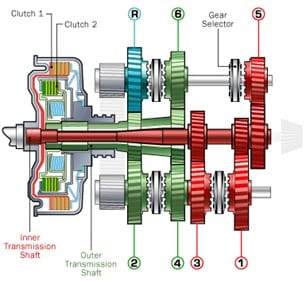
In this transmission type, computerised clutches have a concentrical placement. Also, the crankshaft is connected to the clutch and is always ready to change to another. The countershafts have two cylindrical shafts that are independent. One of the countershafts in DCT is for even gear numbers, while the other is for odd.
The computer automatically anticipates the following gear ratio when the output shaft runs at a specific gear ratio. For this purpose, the computers analyse acceleration, deceleration, engine speed, and ongoing speed.
Pros of Dual Clutch Transmission (DCT)
Several benefits of opting for a vehicle with a dual clutch automatic transmission. We have discussed a few below:
- DCTs tend to offer better fuel efficiency than other automatic transmissions. It also delivers a smoother and seamless performance.
- Owing to their fuel efficiency and high-quality performance, many fleet owners prefer DCTs. Due to these advantages, DCTs are also ideal for significant long-term savings.
- Since they allow to shift gears smoothly and swiftly, the dual-clutch automatic transmission has also found its place in performance driving.

Photo Credit: mediapool.bmwgroup.com
Cons of Dual Clutch Transmission (DCT)
Each type of transmission comes with its cons. However, the cons of DCT are pretty easy to navigate over time. In any case, let's look at the setbacks of dual-clutch automatic transmission:
- Most car owners claim that DCT is more complex than other transmission systems.
- Also, DCT takes more room under the hood than any other transmission system.
If we compare Dual-clutch transmission to manual, CVT or any other transmission, DCT emerges as the winner. By navigating some of its downfalls, DCT can become the next big thing in automobiles.
Related News

Latest Cars


Upcoming Cars


Latest News


 car&bike Team | Nov 12, 2026Kia To Invest USD 2 Billion For Second Andhra Pradesh Manufacturing FacilityThe brand’s annual production capacity from this plant is rated at 2 lakh units.1 min read
 car&bike Team | Nov 12, 2026Why Does Regenerative Braking In EVs Stop At 100% Battery Charge?We have explained why your electric car suddenly glides freely instead of slowing down when driven with a completely full battery pack.1 min read
 car&bike Team | Nov 12, 2026BYD's Denza D9 MPV, Z9 GT Shooting Brake India Launch Tomorrow: What To Expect?BYD’s luxury brand Denza will enter India with two very different electric offerings: the D9 luxury MPV and the 1,140 bhp Z9 GT Shooting Brake.3 mins read
 car&bike Team | Nov 12, 2026Does Hardwiring A Dashcam Void Your Car Warranty?Take a look at whether hardwiring a dashcam really affects your factory warranty and how you can install one safely in India.6 mins read
 car&bike Team | Nov 11, 2026RTI vs Zero Depreciation: Which Car Insurance Cover Pays More?Return to Invoice (RTI) covers the gap between your car's current IDV (Insured Declared Value) and the original invoice value in case of theft or total loss. Zero Depreciation reduces deductions on replaced parts during accident repairs.1 min read
 car&bike Team | Nov 11, 2026Engine Protection vs Zero Depreciation: What's The Difference?Zero Depreciation reduces your share of accident repair costs, while Engine Protection covers certain engine and gearbox damage caused by water ingress or oil leakage.1 min read