
Station Access and Mobility Program Launched in Delhi; Focus On Improving Metro Station Accessibility

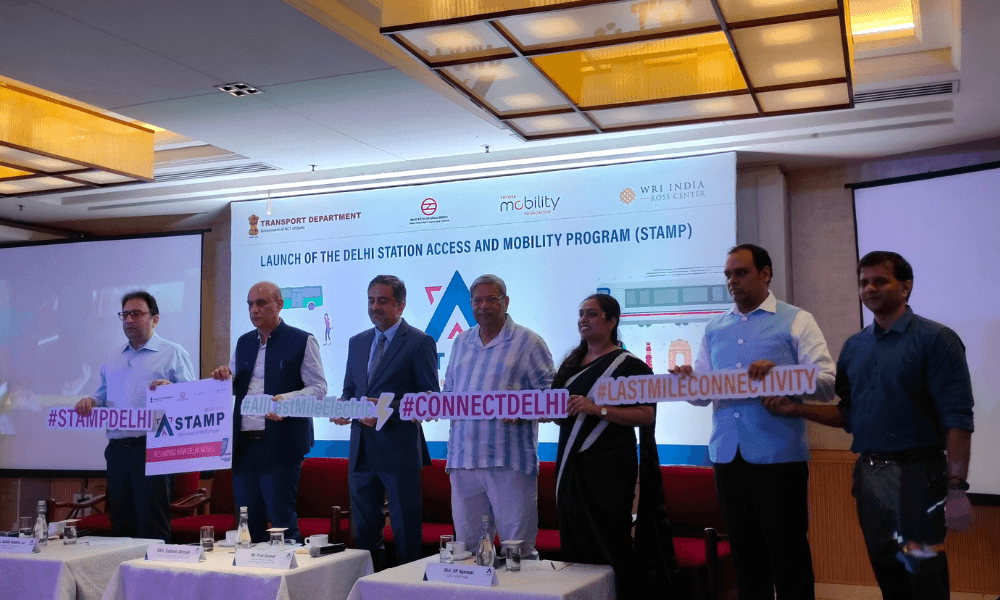
- STAMP Delhi is the 7th edition of the program, initiated by TMF and WRI India.
- The Delhi edition of STAMP will improve multimodal integration to and from the metro.
- STAMP Delhi's focus is aligned with the city's efforts to provide clean, digital, & interconnected transport.
The Transport Department, Govt. of NCT, Delhi, and Delhi Metro Rail Corporation (DMRC), in association with Toyota Mobility Foundation (TMF) and World Resources Institute India (WRI India), launched the Delhi edition of the Station Access and Mobility Program (STAMP), to improve multimodal integration to and from the metro. STAMP Delhi is the 7th edition of the program, initiated by TMF and WRI India in December 2016, to facilitate high-quality last-mile connectivity solutions across Indian cities. At present, the STAMP initiative is operational in Bengaluru, Hyderabad, Kochi, Mumbai, Pune, and Nagpur.
Ashish Kundra, Principal Secretary and Commissioner, Transport Department, GNCTD, said, "As Delhi grows, the demand for more efficient mass transit will drive advancements in technology. The future of transport in the city lies in developing an integrated mobility-as-a-service solution. Crafting this for commuters will require a participatory approach from several stakeholders. Our collaboration with DMRC and TMF and WRI India's STAMP will be a good first step to bring more eco-friendly, flexible, and multimodal transport to Delhi."
STAMP Delhi's focus, aligned with the city's efforts to provide clean, digital, and interconnected transport, works to facilitate data-enabled solutions and strategies. The main objective of the initiative is to make mass transit more seamless and unified for Delhi's metro commuters with a focus on decongesting the capital's roads. The solutions that will arise out of the STAMP Challenge will benefit stakeholders across the board, from commuters and last-mile operators to transit agencies. This aims to encourage better uptake of public transportation, multimodal mobility, data-driven planning, and carbon-reducing technologies.
Vikas Kumar, Managing Director, DMRC, said, "We are excited to partner with STAMP and invest in enhancing connectivity to and from the metro. Through the STAMP Challenge, DMRC is working to build smart and safe mobility solutions for commuters and our last-mile partners. STAMP's work across India can aid in improving connectivity to the Delhi Metro and will be invaluable as we continue to create seamless mobility for the city.”
STAMP Delhi's work will aim to target three focus areas- first, it aims to create a mobility-as-a-service platform that will allow commuters to plan their public transport journey, across different transit modes, on a single interface. Secondly, STAMP is working to leverage existing last-mile services, such as shared mobility, autos, and e-rickshaws, to provide more efficient on-demand services to commuters. The interface will provide crucial information to drivers in underserved areas and times of high demand, allowing them to provide better last-mile services to commuters. Finally, STAMP is looking to partner with upcoming last-mile operators with innovative form factors to improve metro connectivity, particularly in areas with limited access to e-rickshaws and shared transport.
Pras Ganesh, Executive Program Director, Asia Region, Toyota Mobility Foundation, noted "When we started STAMP in 2016, we had a vision of enabling better multimodal mobility towards congestion: alleviation. Now after completing the process in 6 cities, we have a proven methodology of ideating innovative last-mile connectivity solutions and facilitating an integrated and seamless mobility experience for commuters, centered on the mass rapid transit initiatives of the Indian government.”
Madhav Pai, Executive Director, WRI India Ross Center, said, "As Indian cities invest more in metro rail, they also need to invest in creating an enabling environment for innovative enterprises that provide services which allow commuters to complete their last mile journeys in affordable, seamless ways."
The Station Access and Mobility Program (STAMP) is an initiative led by TMF and WRI India to promote better multimodal integration of metro rail, with other modes of transportation in Indian cities, through a partnership model with the innovation and entrepreneurial ecosystem. The initiative, which started in 2016, aims to support pan-India metro rail in becoming an efficient and attractive mode of travel, to ensure faster travel times, reduce road congestion, and lower air pollution.
Related News

Latest Cars


Upcoming Cars


Latest News


 Jaiveer Mehra | Aug 23, 20262027 Renault Kwid Spied Ahead Of Global DebutNew update to the internal combustion Kwid brings styling tweaks and a Kwid E-Tech-inspired cabin.1 min read
 car&bike Team | Aug 22, 2026Volkswagen Tukan Pickup Truck Unveiled In BrazilThe Tukan is the first VW pickup to sit on the MQB platform.1 min read
 Jafar Rizvi | Aug 22, 2026Skoda Kylaq Sportline vs Kylaq Prestige: Differences ExplainedThe Kylaq Sportline sits below the Prestige in the line-up and costs Rs 43,000 less, but the price difference isn't just about the badge. The Sportline gets a darker exterior and interior treatment, while the Prestige packs a few more features.3 mins read
 Jafar Rizvi | Aug 22, 2026BMW X1 LWB vs X1: What's Different?The BMW X1 LWB stretches the standard SUV by 116mm and adds 108mm to the wheelbase. Let’s take a look at all that is different.2 mins read
 Preetam Bora | Aug 22, 2026Opinion: Hero’s Premium Challenge Isn’t Products, It’s PerceptionIn a market increasingly driven by aspiration, identity and experience, Hero MotoCorp needs to build not just better premium motorcycles, but a stronger premium brand around them.1 min read
 Abhishek Nigam | Aug 21, 2026Kawasaki Corleo Hydrogen-Powered Horse Reveals New DetailsKawasaki’s futuristic four-legged mobility concept uses rider movement, hydrogen power and multiple riding modes to navigate challenging terrain.1 min read
 Seshan Vijayraghvan | Aug 19, 20262026 BMW X1 Long-Wheelbase Review: Is This The X1 To Buy?Along with the extra rear legroom, the new BMW X1 LWB offers more features, more safety tech, and a more powerful petrol engine. But do these updates actually make it a better SUV?1 min read
 Janak Sorap | Aug 17, 2026Bajaj Pulsar N160 SS First Ride Review: The Most Tech-Loaded Pulsar Yet?The Bajaj Pulsar N160 SS brings more power, new-age electronics and sharper styling to the familiar 160cc Pulsar formula.5 mins read
 Jaiveer Mehra | Aug 16, 2026Honda Amaze CVT Long Term First Report: 1800 Km InThe Amaze is the first sedan to join our long term feet in a year, and while on paper it lacks some of the features offered in its rivals, there’s plenty of promise in the package.1 min read
 Preetam Bora | Aug 12, 2026Royal Enfield Himalayan 440 Custom Review: Beating RE to the PunchDelhi-based custom motorcycle shop TNT Motorcycles introduces packages to convert existing Himalayan 411 adventure bikes to Himalayan 440. Is it worth the expense?8 mins read
 Seshan Vijayraghvan | Aug 11, 20262026 Nissan Tekton 700 km Review: Can It Conquer The Himalayas?We drove the newly launched Nissan Tekton from Chandigarh all the way up to Leh, covering over 700 km with the new SUV. From exploring the Tekton’s capabilities in the Himalayas to setting an India Book Record, here’s how the trip unfolded.8 mins read