
Top Carmakers Disagree About the Car of the Future


Automakers and Silicon Valley upstarts are kicking their efforts to define the car of the future into a higher gear, even though many of the players disagree about what that car should be.
The emerging autonomous vehicle technology sector is still in a turbulent stage akin to the old debate over "Betamax versus VHS" format. Standards are not yet defined, winners and losers are not sorted out and major players disagree sharply about the best way to bring the promise of safer, smarter cars to market.
Consider the contrasting visions of the automotive future put forward at the Consumer Electronics Show in Las Vegas this week by Mark Fields and Dieter Zetsche, the chief executives of Ford Motor Co and Daimler AG, respectively.
Ford's approach, Fields says, is to focus initially on connecting cars and their drivers to the mobile Web, with apps as the building blocks, and work on sensors and software that eventually will enable the development of fully autonomous vehicles in the next decade. Ford wants to develop affordable technology for a broad swath of consumers - the philosophy behind founder Henry Ford's Model T.
Daimler's Mercedes-Benz has a different idea from Ford - and worlds apart from Internet company Google Inc, which has jolted the automotive establishment with its high-profile effort to develop a fully self-driving city car.
Zetsche presented a futuristic Mercedes prototype at CES that could drive itself down city boulevards while passengers used hand gestures to call up information about restaurants along the route or receive invitations to party from friends nearby.
Where Ford wants to make autonomous cars for "Everyman," and Google envisions cars as pod-like appliances, Daimler presented robotic driving as part of a technology package that sets its premium cars apart from plebian rides. At the same time, Zetsche said Daimler could extend the self-driving concept to tiny "green" cars such as its Smart EV or into car-sharing programs such as its Car2Go enterprise - potentially challenging Google in that sphere.
"I hope you will still recognize us as being the inventor of the car," Zetsche told Reuters. "But we should be defined by our future, not by our past."
Sense of Urgency
The urgency among the companies looking to profit from connected vehicle technology, including the hardware and software required for automated driving, is increasing. Several automakers, including Mercedes, General Motors Co and Volkswagen AG's Audi, have said they want to have vehicles capable of significant levels of hands-free driving on the road between 2016 and 2020. That means contracts to supply hardware and software need to be signed now.
The head of Google's autonomous vehicle project, Chris Urmson, is scheduled to speak next week at an industry conference in Detroit to send the message that Google wants to forge partnerships with traditional automakers and suppliers to get its technology on the road.
Research firm IHS Automotive has estimated that self-driving car technology will add more than $31 billion in revenue for Google by 2040.
It is not clear, however, how automakers and such traditional technology suppliers as Continental AG, Delphi Automotive PLC, Robert Bosch GmbH or Visteon Corp, will welcome Google and other Silicon Valley companies looking to muscle their way between automotive brands and their customers.
Volkswagen, for example, announced at CES this week that it has partnered with Google rival TomTom to provide mapping data for its vehicles. Accurate maps are critical for autonomous driving, and they also provide richer information to drivers based on their location.
Shaking up Status Quo
Investors are betting that whatever happens, the status quo will be upended. Enthusiasm is high for companies positioned to benefit from increased automation and digital connectivity - including ride-sharing companies such as Uber, which aim to blow up traditional car ownership.
Valuations for some technology upstarts in the auto sector have soared above many of the industry's stalwarts.
"You will see the Old Guard lose its (share price) multiples and the New Guard valued at crazy levels," said Cathie Wood, chief executive of Ark Investment Management LLC, which invests in shares of companies it believes will benefit from the growth in connected and autonomous vehicle technology.
The traditional auto sector is also investing heavily to avoid being eclipsed.
"It's protecting our future," said Tim Yerdon, vice president of Visteon's connected services. "We have to play in it one way or the other."
Related News


Popular Audi Models


Latest Cars


Upcoming Cars


Latest News


 car&bike Team | Jun 29, 2026Delhi EV Policy Approved: Electric Cars Under Rs 30 Lakh To Get Full Tax ExemptionThe new policy offers purchase incentives and scrappage benefits while laying down a roadmap for EV-only registrations across several vehicle segments, including two-wheelers from 2028.2 mins read
 car&bike Team | Jun 29, 2026New-Gen BMW X5 Teased Ahead Of Global Debut TomorrowThe teaser previews a fresh X-shaped lighting signature in a familiar illuminated grille setup.3 mins read
 car&bike Team | Jun 29, 2026Tata Sierra EV Launch Tomorrow: What To Expect?The Sierra EV is expected to share much of its package with the Harrier EV.3 mins read
 Jaiveer Mehra | Jun 28, 2026Nissan Tekton Spied Undisguised Ahead Of July 9 DebutSole image of the SUV showcases the rear design of the SUV.1 min read
 Carandbike Team | Jun 28, 2026Renault Kwid Facelift India Launch On July 3Latest facelift marks the second major update for the entry hatchback since its launch in 2015.1 min read
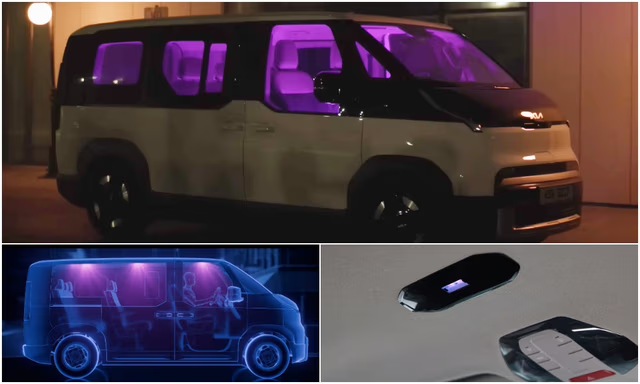 Amaan Ahmed | Jun 27, 2026Future Hyundai, Kia Cars May Feature In-Built UVC SanitiserHyundai Motor Group has unveiled 'Plasma Care UVC' technology, which utilises plasma lamps to safely and effectively destroy bacteria and viruses present inside a car.1 min read
 Seshan Vijayraghvan | Jun 29, 2026Renault Kiger vs Toyota Urban Cruiser Taisor: Which Underdog Deserves Your Money?Both the Kiger and the Taisor promise strong performance, solid features, comfortable cabins and everyday usability, all without breaking the bank. But which of these underrated subcompact SUVs deserves your money? Let's find out.1 min read
 Seshan Vijayraghvan | Jun 29, 2026Skoda Kodiaq RS Review: The Best Kodiaq Yet?The Skoda Kodiaq RS is finally here, and it's every bit as exciting as I expected. But was it worth the wait?7 mins read
 Bilal Firfiray | Jun 28, 2026BMW X6 M60i Review: It’s Back And HOW!The BMW X6 M60i blends a 530bhp twin-turbo V8, with its unmistakable coupe-SUV styling. There’s plenty of character, but is it worth your money?6 mins read
 Janak Sorap | Jun 25, 2026350cc Bajaj Dominar 400 Review: Same Character, Lower PriceA slightly lower displacement engine, a significantly lower price tag and nearly the same performance — the Bajaj Dominar 400 aims to be smarter rather than faster.6 mins read
 Preetam Bora | Jun 25, 20262026 Bajaj Pulsar NS400Z First Ride Review: Smaller Engine, But Should You Buy It?The Bajaj Pulsar NS400Z won our Two-Wheeler Upgrade of the Year. Then new tax slabs happened. Smaller engine, same badge – but does it still deliver?6 mins read