
Musk's ESG Attack Spotlights $35 Trillion Industry Confusion


Elon Musk's rejection of environmental, social and corporate governance (ESG) scores as a "scam" highlights how Wall Street's hottest investment trend that encompasses some $35 trillion in assets means different things to different people. The chief executive of Tesla Inc lashed out on Wednesday against S&P Global Inc after the electric car maker was dropped from its flagship ESG index while it added some companies whose activities are harmful to the environment, such as oil and gas producers.
Musk took to Twitter to express his frustration with the move "despite Tesla doing more for the environment than any company ever!" He added that ESG "has been weaponized by phoney social justice warriors."
S&P Dow Jones Indices senior director Margaret Dorn told Reuters that Tesla had been excluded from the index because its score declined slightly just as the scores of other automakers had improved. Tesla was not excluded because S&P executives decided to kick the company out of the index over a particular issue, she added.
While Tesla's cars contribute to lower carbon emissions, its ESG score had "fallen behind" in other aspects, such as poor working conditions at its U.S. Fremont factory, claims of racial discrimination and its handling of a U.S. government probe into multiple deaths and injuries linked to its autopilot technology.
Sustainable investing - taking into account ESG factors in portfolio selection - has exploded in recent years, reaching $35.3 trillion by the start of 2020, according to the Global Sustainable Investment Alliance.
Half a dozen investment managers interviewed by Reuters said Musk's spat with S&P illustrates how confusion still reigns over how many investors and executives view the industry.
Some, like Musk, believe the ratings should reward companies that do the most for the planet and society. Others, including firms like S&P that produce the scores, say they are meant to show how much risk a company's stock faces from ESG factors.
This explains why some companies that are major contributors to climate change, such as Exxon Corp, are allowed to stay in an ESG index if they can show they are taking actions to reduce that risk.
"Ultimately ESG is a way of identifying and trying to quantify risk. So it's basically risk mitigation," said Chi Chan, portfolio manager at Federated Hermes. "Effectively Musk is conflating ESG with sustainability."
Mark Tinker, chief investment officer at Toscafund Hong Kong, said Musk "rightly pointed out" that societal and corporate governance considerations are being used "for political driven cancelling" and that a company's contribution to the environment can also "mean what you want it to."
"The whole thing is very subjective," Tinker said.
Tesla did not respond to a request for comment on behalf of the company or Musk.
S&P published the change in its ESG index on April 22. But it was not until May 18, a day after Horn wrote a blog post that explained why Tesla was excluded from the index, that Twitter users started disseminating it, catching Musk's attention.
Only a tiny fraction of the ESG's industry's assets under management - $11.7 billion as of the end of 2020 - are tied to S&P Indexes. S&P's influential ESG index rival MSCI Inc has so far kept Tesla in its bluechip ESG index.
It was not immediately clear if the exclusion from the S&P ESG index had any impact on Tesla's shares this week. The stock had already been sliding almost every day since early April, losing close to 40% of its value, amid concerns that China's COVID-19-related lockdowns will disrupt Tesla's car production and a potential economic slowdown and raging inflation will dampen demand for its vehicles.
Uncertainty over whether Musk will complete his $44 billion acquisition of Twitter Inc has also weighed on Tesla's stock.
S&P declined to provide a breakdown of its ESG score of Tesla, which is compiled based on scores of the company's various operations and practices.
MSCI also declined to provide a breakdown, but a May 3 copy of its Tesla rating sent to investors and reviewed by Reuters shows how its perceived poor performance on social issues took some of the shine out of the company's strong green credentials.
Tesla scored 9.1 out of 10 on environmental grounds, against an industry average of 6.5. This made up 30% of its total ESG score. On social issues, however, it ranked 1.4 compared with an average of 3.5, while on governance it scored 5.1 against an average of 3.2.
Andrew Poreda, senior vice president for Sage Advisory Services, an Austin-based investment firm, said as a Tesla investor he understood why the company's ESG scores were lower than they might have been based solely on the company's contribution in the fight against climate change.
"You can't live in a vacuum of just environmental or just social issues, they are all intertwined," Poreda said.
(This story has not been edited by NDTV staff and is auto-generated from a syndicated feed.)
Related News


Popular Tesla Models

Latest Cars


Upcoming Cars


Latest News


 Jaiveer Mehra | Jul 9, 2026Nissan Tekton Makes Global Debut; Launched At Rs 10.49 LakhEssentially the sister model to the new Renault Duster, the Tekton shares much with its Renault sibling under the skin.3 mins read
 car&bike Team | Jul 9, 2026Nissan Tekton SUV India Debut LIVE Updates: Exterior, Interior, Specifications, DetailsNissan will debut the Tekton in India today. Watch this space to get all the details firsthand.0 mins read
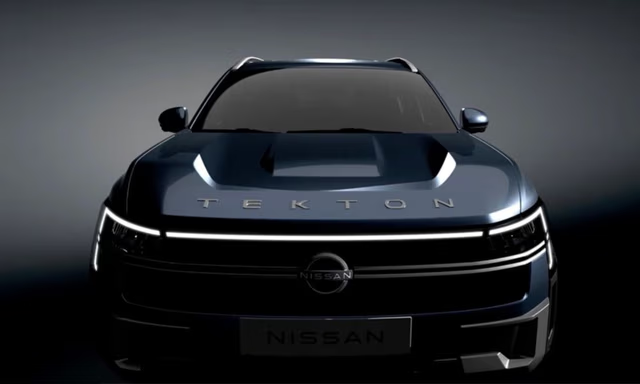 car&bike Team | Jul 9, 2026Nissan Tekton SUV To Debut Today: What To ExpectBased on the Renault Duster, the Tekton gets its own design inside and out while sharing the same platform and engine options.3 mins read
 Seshan Vijayraghvan | Jul 8, 20262026 Land Rover Defender Updated; Gets New Vertex Trim, Accessory Kit And 6-Seat Layout OptionIn addition to the new Defender Vertex trim and the new upgrades, Land Rover has also introduced a special accessory pack for the luxury off-roader.1 min read
 Preetam Bora | Jul 8, 2026Opinion: India’s Ethanol Blending Policy Needs More Clarity & TransparencyIndia needs a clearer, more transparent and consumer-focussed approach to roll out ethanol blends in petrol. The current confusion will only add to less public confidence.6 mins read
 Jafar Rizvi | Jul 8, 2026Yamaha Aerox Electric Launched In India At Rs 2.82 LakhThe Aerox Electric costs nearly twice as much as the petrol-powered Aerox 155.2 mins read
 Seshan Vijayraghvan | Jul 7, 2026Tata Altroz Petrol DCA Long-Term Review: Intercity & Highway Driving ReportWe tested the Tata Altroz Petro DCA’s highway manners, intercity performance, and real-world fuel efficiency.1 min read
 Seshan Vijayraghvan | Jun 29, 2026Renault Kiger vs Toyota Urban Cruiser Taisor: Which Underdog Deserves Your Money?Both the Kiger and the Taisor promise strong performance, solid features, comfortable cabins and everyday usability, all without breaking the bank. But which of these underrated subcompact SUVs deserves your money? Let's find out.1 min read
 Seshan Vijayraghvan | Jun 29, 2026Skoda Kodiaq RS Review: The Best Kodiaq Yet?The Skoda Kodiaq RS is finally here, and it's every bit as exciting as I expected. But was it worth the wait?7 mins read
 Bilal Firfiray | Jun 28, 2026BMW X6 M60i Review: It’s Back And HOW!The BMW X6 M60i blends a 530bhp twin-turbo V8, with its unmistakable coupe-SUV styling. There’s plenty of character, but is it worth your money?6 mins read
 Janak Sorap | Jun 25, 2026350cc Bajaj Dominar 400 Review: Same Character, Lower PriceA slightly lower displacement engine, a significantly lower price tag and nearly the same performance — the Bajaj Dominar 400 aims to be smarter rather than faster.6 mins read