
Truckers And Subsidies Rev Up Interest In Fuel Cell Vehicles

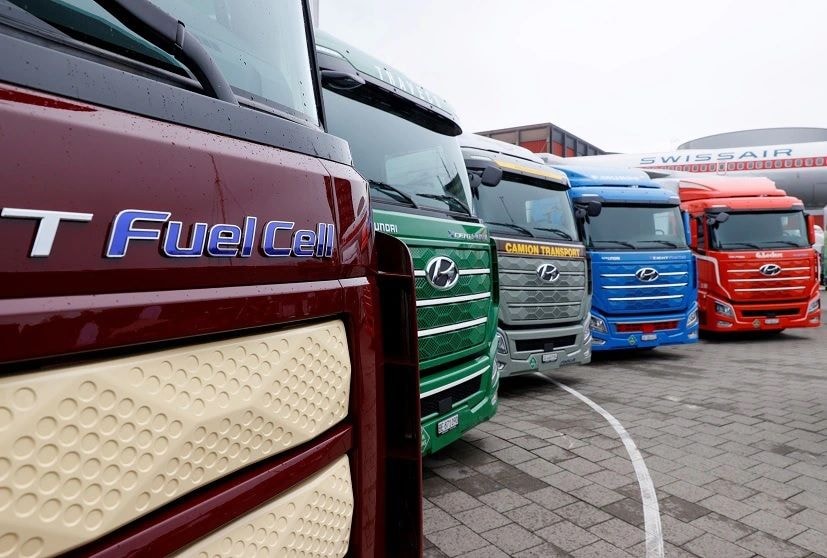
Interest in using hydrogen fuel cells to power trucks and vans is getting a boost from fleet operators looking for a more practical alternative to electric vehicles and rising government aid, particularly the U.S. Inflation Reduction Act (IRA).
While most of the world's combustion engine cars and short-distance vans and lorries should be replaced by battery electric vehicles (BEVs) over the next two decades, fuel-cell proponents and some long-haul fleet operators say batteries are too heavy, take too long to charge and could overload power grids.
Vehicles with hydrogen fuel cells, in which hydrogen mixes with oxygen to produce water and energy to power a battery, can refuel in minutes and have a much longer range than BEVs.
"The fact is we need both BEVs and hydrogen," Daimler Truck Chief Executive Martin Daum told Reuters. "The amount of energy BEVs need is so enormous that I see a strain on our grid that ultimately it can't fulfill."
Daimler Truck will invest up to 15 billion euros ($16 billion) on fuel cells over the next decade, Daum said.
British supermarket chain Asda, with 1,000 large diesel vehicles hauling goods around the clock between hubs and stores, would be forced to add to its fleet if it turned to BEVs, and so is looking closely at fuel cells.
"I'm not closing the door on batteries, but the benefit of hydrogen is it doesn't need that dwell time (for charging) and has better range," Asda fleet manager Sean Clifton said.
Like BEVs, hydrogen's main challenge is infrastructure, which is too scant to support fleets today. But more governments are offering subsidies, including for producing more hydrogen from renewable power or rolling out fuelling stations.
Asda, for instance, is part of a consortium including British fuel cell startup HVS that has received a UK government grant to develop a self-driving hydrogen heavy goods vehicle.
In the United States, the IRA provides subsidies for cheap hydrogen and fuelling infrastructure that industry executives say will speed development of hydrogen semi-trucks and heavy-duty pickup trucks.
The European Union is negotiating renewable energy targets, including hydrogen.
"Thanks to the IRA, things will move faster in the U.S.," said Philippe Rosier, CEO of French fuel cell maker Symbio, a joint venture between Faurecia and Michelin.
Carmaker Stellantis is buying a stake in Symbio. Rosier said that will accelerate plans, particularly in North America where it aims to be ready for hydrogen pickup trucks by 2026.
Symbio, which supplies fuel cells for Stellantis vans, expects global fuel cell vehicle sales to reach 2 million units annually by 2030 and wants a 10% share.
'NOT SUSTAINABLE'
Vittore Fulvi, owner of a trucking company based in Perugia, central Italy, runs a fleet of 60 diesel semi-trucks that manage 2,000 km (1,243 miles) - four days driving - on one tank.
Fulvi Trasporti is considering hydrogen because heavy BEV alternatives would cut its load capacity 15% and require daily charging.
"We would need to buy more lorries, more than one for every 10 we own," Fulvi said. "That is not sustainable."
Ford fleet customers run large diesel vans up to 600 miles (966 km) daily, often carrying refrigerated goods requiring extra energy that would overwhelm a BEV.
"We need a plan B for those customers," Ford's UK head Tim Slatter said.
Heavy-duty pickup trucks used for everything from delivery trucks to ambulances in the United States could also switch to hydrogen.
With the notable exception of Tesla, whose CEO Elon Musk derides fuel cells as "fool cells," almost all automakers have invested in hydrogen technology.
Both General Motors (GM) and Toyota are testing fuel cells for larger vehicles including semi-trucks and trains to build scale and lower costs.
Toyota recently received UK government funding in partnership with insurance industry research group Thatcham Research to develop a hydrogen version of its Hilux pickup, with prototypes due this summer.
GM has received a U.S. government grant to develop four heavy-duty hydrogen fuel cell pickups, which should become a "sweet spot" for the technology, said Charlie Freese, executive director of GM's Hydrotec business.
Volkswagen truck unit Traton is not currently investing in hydrogen, because it is so saddled with debt from its acquisition of U.S. truckmaker Navistar it can only afford BEV investments, CEO Christian Levin said.
Traton will rely on others for hydrogen if needed, he said. While Volkswagen is not currently investing in fuel cells, it has hundreds of patents around the technology.
Related News


Latest Cars


Upcoming Cars


Latest News


 car&bike Team | Aug 5, 2026River Mobility Raises $120 Million, Plots Manufacturing ExpansionThe funding round saw participation from existing investors, including Yamaha Motor Corporation, among others.2 mins read
 car&bike Team | Aug 5, 2026KTM 390 Duke Prices Hiked By Up To Rs 7,000390 Duke R is dearer by Rs 6,000; standard 390 Duke up by Rs 7,000.1 min read
 Seshan Vijayraghvan | Aug 5, 2026BMW X1 Long Wheelbase Teased; India Launch On August 21The BMW X1 LWB will be launched in India on August 21, 20261 min read
 Amaan Ahmed | Aug 5, 2026Ather Konarc Is The Name Of Production-Spec EL01 E-ScooterThe Konarc will be the most affordable Ather model yet, and also the first Ather to feature a 14-inch front wheel.1 min read
 Jaiveer Mehra | Aug 5, 2026Range Rover SV Ultra Launched At Rs 3.80 CroreRange-topping Range Rover brings JLR’s new SV Electrostatic sound system to India.1 min read
 car&bike Team | Aug 5, 2026Supreme Court Mandates Extension Of Third-Party Insurance For New Cars And Two-WheelersThird-party insurance for newly registered cars has been extended to four years, while new two-wheelers will now require six years of coverage.1 min read
 Bilal Firfiray | Aug 1, 2026Toyota Hilux Review: The InvincibleMarking it as the ninth generation, the Hilux comes with a major cosmetic overhaul. But is it still relevant enough for the current times or is it getting too long in the tooth?5 mins read
 Bilal Firfiray | Jul 30, 2026Kia Syros EV Review: Best EV To Buy Under Rs 20 Lakh?The Kia Syros EV comes into the game with a modern design, spacious cabin, strong performance, decent range and an aggressive pricing. But could it become the new benchmark under Rs 20 lakh?5 mins read
 Jaiveer Mehra | Jul 27, 20262026 Maruti Suzuki Brezza Facelift Review: Bestseller Joins The Turbo ClubWhile Maruti’s facelifts have always tended to bring subtle updates over the outgoing models, the latest Brezza brings some heavy updates under the skin, including a new 6-speed manual gearbox and, for the first time, a turbocharged petrol engine option.1 min read
 Bilal Firfiray | Jul 24, 2026Honda ZR-V Review: Who Is It For?Honda has brought the new ZR-V to India as their current flagship offering. It’s a CBU, it’s a hybrid, and it’s here for a limited few. Who is it for though?1 min read
 Girish Karkera | Jul 29, 2026Mercedes-AMG E53 4MATIC+ PHEV First Drive Review: Just What The Doctor OrderedThere are luxury cars and there are high-performance cars. But what if you want both for the price of one? Mercedes-Benz has a recommendation that promises to tread a fine line between the two – the second generation E53 with a twist.7 mins read