
U.S. Hits The EV Accelerator To Cut Chinese Metals Ties - Report


The Inflation Reduction Act (IRA) includes the "largest investment ever in combating the existential crisis of climate change", according to President Joe Biden, who will sign the bill into law later on Tuesday.
Around $369 billion of federal funds will flow into climate change and energy security, boosting domestic capacity to produce wind turbines, solar panels and electric vehicles.
However, the green investment comes with a metallic sting in the tail.
The IRA extends and expands the existing electric vehicle (EV) subsidy of up to $7,500 but conditions the tax credit on the sourcing of the mineral content of the battery.
At least 40% of the critical metals in the battery - lithium, nickel, cobalt and manganese - must come from the United States or a Free Trade Agreement (FTA) partner. That percentage rises to 80% in 2026.
Auto-makers lobbied hard against the linkage, arguing that China is still too dominant and the United States too lagging in the battery metals supply chain for it to work.
That, though, is the point. The link between subsidy and mineral input is meant to accelerate the drive to build out domestic, or at least friendly, critical minerals capacity and break China's stranglehold.
MADE IN AMERICA
Auto-makers should "get aggressive and make sure that we're extracting in North America, we're processing in North America and we put a line on China," said Senator Joe Manchin, the architect of the minerals sourcing component of the EV subsidy scheme.
It's a daunting challenge.
Benchmark Mineral Intelligence estimates that https://www.benchmarkminerals.com/membership/what-does-the-us-inflation-reduction-act-mean-for-the-ev-battery-supply-chain/?mc_cid=3cf148c4a4&mc_eid=87d38dc58b China currently has 81% of the world's battery cathode manufacturing capacity, 75% of its cobalt refining capacity and 59% of its lithium processing capacity.
The United States and Canada combined refine just 3.0% and 3.5% of the world's lithium and cobalt respectively and have even less battery cathode capacity.
Canada is an FTA partner. So too are other major mineral producers such as Australia, Chile, Mexico and Peru.
However, not on the list are Argentina, currently experiencing a lithium investment boom, or Indonesia, which is emerging as a major battery metals production hub centred on its massive nickel deposits.
Also not on the list is the European Union, which has already said the new EV subsidy scheme may breach World Trade Organization rules.
South Korea agrees. While battery manufacturers such as LG Energy Solution and Samsung SDI should benefit from the country's FTA status, they may themselves be dependent on Chinese metal inputs.
Given the EU and South Korea are both members of the U.S.-backed Minerals Security Partnership, a metallic alliance of "friendly countries", there is likely to be some scope for compromise in the devilish detail of the sourcing criteria.
The challenge for auto-makers to qualify for the subsidies still remains immense, given the multi-year process of building new mines, particularly in the United States.
INVESTMENT DRIVE
There is no shortage of government money to do so.
The Department of Energy was given $6 billion to invest in a domestic battery supply chain by the Bipartisan Infrastructure Law passed last year.
Applications for the first tranche of battery metals processing funding closed at the start of July and the money is expected to start flowing in the next couple of months.
The Department of Defense is separately investing in a $120 million rare earths separation plant in alliance with Australia's Lynas Rare Earths. Rare earths are critical for electric motors, meaning they are captured by the EV minerals sourcing rules.
The IRA delivered a little more bounty by lifting the tax credit to 30% for investment in any "advanced energy project", which covers a wide spectrum of green transition technology.
Such huge U.S. government investment in mining and metals processing hasn't been seen since the Second World War and the Biden Administration has invoked a relic of the Korean War - the Defense Production Act - to stimulate it further.
GREEN GAUNTLET
It should be a boom time for North America's mining and processing industry.
But it's not. The number of applications to mine on federal land has been falling for a decade, according to E&E News https://www.eenews.net/articles/biden-wants-minerals-but-mine-permitting-lags. So too has the number of permits granted.
Mining companies and their shareholders have suffered bruising permitting battles with environmentalists. All too often they have been on the losing side with major projects such as Antofagasta's Twin Metals copper and nickel mine in Minnesota blocked.
However, the stick of the EV subsidy sourcing rules comes with the promised carrot of mine permitting reform.
"We have reached agreement with President Biden and Speaker Pelosi to pass comprehensive permitting reform legislation before the end of this fiscal year," said Joe Manchin and Senate Leader Chuck Schumer in a joint statement.
Whether this amounts to tweaking or more fundamentally rewriting the long-outdated General Mining Act of 1872 remains to be seen.
But there is a clear understanding that permitting is a major log-jam in building out a full battery metals supply chain on home soil.
Senator Manchin's EV scheme also challenges directly the contradictions at the heart of the green movement, which wants to move faster to a low-carbon world but doesn't support the means of facilitating that transition.
The messaging seems to be that if you want government-subsidised electric vehicles, you'll have to stop opposing the new domestic metals capacity that will be needed to make them.
Whether it works remains to be seen.
But make no mistake. This EV subsidy scheme marks another big movement in the reshaping of critical mineral supply chains.
The opinions expressed here are those of the author, a columnist for Reuters
Related News


Latest Cars


Upcoming Cars


Latest News


 Jaiveer Mehra | Jul 9, 2026BMW Group India Reports Best-Ever Sales In H1 2026 With 9,075 Cars & SUVs Sold9,075 units included 504 units sold under the Mini brand in India which reported a 70 per cent sales growth.1 min read
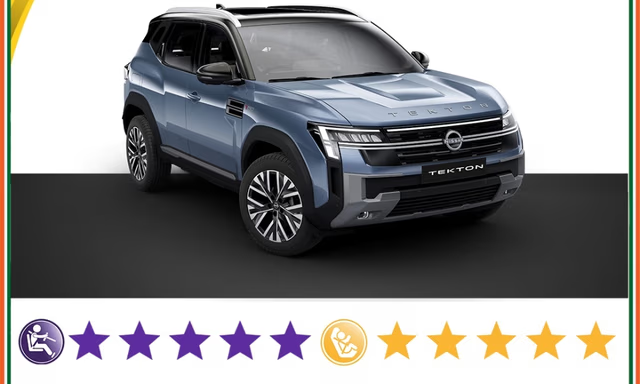 car&bike Team | Jul 9, 2026Nissan Tekton Bags 5 Stars In Bharat NCAP Crash TestsThe Tekton has essentially carried over its sibling Duster’s rating, since it shares its platform and body structure with the latter.2 mins read
 Jaiveer Mehra | Jul 9, 2026Nissan Tekton Price, Variants ExplainedThe Tekton is offered with two turbo-petrol engine options and in six variants.3 mins read
 car&bike Team | Jul 9, 2026Nissan Tekton: In PicturesOffered in six variants and two powertrain options, prices for the Nissan Tekton range between Rs 10.49 lakh and Rs 18.59 lakh (ex-showroom, introductory).3 mins read
 Jaiveer Mehra | Jul 9, 2026Nissan Tekton Makes Global Debut; Launched At Rs 10.49 LakhEssentially the sister model to the new Renault Duster, the Tekton shares much with its Renault sibling under the skin.3 mins read
 car&bike Team | Jul 9, 2026Nissan Tekton SUV India Debut Highlights: Exterior, Interior, Specifications, DetailsNissan will debut the Tekton in India today. Watch this space to get all the details firsthand.0 mins read
 Seshan Vijayraghvan | Jul 7, 2026Tata Altroz Petrol DCA Long-Term Review: Intercity & Highway Driving ReportWe tested the Tata Altroz Petro DCA’s highway manners, intercity performance, and real-world fuel efficiency.1 min read
 Seshan Vijayraghvan | Jun 29, 2026Renault Kiger vs Toyota Urban Cruiser Taisor: Which Underdog Deserves Your Money?Both the Kiger and the Taisor promise strong performance, solid features, comfortable cabins and everyday usability, all without breaking the bank. But which of these underrated subcompact SUVs deserves your money? Let's find out.1 min read
 Seshan Vijayraghvan | Jun 29, 2026Skoda Kodiaq RS Review: The Best Kodiaq Yet?The Skoda Kodiaq RS is finally here, and it's every bit as exciting as I expected. But was it worth the wait?7 mins read
 Bilal Firfiray | Jun 28, 2026BMW X6 M60i Review: It’s Back And HOW!The BMW X6 M60i blends a 530bhp twin-turbo V8, with its unmistakable coupe-SUV styling. There’s plenty of character, but is it worth your money?6 mins read
 Janak Sorap | Jun 25, 2026350cc Bajaj Dominar 400 Review: Same Character, Lower PriceA slightly lower displacement engine, a significantly lower price tag and nearly the same performance — the Bajaj Dominar 400 aims to be smarter rather than faster.6 mins read