
Battery Giants Face Skills Gap That Could Jam Electric Highway


The South Korean battery giants powering many of the world's electric vehicles face a skills shortage that could drag on the global race towards zero-emissions transport. The country's three major players, which command a third of the global electric vehicle (EV) battery market, told Reuters they were all grappling with a shortage of research and engineering specialists as demand for the technology balloons. LG Energy Solution (LGES), SK On, and Samsung SDI Co Ltd all rank in the top-six global battery makers, and supply the likes of Tesla Inc, Volkswagen and Ford Motor Co among others.
Yet they are facing growing demands from big automakers and can't find enough technicians with the training needed to keep advancing cutting-edge tech such as solid-state batteries. "Although we are seeing such a growth in the industry, it appears that we are facing a shortage of talent," an official at LGES said. "It is crucial to recruit external talents as well as nurturing our own talent." This was echoed by its two big domestic rivals, with SK On describing the sector's expansion as "exponential".
Indeed the global battery sector has doubled in size over the past five years and South Korea is short of almost 3,000 graduate degree-level positions in areas such as research and design, according to the most recent data from the Korea Battery Industry Association, from late 2020. LGES, SK On and Samsung SDI currently have a total of about 19,000 employees.

Korea's growing talent shortage across a wider global battery market is expected to triple in size to almost $90 billion by 2025
The Korean crunch reflects a growing talent shortage across a wider global battery market that, according to IHS Markit forecasters, will triple in size to almost $90 billion by 2025. The EU's European Battery Alliance planning group, for example, says "re-/up-skilling" is needed in the bloc because its battery industry needs 800,000 new workers by 2025.
If the global skills gap is not plugged, some industry experts say it could slow the pace of advances in batteries, which are being counted on to clean up road transport, one of the biggest sources of greenhouse gas emissions. "Talent demand in the battery industry outweighs supply, and battery makers are anxious to ensure that they have got this small group of people who can work on this technology, and won't be left behind in the fast-growing market," said Samsung Securities analyst Cho Hyun-ryul.
'COMPETITIVE PACKAGES'
In a sign of the skills pressure, LGES - South Korea's No.1 battery maker by volume - plans to launch a new "battery-smart factory department" at the prestigious Korea University next spring with guaranteed jobs for graduates.
More immediately, executives have been flying to the United States to lead recruiting events at schools there. The LGES CEO and his managers went to Los Angeles last month while the SK Innovation CEO and staff hosted an event in San Francisco on Saturday.
These companies are not only competing with other established Asian players, including market leader CATL from China and Japan's Panasonic, but fast-growing U.S. and European rivals like Sweden's Northvolt bridging the technology gap.

In addition to Asian players, like CATL from China and Japan's Panasonic, the Korean giants are also competing with fast-growing U.S. and European rivals like Sweden's Northvolt
The talent shortage in South Korea is being compounded by some existing employees moving to foreign competitors that had offered better pay, according to two industry sources with knowledge of the matter. They declined to be named due to the sensitivity of the matter.
Northvolt, which counts Volkswagen as a client, has previously said that some of its employees were recruited from top battery makers, including LGES and Panasonic.
"We do have few people working for Northvolt that are from South Korea, which is obviously a very impressive country when it comes to battery manufacturing and development with several well-respected companies active in this space," a spokesperson for the company told Reuters last week.
"We try to offer competitive packages to our employees - everyone working here is a shareholder in the company for instance," he added, though did not specify pay details.
Battery specialists in South Korea newly graduated with doctorate degrees can earn as much as 100 million won ($85,000) a year, and those without that level of qualification average about 80 million won after gaining a few years of experience, according to two sources at major South Korean battery firms.
South Korea's average annual salary was 37.4 million won in 2019, according to tax agency data.

Battery specialists in South Korea newly graduated with doctorate degrees can earn as much as 100 million won ($85,000) a year
'WIN FOR AMERICAN AUTOS'
The Korean sector has also been mired in internal conflict, with LGES and SK Innovation, which wholly owns SK On, locked in a two-year dispute over technology, trade secrets and staff poaching until April this year when they settled their differences.
In a signs of the global importance of the two conglomerates, U.S. President Joe Biden - who has made boosting EVs a top priority - described the settlement as "a win for American workers and the American auto industry."
"We need a strong, diversified and resilient U.S.-based electric vehicle battery supply chain," he added.
Even in the face of the growing skills gap, the worldwide demand for their products has supercharged the battery makers' expansion plans.
LGES expects its production capacity to reach 155 gigawatt-hours (GWh) of batteries by the end of this year and plans to raise that to 430 GWh in 2025 that could power about 7.2 million EVs.
SK Innovation aims to boost its annual production capacity more than five-fold to 220 GWh by 2025 and last week announced the plan to invest 10.2 trillion won with Ford to build three battery plants in the United States.
Richard Kim, principal analyst at IHS Markit, said the skills gap was likely to be a problem for years to come.
"The labour shortage in the battery industry has already been a global issue, and the reality is that there has been an imbalance of supply and demand of manpower as many companies start to expand their capacity," he added.
(This story has not been edited by NDTV staff and is auto-generated from a syndicated feed.)


Latest News


 Jaiveer Mehra | Jun 28, 2026Nissan Tekton Spied Undisguised Ahead Of July 9 DebutSole image of the SUV showcases the rear design of the SUV.1 min read
 Carandbike Team | Jun 28, 2026Renault Kwid Facelift India Launch On July 3Latest facelift marks the second major update for the entry hatchback since its launch in 2015.1 min read
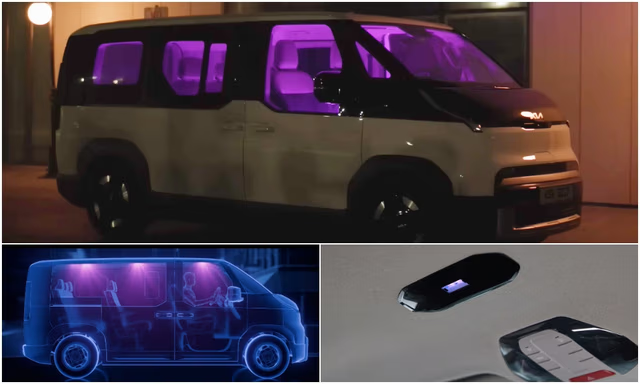 Amaan Ahmed | Jun 27, 2026Future Hyundai, Kia Cars May Feature In-Built UVC SanitiserHyundai Motor Group has unveiled 'Plasma Care UVC' technology, which utilises plasma lamps to safely and effectively destroy bacteria and viruses present inside a car.1 min read
 Amaan Ahmed | Jun 27, 20262026 Maruti Suzuki Brezza Facelift To Be Launched On July 23Launched back in 2022, the current generation of the Brezza subcompact SUV is expected to gain a new engine option, along with a longer list of features.2 mins read
 Jaiveer Mehra | Jun 26, 2026New Hyundai Elantra Makes Global Debut: Boxy Styling, Hybrid Powertrain & Pleos InfotainmentNew generation of the Elantra – sold as the Avante in South Korea – adopts Hyundai’s Art of Steel design language.1 min read
 car&bike Team | Jun 26, 2026TVS NTorq 125 Launched With New Colours From Rs. 82,500TVS Motor Company has introduced three new colours for the NTorq 125 Race Edition and two colour options for the disc variant of the scooter.1 min read
 Bilal Firfiray | Jun 28, 2026BMW X6 M60i Review: It’s Back And HOW!The BMW X6 M60i blends a 530bhp twin-turbo V8, with its unmistakable coupe-SUV styling. There’s plenty of character, but is it worth your money?6 mins read
 Janak Sorap | Jun 25, 2026350cc Bajaj Dominar 400 Review: Same Character, Lower PriceA slightly lower displacement engine, a significantly lower price tag and nearly the same performance — the Bajaj Dominar 400 aims to be smarter rather than faster.6 mins read
 Preetam Bora | Jun 25, 20262026 Bajaj Pulsar NS400Z First Ride Review: Smaller Engine, But Should You Buy It?The Bajaj Pulsar NS400Z won our Two-Wheeler Upgrade of the Year. Then new tax slabs happened. Smaller engine, same badge – but does it still deliver?6 mins read
 Preetam Bora | Jun 25, 2026Triumph Tracker 400 First Ride Review: What's It Really Like?The Triumph Tracker 400 is here, now with a downsized 349 cc engine. We spent a couple of hours with it to share our first impressions. Is it worth your attention?1 min read
 Preetam Bora | Jun 15, 20262026 Yezdi Scrambler Review: The Update That Changes EverythingThe Yezdi Scrambler gets a comprehensive update with an updated engine, revised chassis, reduced weight and proper features list. Does it deliver? Here’s our take.10 mins read