
Factbox-Swapping Electric Car Batteries Since The Gilded Age


Battery swapping - replacing a depleted battery with a freshly charged one - is not new: The first experiments with exchanging batteries in electric cars date to America's Gilded Age in the late 1890s, according to industrial historian David A. Kirsch.
Here is a timeline of key events in the development of battery swapping:
1896: Auto pioneers consider the exchange of depleted batteries with fresh ones as a way to extend the operating range of early rudimentary electric vehicles, from streetcars to delivery trucks.
1912: General Electric Co teams up with local partners in Connecticut to launch a "battery service" that enables electric vehicle owners to swap batteries for a modest monthly fee and a variable per-mile charge. Other similar services spring up in large cities. Semi-mechanized swaps take as little as three minutes at some stations. And by separating the battery from the vehicle, the service helps lower the initial cost by a third or more.
1924: General Electric's GeVeCo battery service is discontinued. Waning demand for electric vehicles and the lack of interest in industry-wide battery standardization stall further development of electric vehicle battery swapping for more than 80 years.
2007: Silicon Valley startup Better Place develops a "battery switching" process and signs up Renault-Nissan for pilot projects in several countries.
2008: The Beijing Olympics showcase a fleet of 50 electric buses featuring swappable batteries. China's Wanxiang demonstrates an electric bus with swappable batteries at the Games.
2010: Better Place is invited to meet with officials of the state-owned China Grid to discuss battery swapping. China Grid ends the talks without a deal.
2013: The same issues that helped kill the decades-earlier GeVeCo serefvice, notably lack of interest by consumers and vehicle manufacturers, catch up to Better Place. After raising - and burning through - more than $600 million in investors' money in just six years, the company files for bankruptcy.
2013: Tesla offers a limited battery swap service for the new Model S, which was designed from the start to accommodate swappable batteries. The swapping process is arduous ("a pain in the ass," recalls a former Tesla executive) and the pilot program is quietly retired in 2015. Tesla CEO Elon Musk orders his team instead to turn its attention instead to building out a proprietary network of charging stations called "superchargers."
2014: Nio is established in China, with satellite operations in the United States and Europe. In 2017, it announces a plan to offer customers the option of swappable batteries, a service that it begins in 2018.
(Reporting by Paul Lienert in Detroit and Nick Carey in London; Editing by Pravin Char)
(This story has not been edited by NDTV staff and is auto-generated from a syndicated feed.)
Related News





Latest Cars


Upcoming Cars


Latest News


 Jaiveer Mehra | Jun 28, 2026Nissan Tekton Spied Undisguised Ahead Of July 9 DebutSole image of the SUV showcases the rear design of the SUV.1 min read
 Carandbike Team | Jun 28, 2026Renault Kwid Facelift India Launch On July 3Latest facelift marks the second major update for the entry hatchback since its launch in 2015.1 min read
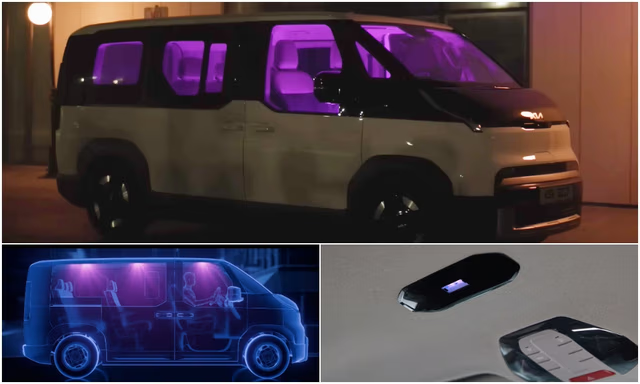 Amaan Ahmed | Jun 27, 2026Future Hyundai, Kia Cars May Feature In-Built UVC SanitiserHyundai Motor Group has unveiled 'Plasma Care UVC' technology, which utilises plasma lamps to safely and effectively destroy bacteria and viruses present inside a car.1 min read
 Amaan Ahmed | Jun 27, 20262026 Maruti Suzuki Brezza Facelift To Be Launched On July 23Launched back in 2022, the current generation of the Brezza subcompact SUV is expected to gain a new engine option, along with a longer list of features.2 mins read
 Jaiveer Mehra | Jun 26, 2026New Hyundai Elantra Makes Global Debut: Boxy Styling, Hybrid Powertrain & Pleos InfotainmentNew generation of the Elantra – sold as the Avante in South Korea – adopts Hyundai’s Art of Steel design language.1 min read
 car&bike Team | Jun 26, 2026TVS NTorq 125 Launched With New Colours From Rs. 82,500TVS Motor Company has introduced three new colours for the NTorq 125 Race Edition and two colour options for the disc variant of the scooter.1 min read
 Bilal Firfiray | Jun 28, 2026BMW X6 M60i Review: It’s Back And HOW!The BMW X6 M60i blends a 530bhp twin-turbo V8, with its unmistakable coupe-SUV styling. There’s plenty of character, but is it worth your money?6 mins read
 Janak Sorap | Jun 25, 2026350cc Bajaj Dominar 400 Review: Same Character, Lower PriceA slightly lower displacement engine, a significantly lower price tag and nearly the same performance — the Bajaj Dominar 400 aims to be smarter rather than faster.6 mins read
 Preetam Bora | Jun 25, 20262026 Bajaj Pulsar NS400Z First Ride Review: Smaller Engine, But Should You Buy It?The Bajaj Pulsar NS400Z won our Two-Wheeler Upgrade of the Year. Then new tax slabs happened. Smaller engine, same badge – but does it still deliver?6 mins read
 Preetam Bora | Jun 25, 2026Triumph Tracker 400 First Ride Review: What's It Really Like?The Triumph Tracker 400 is here, now with a downsized 349 cc engine. We spent a couple of hours with it to share our first impressions. Is it worth your attention?1 min read
 Preetam Bora | Jun 15, 20262026 Yezdi Scrambler Review: The Update That Changes EverythingThe Yezdi Scrambler gets a comprehensive update with an updated engine, revised chassis, reduced weight and proper features list. Does it deliver? Here’s our take.10 mins read