
Tesla, Others Seek Ways To Ensure Drivers Keep Their Hands On The Wheel

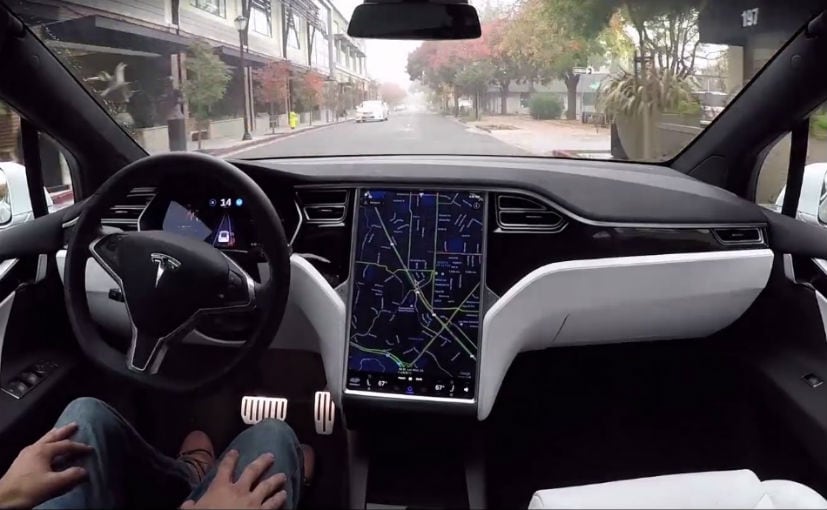
- In September 2016, Tesla unveiled new restrictions on Autopilot
- Automakers are now using tiny cameras, sensors to track drivers
- Audi's system brings the vehicle to a stop if the driver does not respond
In a report this week on the May 2016 crash of a Tesla Inc Model S that killed a driver who was using Autopilot, the National Transportation Safety Board demonstrated that users could mostly keep their hands off the wheel for extended periods despite repeated warnings from the vehicle.
But the crash underscored a vexing problem for automakers that want to gain an edge by launching technology that completely automates driving tasks. Unless a car is capable of driving itself safely in every situation, drivers will still have to remain alert and ready to take control even if the car is piloting itself.
The NTSB, the federal agency charged with investigating significant transportation accidents, said during a 37-minute section of the 41-minute Tesla trip, the driver kept his hands on the wheel for just 25 seconds, putting his hands on the wheel for one- to- three second increments after getting repeated visual and audible warnings. General Motors Co delayed introduction of a driver assistance technology called Super Cruise that was initially planned for late last year because it said it was not ready. The technology will go on sale this fall.
Barry Walkup, chief engineer of Super Cruise, said the company added "a driver attention function, to insist on driver supervision." The system uses a small camera that focuses on the driver and works with infrared lights to track head position to determine where the driver is looking. If the system - which uses facial recognition software - detects the driver is not paying attention, it will prompt the driver to return attention to the road. If the driver does not respond, it will escalate alerts, including a steering wheel light bar, visual indicators, tactile alerts in the seat and audible alerts. If the driver does not respond, the vehicle is brought to a controlled stop.
Volkswagen AG's luxury Audi unit has a system that handles steering and braking at speeds of up to 40 miles. The system requires the driver to check in with the steering wheel every 15 seconds. Audi said the system will beep alerts at the driver, and if the driver does not respond, it will bring the vehicle to a stop.
The National Highway Traffic Safety Administration, which is the lead agency for regulating self-driving cars, does not test or preapprove driver assistance systems before automakers install them. Instead, the agency responds to complaints or crashes when it investigates whether a potential defect poses an unreasonable risk to driver safety. The May 2016 Tesla accident has raised concerns about the regulation of self-driving cars.
The NTSB will issue probable cause findings and may make recommendations to the NHTSA in the Tesla crash but does not plan to hold a public hearing on the incident, spokesman Keith Holloway said.
In September 2016, Tesla unveiled new restrictions on Autopilot after widespread concerns the system lulled users into a false sense of security through its "hands-off" driving capability. The updated system temporarily prevents drivers from using the system if they do not respond to audible warnings to take back control of the car.
The car sounds warnings if drivers take their hands off the wheel for more than a minute at speeds above 45 miles per hour (72 kph) when there is no vehicle ahead, Tesla Chief Executive Elon Musk told reporters in September. If the driver ignores three audible warnings in an hour, the system temporarily shuts off until it is parked.
Musk said at the time that autopilot accidents are far more likely for expert users of the system, saying some users got as many as 10 warnings in an hour under the prior system. "It's not the neophytes, it's the experts. They get very comfortable with it and repeatedly ignore the car's warnings and in effect it becomes like a reflex action," Musk said.
Tesla monitors drivers through their interactions with the steering wheel, turn signal, and speed setting, NHTSA said in a separate report.
Alphabet Inc's Waymo unit, which is also working on self-driving technology, is taking a different approach, arguing that asking drivers to pay attention while the car drives itself is wrong. Waymo is focusing its efforts on fully autonomous vehicles where humans take no part in driving, rather driver assistance. "We're not seeking to build a better car. Our goal is to build a better driver," Waymo Chief Executive Officer John Krafcik said earlier this year.
(Reporting by David Shepardson; Editing by Chris Sanders and Bernard Orr)
(This story has not been edited by NDTV staff and is auto-generated from a syndicated feed.)
Related News


Popular Tesla Models

Latest Cars


Upcoming Cars


Latest News


 car&bike Team | May 6, 2026Harley-Davidson Sprint To Be Introduced Based On Made-in-India X440Harley-Davidson is set to introduce affordable models including a 440 cc global model and a new Sportster in a bid to kick-start turnaround.3 mins read
 car&bike Team | May 6, 2026TVS iQube S 4.7 kWh Launched At Rs 1.54 LakhThe 4.7 kWh battery pack option is only offered on the S trim of the iQube.2 mins read
 Preetam Bora | May 6, 2026Maruti Suzuki Jimny Road Trip: Driving To Anini And Dri Valley, Arunachal PradeshDriving a Maruti Suzuki Jimny to Anini and Acheso, Dri Valley in eastern Arunachal Pradesh.11 mins read
 Jaiveer Mehra | May 6, 2026Mahindra To Ramp Up XEV 9S Production In Next 4-5 MonthsThe carmaker says that it is presently not able to increase XEV 9S production owing to capacity constraints.1 min read
 Seshan Vijayraghvan | May 5, 2026Tata Harrier, Safari Ultra & Ultra Red Dark Variants Introduced For Diesel Models; Priced From Rs. 23.85 LakhThe Harrier Ultra and Ultra Red Dark range is priced from Rs. 23.85 lakh to Rs. Rs. 25.85 lakh. The Safari Ultra and Ultra Red Dark range is priced at Rs. 23.33 lakh to Rs. 25.20 lakh.2 mins read
 car&bike Team | May 5, 2026McLaren Reveals Track-Only MCL-HY HypercarThe GTR will be offered to select customers, bundled with access to Le Mans and the 2027 World Endurance Championship.2 mins read
 Jafar Rizvi | May 3, 2026River Indie Gen 3 Long Term Report: 1 Month, 400 km AfterAfter a month and 400 km, the River Indie impresses with its utility-first approach, smooth ride and standout design, despite a few everyday usability compromises.8 mins read
 Bilal Firfiray | May 2, 2026Volkswagen Taigun Facelift Review: Still The Driver’s SUV, But Improved!The updated Volkswagen Taigun gets a new 8-speed automatic, a refreshed design, and added features. But does it still deliver the best driving experience in the C-SUV segment?5 mins read
 Shams Raza Naqvi | Apr 29, 2026Toyota Innova Hycross Vs Mahindra XEV 9S: Choosing The Right Three Row Family MoverIn a battle of three-row cars the electric Mahindra XEV 9S takes on the Toyota Innova Hycross. Which one ticks more boxes?1 min read
 Janak Sorap | Apr 26, 2026BMW F 450 GS First Ride Review: Almost A Proper GS With Big Bike DNANew 420cc twin, premium build, feature-loaded and Easy Ride Clutch — but does it deliver where it truly matters?8 mins read
 Seshan Vijayraghvan | Apr 25, 20262026 MG Majestor Review: Bold, Feature-Packed And Off-Road ReadyWe spent time with the MG Majestor to see how much of an improvement it is over the Gloster, and whether it can take on the segment leader – Toyota Fortuner.9 mins read