
2024 TVS Jupiter 110 First Ride Impressions: Gunning For Gold

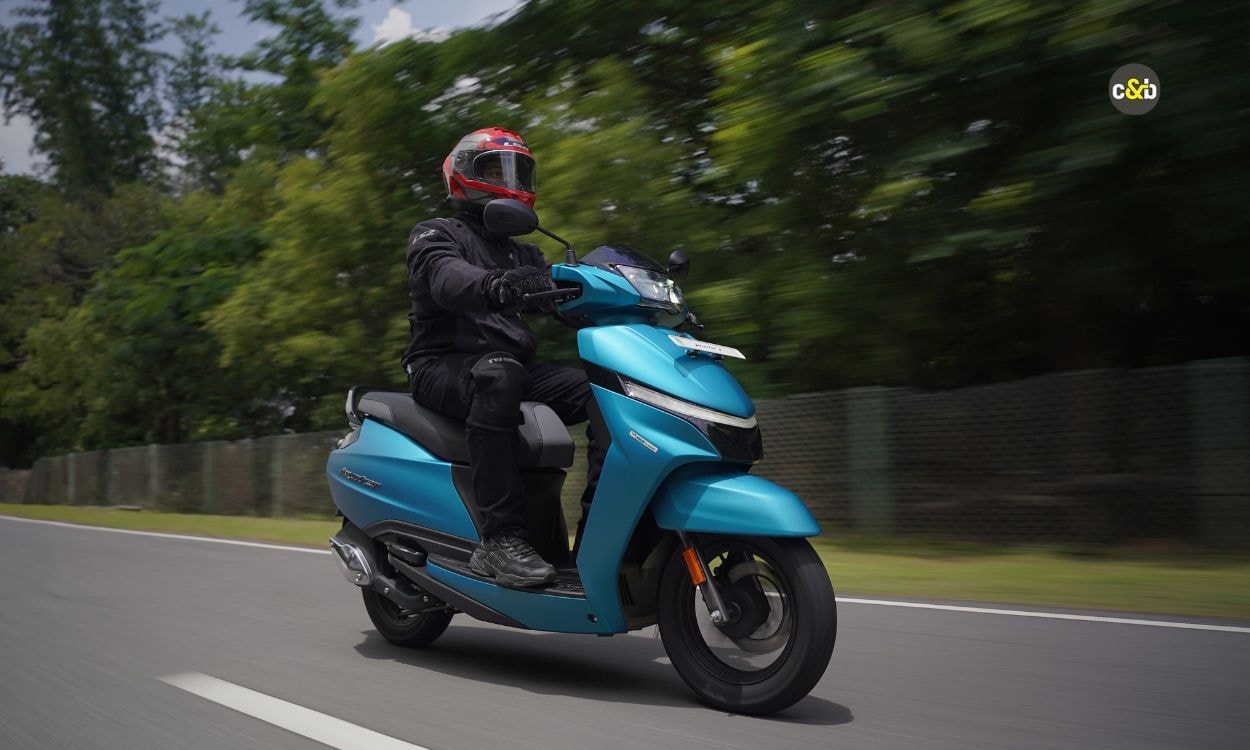
- New TVS Jupiter 110 makes a statement with its dynamic, yet subdued design language.
- Performance from the all-new 113 cc hybridised engine is strong for this segment.
- Low kerb weight means the new Jupiter is keener to change directions and is surprisingly fun to ride.
Photography: Arvind Salhan
How can a product that has found millions of buyers over a decade not be a market leader? Unlikely as that sounds, the TVS Jupiter has found itself in this position ever since it was launched in 2013. It has, after all, entered into the ring with the Honda Activa, the leviathan that has dominated India’s scooter market for more than two decades. Some may argue that the Activa’s sustained success stems mainly from its bulletproof reliability and customer trust won over the years, but whichever way you slice it, the truth is the Jupiter – which also continued largely unchanged for the better part of 11 years – has had to settle for second place. That is something the second-generation Jupiter 110 will no longer accept, and its laser-like focus on leapfrogging its Japanese nemesis is clear as day after a brief first ride.
Also Read: New TVS Jupiter 110 vs Honda Activa 6G: Price, Specifications, Features Compared
TVS Jupiter 110 First Ride: Design And Dimensions
Much like the Activa, the Jupiter, which was always a family scooter, adopted a safe, please-all-offend-none approach to design. Its simple-yet-timeless lines were digestible for the Indian masses, and the original Jupiter quickly and easily blended into India’s bustling streets. However, barring the odd paint scheme and trim introductions, the first-generation Jupiter looked more or less the same throughout its lifecycle. It was staid, and was clearly starting to age.
TVS has adopted a bolder design approach with the new Jupiter 110.
The new Jupiter makes a clean break from the design philosophy of the original. This is the most dynamic-looking Jupiter yet, with prominent creases in the bodywork serving to represent its more youthful character. The ‘Infinity’ LED daytime running light (DRL), which seamlessly integrates turn indicators, lends an air of sophistication, with the LED headlight sitting proud on top. It’s well-proportioned, and carries over 12-inch wheels (10-spoke alloys on the higher variants, steel wheels on the base model).
Creases in the bodywork extend to the side panels, to add some visual character.
The pillion grab handle looks almost organic, as it sprouts from the gloss-black LED tail-light surround, with the clear tail-light itself mimicking the shape and structure of the DRL. A total of six colour options are available, including the matte Dawn Blue you see here, but I wish TVS offered a wider variety of options, as the SmartXonnect versions are only available in three colours, including two matte shades. All said and done, this is one good-looking scooter – an almost-necessary change-up in the entry-level scooter segment.
The new Jupiter is lighter, at 105 kg (kerb).
The second-gen model is based on the same platform as the Jupiter 125 that came in 2021, and as a result, it is longer, but also narrower and lower than the outgoing Jupiter. The wheelbase remains unchanged at 1,275 mm, as does the ground clearance (163 mm).
Fuel filler port now located at the front, same as on the Jupiter 125.
However, the mechanical layout has been altered, so the fuel tank – which is smaller, at 5.1 litres – now sits under the floorboard, enabling the fuel filler cap to be located at the front. TVS has also been able to reduce the weight of the new Jupiter, which, at 105 kg (kerb), is about four kilos lighter than the first-gen model.
Also Read: New TVS Jupiter 110: In Pictures
Six colours available in total, but only three options for the SmartXonnect variants.
TVS Jupiter 110 First Ride: Comfort, Ergonomics And Practicality
Benefiting from the new platform, the 2024 Jupiter 110 also has a longer seat (756 mm), and a bigger underseat storage compartment. The seat is longer than that of an Activa, and in practice, it does have plenty of room – I had a generously-sized pillion seated with me, and there was still enough space for the both of us.
756 mm-long seat can easily accommodate rider and pillion, with room to spare.
The underseat storage capacity has risen to 33 litres – the same as on the Jupiter 125, and almost level with storage seen on some electric scooters. It can easily gobble up two half-face helmets, and while full-face helmets may not fit, this compartment will be sufficient for most grocery and shopping runs.
Underseat storage capacity has risen to 33 litres – same as the Jupiter 125.
Seat height is a friendly 770 mm, so riders of all heights should be reasonably comfortable, and the floorboard has enough space to carry large items – including a cylinder, as per TVS.
There’s also a two-litre storage bin designed into the inner front panel, which has handy space for odds and ends (and a mobile charger located conveniently right above it), but it has no lockable cover, so it’s best not to put any valuables there that you could potentially forget on the scooter. The switchgear is conventional and nothing to write home about, but all controls fall easily to hand, and the riding position itself is comfortable.
Two-litre storage compartment is handy, with mobile charger located right above it.
TVS Jupiter 110 First Ride: Features And Connectivity
Out goes the older Jupiter’s positive LCD digital display, and in its place comes a reverse LCD cluster with colour elements. The display itself remains somewhat small (with tell-tale lights flanking it), but it is legible, even under bright sunlight. Lower-spec variants still continue with an analogue instrument cluster. As before, you can pair your smartphone to the scooter via Bluetooth and use turn-by-turn navigation (with the base map sourced from MapMyIndia).
Reverse LCD cluster remains legible even under harsh sunlight, but is a tad small.
SmartXonnect app connectivity is still available, only this time, you get some more features, including a remote ‘Find me’ function, average fuel economy and distance to empty estimates, advanced trip summary (with a break-up of riding data in Eco and Power modes), carbon savings and idling durations, and additional commands for the voice assistant (what’s my range, top speed and more). However, we’ll have to reserve comment for how well these functions work, as at the media ride, we did not have a chance to experience the connectivity features.
Also Read: New TVS Jupiter 110 Launched At Rs 73,700; Gets All-New 113 cc Engine With ISG
Lower-spec Jupiter variants continue with a regular analogue speedometer.
TVS Jupiter 110 First Ride: Performance, Handling And Fuel Efficiency
The powertrain is perhaps the star of the new Jupiter 110 story. Derived from the Jupiter 125’s engine, this is an all-new, 113 cc unit, which benefits from a low-inertia crankshaft and DLC coating, and is lighter than the 109.7 cc engine it replaces. On its own, this engine produces a smidge more power (7.91 bhp) and 9.2 Nm of torque, about 0.4 Nm more than before.
ISG enables ‘iGo Assist’ performance boost – but it's available only on the SmartXonnect variants.
However, the inclusion of an integrated starter generator (ISG) means TVS can offer ‘iGo Assist’ on the new Jupiter, with which the ISG supplements the engine with additional torque under hard acceleration. This boosts total torque to 9.8 Nm, a full 1 Nm than before. More importantly, peak torque is now available at lower revs (5,000 rpm).
All-new 113 cc engine is lighter than the previous Jupiter's unit.
The new Jupiter pulls away cleanly from standstill. It starts off in Eco mode, and the display flashes ‘iGo Assist Ready’ to indicate that additional power is available. It’s only when you twist the throttle beyond a certain degree that the Jupiter switches automatically to Power mode, and the ISG works to propel you to highway speeds in reasonably quick fashion. Be it in a 30 to 50 kmph sprint or a 50 to 70 kmph sprint, the Jupiter’s powertrain feels gutsy, and is one of the strongest performers I’ve experienced in the entry scooter segment till date. The speedo-indicated top speed I saw during my ride was 84 kmph, which is a respectable figure, and even at that speed, the Jupiter felt planted and assuredly stable.
New Jupiter comfortably gets up to highway speeds, with iGo Assist providing a boost in torque.
TVS’ test track at Hosur only has two sweeping corners, but chucking the new Jupiter into them was surprisingly fun. You have to remember this is a family scooter still, and grip from the TVS tyres is predictably limited, but the reduced weight of the scooter means it is eager to change direction, and will comfortably hold its line through a corner even at higher speeds. Within the limits of reason, the new Jupiter promises to be one of the more enjoyable scooters to ride in this segment.
Petal-type front disc employed as it has better heat dissipation capabilities.
The brakes work well, with the front disc brake – now petal-type, for better heat dissipation – offering enough stopping power, but you still only get a combined braking system, with no anti-lock brakes (ABS) available even as an option.
New Jupiter is surprisingly fun to ride, and its lower weight means it is eager to change direction.
The Jupiter was ridden by several mediapersons on the track, with almost everyone subjecting it to hard acceleration runs. However, the scooter still flashed a fuel efficiency figure of 42 kmpl, so with a gentler right hand, that figure should rise comfortably in real-world riding. Efficiency will be further aided by the integrated start-stop system, which shuts off the engine after it idles for seven seconds, and lets the rider revive it by engaging the rear brake lever and opening the throttle, a procedure that works fairly seamlessly most of the time.
Grip from the TVS tyres is limited, but the Jupiter holds its line through the corners.
TVS Jupiter 110 First Ride: Verdict
Prices for the new Jupiter 110 start at Rs 73,700, and go up to Rs 87,250 (all prices, ex-showroom, Delhi) for the front disc brake SmartXonnect variant we sampled at the test track. These prices are lower than before, especially for the fully-loaded variant. The base version undercuts the Honda Activa by a substantial margin, while the top-spec variant is notably more expensive than the Activa. And it's worth noting the iGo Assist functionality is present only on the SmartXonnect variants – on the lower variants, the ISG is present only for a silent-start function, so to reap the full benefits of the ISG, you will have to pay close to Rs 1 lakh on-road.
Prices for the new Jupiter 110 range from Rs 73,700 to Rs 87,250 (ex-showroom, Delhi).
After a brief first ride, I can tell you the new Jupiter carries over the likeable qualities of its predecessor. It is reasonably comfortable, feels well put together, has enough space for two (and their luggage) and on design and performance, it has taken two steps forward. This now is a genuinely good-looking scooter, one with a certain aspirational value attached, and the performance is impressively strong for a 110. We still need to conduct a full road test to be able to better understand its ride quality and real-world fuel efficiency. What is clear, though, is the Jupiter has long had to accept its place as second-best; be content with a silver medal. For the new Jupiter, second place is no longer good enough – it is going for gold.
Related News


Research More on TVS Jupiter


Popular TVS Models


Latest Cars


Upcoming Cars


Latest News


 Sarthak Mahajan | Aug 10, 2026Top 5 Major Feature Updates On The New Mahindra Scorpio-NMahindra recently launched the updated Scorpio-N. Here are the top five features to look out for.1 min read
 car&bike Team | Aug 10, 2026New Ducati Monster V2 Launched In India At Rs 13.99 LakhThe updated naked Ducati gets a new 890cc V2 engine in place of the outgoing 937cc unit, along with revised ergonomics and more.1 min read
 Abhishek Nigam | Aug 10, 2026TVS Orbiter Electric Scooter Now Costs Up To Rs 4,000 MoreTVS hikes price of its popular urban EV runabout2 mins read
 car&bike Team | Aug 8, 2026Bugatti Destrier Revealed As One-Off Bolide-Based Hypercar With 1,578 BhpBugatti has revealed the Destrier, a one-off based on the Bolide but with a completely different design brief.3 mins read
 car&bike Team | Aug 8, 2026KTM 160 Duke, RC 160 Prices Hiked By Up To Rs 15,000KTM India has revised the prices of its entry-level motorcycles, with both the 160 Duke and RC 160 getting more expensive.1 min read
 car&bike Team | Aug 8, 2026MG Majestor SUV Prices Hiked By Rs 1.50 LakhAfter the hike, prices for the Majestor now start at Rs 42.49 lakh (ex-showroom) for both 4x2 variants.2 mins read
 Bilal Firfiray | Aug 1, 2026Toyota Hilux Review: The InvincibleMarking it as the ninth generation, the Hilux comes with a major cosmetic overhaul. But is it still relevant enough for the current times or is it getting too long in the tooth?5 mins read
 Bilal Firfiray | Jul 30, 2026Kia Syros EV Review: Best EV To Buy Under Rs 20 Lakh?The Kia Syros EV comes into the game with a modern design, spacious cabin, strong performance, decent range and an aggressive pricing. But could it become the new benchmark under Rs 20 lakh?5 mins read
 Jaiveer Mehra | Jul 27, 20262026 Maruti Suzuki Brezza Facelift Review: Bestseller Joins The Turbo ClubWhile Maruti’s facelifts have always tended to bring subtle updates over the outgoing models, the latest Brezza brings some heavy updates under the skin, including a new 6-speed manual gearbox and, for the first time, a turbocharged petrol engine option.1 min read
 Bilal Firfiray | Jul 24, 2026Honda ZR-V Review: Who Is It For?Honda has brought the new ZR-V to India as their current flagship offering. It’s a CBU, it’s a hybrid, and it’s here for a limited few. Who is it for though?1 min read
 Girish Karkera | Jul 29, 2026Mercedes-AMG E53 4MATIC+ PHEV First Drive Review: Just What The Doctor OrderedThere are luxury cars and there are high-performance cars. But what if you want both for the price of one? Mercedes-Benz has a recommendation that promises to tread a fine line between the two – the second generation E53 with a twist.7 mins read