
Ola S1 Air First Ride Review: A Different Approach To Affordable Electric Mobility

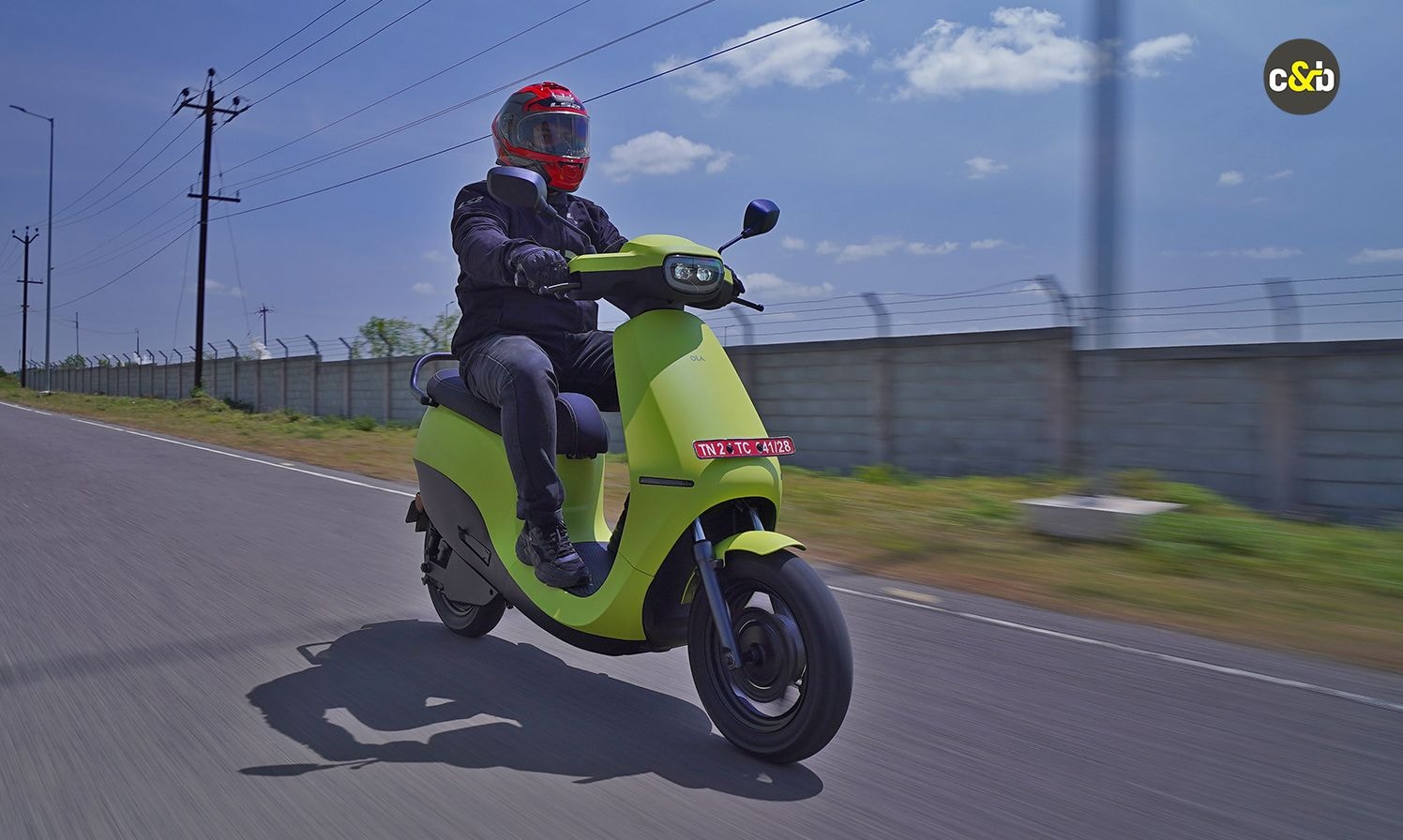
- Ola S1 Air debuted at an introductory price of Rs 79,999; now retails at Rs 1.10 lakh.
- Based on Gen 2 platform; employs telescopic fork, twin shocks and hub motor.
- Low weight enables strong performance; still needs overall quality refinements.
In 2022, Ola Electric announced its ambition to end the age of petrol-powered scooters in India with a super affordable electric scooter named the S1 Air. Now the S1 Air has taken quite some time to get here and it's not quite as affordable as it was initially made out to be.
Back at its debut in October, it wore an introductory sticker price of Rs 80,000, which promised to place it in the heart of India’s scooter market. However, it has taken well over three quarters of a year to finally hit the road. In the interim, the market scenario has changed, with a reduction in central subsidies for electric two-wheelers, so it is no surprise that the S1 Air’s price today is notably higher than that announced in 2022.
The Ola S1 Air was first revealed in October 2022.
With the standard S1 being phased out, the S1 Air is now one of two scooters that Ola builds in total, and it’s an important addition to the line-up, given that the S1 Pro now retails at Rs 1.40 lakh, and Ola’s line-up does need an accessible variant. But this isn’t merely a stripped-down S1 Pro, despite having pretty much the same design and styling cues.
Also Read: Ola S1 X To Debut On August 15 As Sub-Rs. 1 Lakh Electric Scooter
Ola S1 Air: Platform, suspension and powertrain
With controversy and reliability concerns surrounding the single-sided fork seen on the S1 range previously, Ola decided to do away with it in favour of the more durable, and more conventional, twin-sided fork. Paired with the twin rear shocks, this suspension setup is not only time-tested, but is also cheaper to incorporate than the setup seen on other S1 models so far. Also new is the hub motor, which has a continuous output of 2.7 kW and peak output of 4.5 kW, and is also a more affordable alternative to the mid-drive motor used on other S1s so far.
Conventional telescopic fork used instead of S1 Pro's single-sided fork; gets steel wheels and drum brakes at both ends.
The S1 Air is based on Ola’s second-generation platform, which uses 14 per cent fewer parts. The spine-like protrusion on the floor of the S1 models has been done away with here, so you get a flat floor board that will come in handy when one is carrying larger items. Combined with a lighter battery, the S1 Air is a pretty light scooter, weighing in at just 108kg.
Flat floor board enhances practicality quotient.
There’s also a redesigned single-piece pillion grab handle, which is more practical than the split handle seen on the S1 Pro, and also feels sturdier. However, overall quality levels aren’t exactly impressive; the finish of the paint job feels ordinary, and the unpainted lower section makes the scooter look a little too basic for its own good. It will grab attention, especially in this new neon green shade, but I’m not sure how it’ll age over time.
Also Read: Ola Teases Entire Line-Up Of Electric Motorcycles
Hub motor brings cost benefits; generates peak output of 4.5 kW.
Ola S1 Air: Tech and features
The Air continues with the same 7.0-inch touchscreen as seen on the higher-spec S1 Pro, and incorporates the same connected features as well. It runs the company’s MoveOS software, which includes in-built navigation, music playback, keyless go and ‘Moods’ themes. The screen itself, however, isn’t the most responsive, and despite being rated at 1000 nits, isn’t as bright as you’d want it to be, especially on a sunny day. It even gets the cruise control feature from its more expensive sibling, but misses out on hill hold assist, is available in only six colours (as opposed to 12 for the S1 Pro) and has a marginally smaller 34-litre underseat storage space.
Storage capacity, at 34 litres, is marginally lower than the S1 Pro's, but still plenty.
Ola S1 Air: Performance, handling and range
At 806 mm, the S1 Air’s seat height is on the higher side for a scooter, and will be something to consider for shorter riders. But once you get on and get going, the S1 Air feels surprisingly fleet-footed. As you’d expect, Eco mode is set up to maximise range, but shift into Normal mode, and the Air has plenty of usable power. Despite the hub motor being significantly less powerful than the mid-drive unit, it still gives the Air a pep in its step, with the scooter gathering pace smartly at city speeds. Switch to Sport mode, and the S1 Air is sprightlier than you might expect, breaching 40 kilometres an hour in a little over 3 seconds, easily crossing 80 kilometres an hour and attaining its top speed of 90 kmph.
The S1 Air gathers speed smartly, even in Normal mode.
What enriches the riding experience is the S1 Air’s agility. The benefits of the weight reduction show when you’re riding it spiritedly. The Air corners with confidence, with plenty of grip from the TVS Eurogrip tyres egging you on to carve up every turn. It changes direction with minimal effort, and remains stable even at higher speeds.
Also Read: Ola Electric Plans 6 New Electric Products For India By 2027
It’s hard to talk about the Air’s ride quality, as our first ride was on smooth stretches in the vicinity of Ola’s factory in Krishnagiri, and it’s best to reserve comment on ride comfort till we ride the scooter extensively. Braking duties are handled by drums at either end, which do a decent job of bringing the scooter to a halt.
Ola says the S1 Air will cover up to 125 km in Eco mode.
The Air’s 2.98 kWh lithium-ion battery pack, which uses nickel-manganese-cobalt (NMC) cells, blesses the S1 Air with a certified range of 125 kilometres, which translates to about 100 kilometres in Normal mode and 87 kilometres in Sport mode. Charging it using the bundled home charger will take about five hours, claims Ola. The short nature of our ride meant there was no chance to run a real-world range test, and that’s something we’ll find out when we get to ride the scooter for a longer period of time.
While these were pre-production scooters given to the media for the first rides, they did have some niggles. At one point during the ride, I stopped by the side of the road with the scooter in Sport mode, and when I tried to set off again, there was no response from the throttle whatsoever. The scooter only got going again once I switched to the Normal mode. Ola says it will iron out any irritants from the final production scooters that will be delivered to customers.
Ola S1 Air: First ride summary
At present, the S1 Air is priced at Rs 1.10 lakh. This will rise to Rs 1.20 lakh (all prices ex-showroom, including FAME-II subsidy) after Independence Day. Even at that price point, I can see why Ola is confident about the S1 Air finding buyers, as it has its strengths, even though it is decidedly simple. It's actually quite peppy despite having a less powerful motor compared to the now-discontinued S1. It has a good amount of storage space and doesn't skimp on any connectivity features.
The S1 Air's price will be hiked by Rs 10,000 from August 16 onwards.
That being said, I'm not quite sure if this is still ready to take buyers away from the likes of established petrol-powered scooters which have been around for decades, are known for their bulletproof reliability and continue to be more accessible from a price perspective. Also, we are yet to test the full real-world range of the S1 Air, and it remains to be seen how reliable the scooter is in the long run. A comprehensive road test should provide a clearer image. For now, the S1 Air will almost certainly figure in the consideration set for scores of buyers looking to purchase their first electric two-wheeler.
Photography: Arvind Salhan
Ola S1 Air: Specifications
| L x W x H | 1860 mm X 680 mm X 1175 mm |
| Wheelbase | 1359 mm |
| Seat height | 806 mm |
| Ground clearance | 160 mm |
| Underseat storage | 34L |
| Kerb Weight | 108 kg |
| Frame Type | Tubular & Sheet metal |
| Front Suspension | Twin telescopic fork |
| Rear Suspension | Twin shock absorbers |
| Braking System | Drum (F-R) with CBS |
| Tyre and wheel size | 90/90- R12 (F-R) |
| Wheel type | Steel |
| Battery capacity | 2.98 kWh (NMC) |
| Home charging time (0 to 100%) | 5 hours |
| Motor output (Continuous/Peak) | 2.7 kW/4.5 kW |
| Motor type | Hub Motor |
| Ride modes | Eco, Normal & Sport |
| Top speed | 90 kmph |
| Max acceleration (0 to 40 kmph) | 3.3 seconds |
| Max acceleration (0 to 60 kmph) | 5.7 seconds |
| Claimed Range (Eco/Normal/Sport) | 125/100/87 km |
| ARAI Range | 125 km |
Related News


Learn more about

Popular Models


Latest Cars


Upcoming Cars


Latest News


 car&bike Team | Sep 18, 20262026 TVS Apache RTR 200 4V: Top 5 UpdatesThe TVS Apache RTR 200 4V has been introduced in a new top-end variant which gets a lot of new features, including preload adjustable front suspension. Here’s a look at what’s new on the top-spec Apache RTR 200 4V.1 min read
 Jaiveer Mehra | Sep 18, 20262027 Mahindra Thar 3-Door Facelift Teased Ahead Of LaunchSecond update in two years to bring additional cosmetic changes and more features.1 min read
 Amaan Ahmed | Sep 18, 2026Tata Sierra Legend Series Launched At Rs 11.99 Lakh; Adds More Features To Entry And Mid TrimsA slew of features, previously limited to the top-spec Sierra, have been introduced on the Smart+, Pure, Pure+ and Adventure+ variants of the SUV.3 mins read
 car&bike Team | Sep 18, 2026Raptee.HV Commences Customer Deliveries in Bengaluru, Targets 100+ Motorcycles by NovemberThe electric motorcycle maker has begun deliveries in Bengaluru and aims to deliver more than 100 motorcycles across Bengaluru and Chennai by November1 min read
 Abhishek Nigam | Sep 18, 2026New TVS Ronin: What’s New And What’s Still MissingTVS has added safety, connectivity and convenience features to the Ronin range, but the motorcycle's mechanical package remains unchanged1 min read
 car&bike Team | Sep 17, 2026Kia Carens Clavis Line-Up Expanded With More Accessible Automatic VariantsThe HTE (O) and HTE (EX) variants of the Kia Carens Clavis will now come with a turbo DCT setup, while the former will also offer a diesel automatic version.2 mins read
 Preetam Bora | Sep 16, 2026Royal Enfield Himalayan 440 Review: Better Than the 450?The new Himalayan 440 with an upsized engine and gearbox has certainly improved as a touring machine and at an extremely attractive price of Rs. 2.29 Lakh. Is it the better Himalayan to choose for many riders?9 mins read
 Seshan Vijayraghvan | Sep 15, 2026BMW i5 LWB Review: Not The M60, This Is The Proper Electric 5 SeriesThe BMW i5 LWB takes the electric 5 Series formula and puts a stronger focus on rear-seat comfort and long-distance luxury. With a 669 km claimed range, 268 bhp and a more relaxed character, is this the i5 that makes the most sense for India?7 mins read
 Preetam Bora | Sep 14, 2026Ladakh Uncharted: Himalayan Basecamp Off-Road Ride ExperienceA day-long off-road excursion from Royal Enfield’s Himalayan Basecamp event in Ladakh, the Ladakh Uncharted ride by Alpinestars was all about re-discovery!6 mins read
 Janak Sorap | Sep 12, 2026New Bajaj Pulsar 125 First Ride Review: More Tech, Less Weight, Same Pulsar DNAThe new Bajaj Pulsar 125 retains the familiar Pulsar identity but gets a new engine, lighter construction, more features and a sharper riding experience.5 mins read
 Bilal Firfiray | Sep 10, 2026Mahindra XEV 9S Review: 3 Reasons To Buy It, And 3 Reasons To AvoidEveryone keeps telling me that the Mahindra XEV 9S is not the electric XUV 7XO. I disagree.1 min read