
Hyundai Develops New Wearable Robot To Help In Manufacturing Process
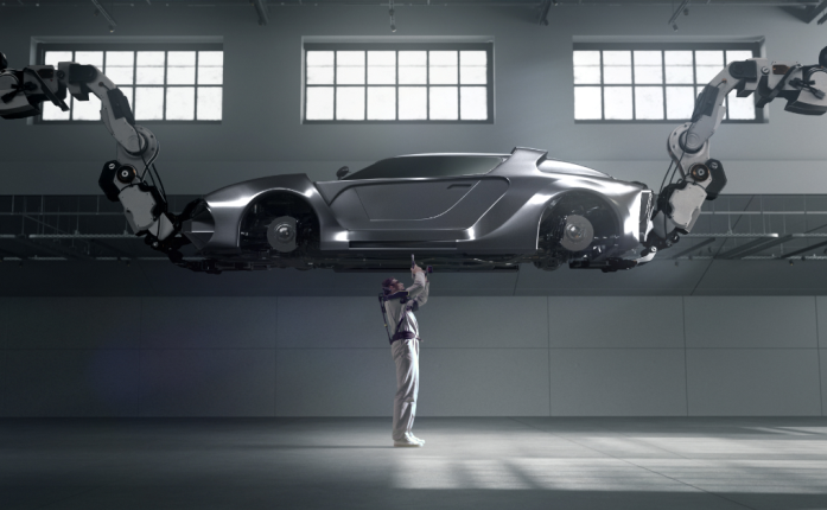
Hyundai Motor Group has developed new Vest EXoskeleton (VEX), a wearable robot created to assist industrial workers who spend long hours working in overhead environments. The VEX enhances productivity and reduces fatigue of industrial workers by imitating the movement of human joints to boost load support and mobility. The wearable vest the polycentric axis - combining multiple pivot points with multi-link muscular assistance - to function, eliminating the need for a battery.
At 2.5kg, VEX weighs 22-42 per cent less than competing products and is worn like a backpack. The user places their arms through the shoulder straps of the vest, then fastens the chest and waist buckles. The back section can adjust in length by up to 18 cm to fit a variety of body sizes, while the degree of force assistance can be adjusted over six levels - up to as much as 5.5 kg.
The newly-developed VEX is targeted at production-line workers whose job is primarily overhead, such as those bolting the underside of vehicles, fitting brake tubes, and attaching exhausts. The development of the VEX included a pilot program in two Hyundai Motor Group plants in the US. The trial was widely successful in assisting workers and boosting productivity and both plants incorporated VEX systems in their production lines.
The Group is considering on implementing the VEX on plants around the world. It is expected to go into commercial production in December by Hyundai Rotem and is projected to cost as much as 30% lower than existing products which usually costs around 5,000 dollars.
As part of the Group's plans to develop a diverse range of robotics technologies, another lightweight wearable device is soon to be commercialized. The 'Chairless EXoskeleton' (CEX) supports workers to maintain a sitting position without a stool or chair. At 1.6kg, it is light yet highly durable and able to withstand weights of up to 150kg.
The CEX's waist, thigh, and knee belts can be easily fitted and adjusted to the user's body size and height. It also features three different angle settings (85 / 70 / 55 degrees). By reducing the user's back and lower body muscle activity by 40%, it reduces fatigue and improves efficiency.
Related News


Popular Hyundai Models


Latest Cars


Upcoming Cars


Latest News


 car&bike Team | Oct 15, 20262027 Ducati Panigale V4 Revealed; Gets More Power & Updated ElectronicsThe 2027 Ducati Panigale V4 and Panigale V4S get more power – 215 bhp, sharper handling and an even more sophisticated electronics package.1 min read
 Jafar Rizvi | Oct 15, 2026BMW F 450 RR UnveiledThe BMW F 450 RR joins the F 450 family with S 1000 RR-inspired styling.5 mins read
 Sarthak Mahajan | Oct 15, 2026Mahindra XUV 3XO CNG vs Tata Nexon CNG vs Maruti Suzuki Brezza CNG: Specifications ComparedThe Mahindra XUV 3XO is now available with three powertrain options: petrol, diesel and CNG.1 min read
 Jaiveer Mehra | Oct 15, 2026Stellantis To Launch 12 Citroen, Jeep Models In India By 2030Stellantis eyes branching out to new segments in the Indian market with seven all-new models, including an MPV and a premium pickup, on the cards.2 mins read
 Jafar Rizvi | Oct 15, 2026Jeep To Launch Toyota Hilux Rival In India By 2030Jeep could launch the Gladiator pickup in India by 2030, taking on the Toyota Hilux as part of Stellantis’ new roadmap.2 mins read
 Sarthak Mahajan | Oct 15, 2026Citroen Plots New Entry-Level Car For India Under Stellantis' FaSTLAne 2030 RoadmapThe A-segment car will be part of Stellantis’ 12-product plan for Jeep and Citroën over the next three years, backed by a fresh investment of approximately ₹4,000 crore.2 mins read