
India Should Take Lead In NCAP's Call To Improve Quadricycle Safety

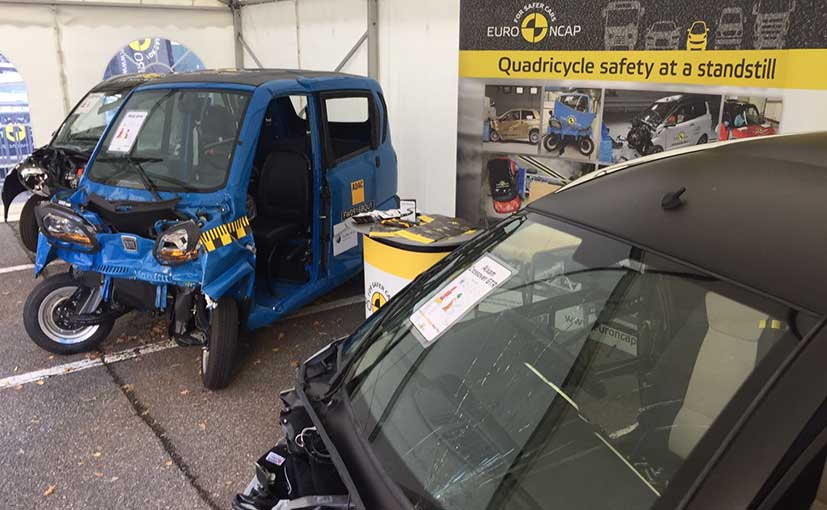
- Crash tests of quadricycles have exposed critical safety problems
- Quadricycles are capable of speeds as much as 100Km/h
- Global NCAP supports Euro NCAPs recommendations for quadricycle safety
The European New Car Assessment Programme has now crash tested eight quadricyles in two phases in 2014 and again this year. The results reveal structural and seat belt failures, direct head contact and excessive chest loadings that risk fatal or serious injury. All life threatening issues that would prevent a passenger car from being sold in Europe. Even more worrying is that Euro NCAP's frontal test was less severe than the one used for cars. The impact was 50 km/h rather than 64 km/h and full width into the barrier rather than 40%. Despite this easier test all the quadricycles tested showed poor levels of safety.
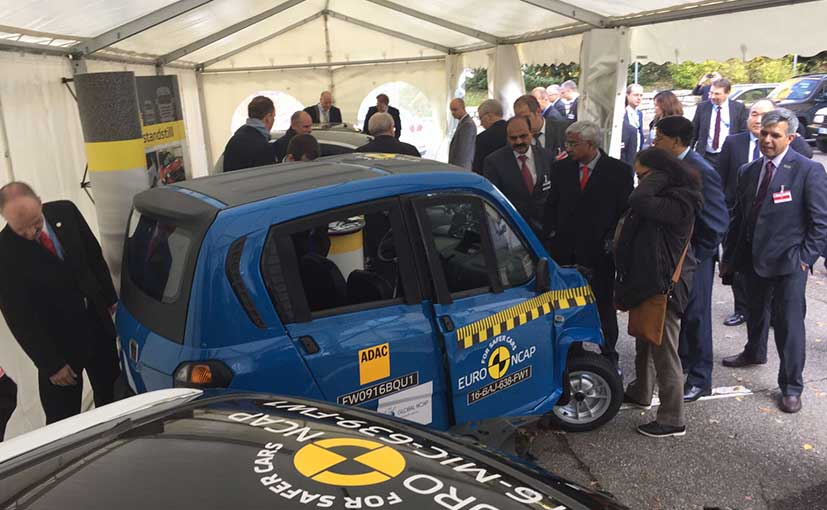
Bajaj Qute Crash Test
In response Euro NCAP is now recommending that all quadricycles should as a minimum include adequate body shell strength that can support the mandatory use of air bags and three-point seat belts; anything less than this exposes the occupants to a high risk of fatal or serious injury. This week Euro NCAP took their message to the UN's World Forum for Harmonisation of Vehicle Regulations which meets in Palais des Nations in Geneva. Some of the crash tested quadricycles were displayed there and Euro NCAP's Secretary General, Michiel van Ratingen briefed government delegates and vehicle safety experts on the need for better safety standards for this class of vehicles.
Included in the display was an Indian made quadricycle the Bajaj Qute which is sold in Europe but not yet permitted for sale in India. That is why the quadricycle issue is also subject to lively debate in India too. From October next year India will be applying crash test standards to passenger cars and the open issue is what kind of safety requirements should now be considered for quadricycles before they are allowed on India's roads.
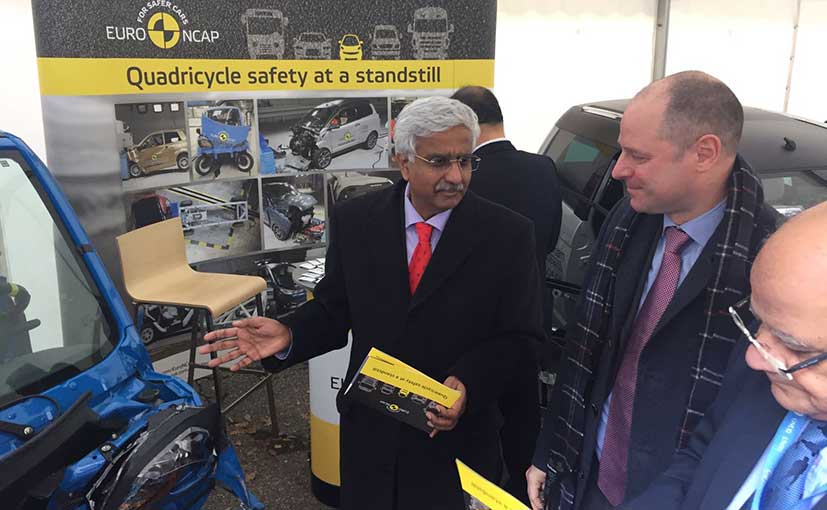
Bajaj Qute Euro NCAP Crash Test
Global NCAP, which works with NCAPs around the world, fully supports Euro NCAP's recommended improvements to quadricycle safety. These vehicles are for all intents and purposes small cars and should offer comparable levels of safety. Improvements to body shell strength and the fitment of an airbag are not that expensive and would make a huge difference to reducing the risk of fatal or serious injury. The best way forward, we believe is to develop a global standard for quadricycle safety through the United Nations vehicle regulatory system. This has the advantage that a new standard could be applied across the world and such harmonisation serves to increase market potential, boosting economies of scale, reducing costs and promoting safety.
It is also significant that in April the UN General Assembly, with the support of the Indian Government, adopted an important resolution on road safety which, inter alia, recommended that all Member States "ensure that all new motor vehicles meet applicable minimum regulations for the protection of occupants and other road users, with seat belts, airbags and active safety systems fitted as standard equipment". This is the UN's strongest ever commitment to motor vehicle safety and is applicable to both quadricyles and passenger cars.
Senior Indian Government officials participate in the UN's vehicle standards body and were present this week in Geneva to hear Euro NCAP's presentation and view the crash tested quadricycles. For India there is a real opportunity here both to promote safety but also to support Prime Minister's Modi's 'Made in India' campaign. The Bajaj Qute is not the worst performing quadricycle and with modifications Euro NCAP believes it could do much better.
So here is the chance for India to demonstrate global leadership by promoting a new standard for quadricycle safety at the UN. This would help overcome the poor safety performance of the quadricycles already sold in Europe and provide a pathway for their introduction on the market in India. Action like this would be the catalyst for a new generation of safer quadricycles which Indian companies like Bajaj could then successfully sell both at home and abroad. It could be India's winning formula for quadricycle safety.
Note: Global NCAP is the international platform for co-operation among New Car Assessment Programmes (NCAP). It is a UK registered charity, has consultative status with the United Nation's Economic and Social Committee, and participates in meetings of the World Forum for Harmonisation of Vehicle Regulations.
(David Ward is Secretary General of the Global New Car Assessment Programme)
Disclaimer: The opinions expressed within this article are the personal opinions of the author. The facts and opinions appearing in the article do not reflect the views of NDTV and NDTV does not assume any responsibility or liability for the same.
Related News


Research More on Bajaj Qute


Popular Bajaj Models

Latest Cars


Upcoming Cars


Latest News


 car&bike Team | Jun 30, 2026Delhi EV Policy 2.0: New Petrol Two-Wheeler Registration Banned in Delhi from April 2028With Delhi's new EV policy approved, new financial incentives for buyers will be introduced while setting a clear roadmap towards an all-electric future for new vehicle registrations.1 min read
 car&bike Team | Jun 30, 2026Tata Sierra EV: Variants, Features, Prices ExplainedThe Sierra EV is offered in six variants and two battery pack options.1 min read
 Hansaj Kukreti | Jun 30, 20262026 Tata Sierra EV: In PicturesThe much-awaited Tata Sierra has finally been launched in its all-electric avatar. Let's take a closer look at it.3 mins read
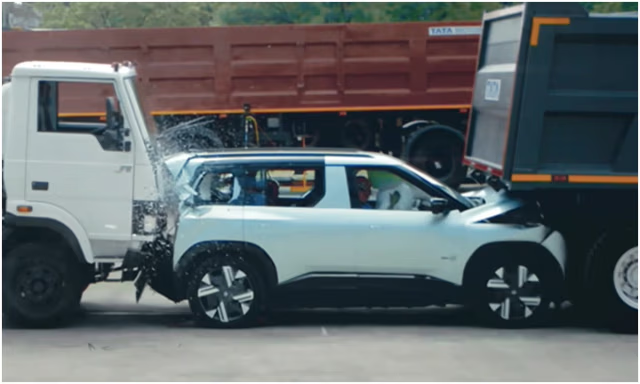 Amaan Ahmed | Jun 30, 2026Tata Sierra EV Sandwiched Between Two Trucks In Novel Crash Test: Watch VideoNobody saw Tata's latest crash test coming -- not even the Sierra EV it was conducted on2 mins read
 Jaiveer Mehra | Jun 30, 2026Tata Sierra EV Launched In India At Rs 18.79 Lakh: 5 Variants, 63 & 75 kWh Battery Options, 500+ km RangeElectric derivative of the Sierra is based on the Acti.ev+ platform and is offers over 500 km of range in real-world use.4 mins read
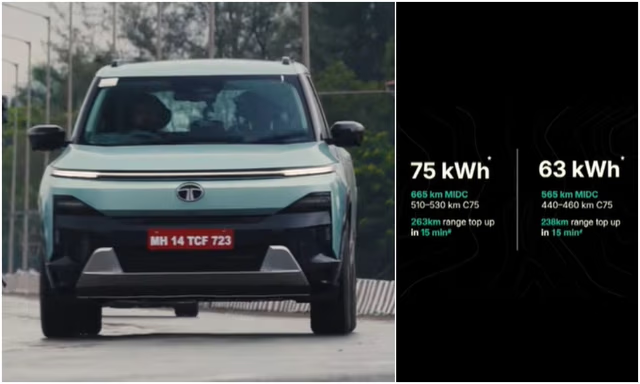 Amaan Ahmed | Jun 30, 2026Tata Sierra EV Real-World (C75) Range Figures RevealedUnlike what you may have seen on social media in recent days, the Sierra EV will not cover 700 kilometres, not even on the forgiving Indian Driving Cycle test2 mins read
 Seshan Vijayraghvan | Jun 29, 2026Renault Kiger vs Toyota Urban Cruiser Taisor: Which Underdog Deserves Your Money?Both the Kiger and the Taisor promise strong performance, solid features, comfortable cabins and everyday usability, all without breaking the bank. But which of these underrated subcompact SUVs deserves your money? Let's find out.1 min read
 Seshan Vijayraghvan | Jun 29, 2026Skoda Kodiaq RS Review: The Best Kodiaq Yet?The Skoda Kodiaq RS is finally here, and it's every bit as exciting as I expected. But was it worth the wait?7 mins read
 Bilal Firfiray | Jun 28, 2026BMW X6 M60i Review: It’s Back And HOW!The BMW X6 M60i blends a 530bhp twin-turbo V8, with its unmistakable coupe-SUV styling. There’s plenty of character, but is it worth your money?6 mins read
 Janak Sorap | Jun 25, 2026350cc Bajaj Dominar 400 Review: Same Character, Lower PriceA slightly lower displacement engine, a significantly lower price tag and nearly the same performance — the Bajaj Dominar 400 aims to be smarter rather than faster.6 mins read
 Preetam Bora | Jun 25, 20262026 Bajaj Pulsar NS400Z First Ride Review: Smaller Engine, But Should You Buy It?The Bajaj Pulsar NS400Z won our Two-Wheeler Upgrade of the Year. Then new tax slabs happened. Smaller engine, same badge – but does it still deliver?6 mins read