
Nissan's Electric Car Hopes Fading Away?

Nissan boss Carlos Ghosn is preparing to cut battery manufacturing, people familiar with the matter said, in a new reversal on electric cars that has reopened deep divisions with alliance partner Renault. The plan, which faces stiff resistance within the Japanese carmaker, would see U.S. and British production phased out and a reduced output of next-generation batteries concentrated at its domestic plant, two alliance sources told Reuters.
In what may also prove a politically sensitive blow to Japan Inc., Nissan would follow Renault by taking cheaper batteries from South Korea's LG Chem for some future vehicles, including models made in China. "We set out to be a leader in battery manufacturing but it turned out to be less competitive than we'd wanted," said one executive on condition of anonymity. "We're still between six months and a year behind LG in price-performance terms."
A decision on the Nissan battery plants in Sunderland, England, and Smyrna, Tennessee, is due next month, the sources said, following a tense procurement review with 43.4 percent shareholder Renault, the smaller but senior partner in their 15-year-old alliance.
"Renault would clearly prefer to go further down the LG sourcing route, and the Nissan engineers would obviously prefer to stay in-house," another insider said. "The write-off costs are potentially huge." Renault-Nissan "remains 100-percent committed to its industry-leading electric vehicle program" and has no plans to write down battery investments, spokeswoman Rachel Konrad said. "We have not taken any decision whatsoever to modify battery sourcing allocation," Konrad said, adding that the alliance "does not confirm or deny procurement reviews."
But Nissan is already negotiating with manufacturing partner NEC Corp. on the shift to dual sourcing, with Chief Executive Ghosn's backing, the sources said. Nissan currently makes all its own electric car batteries.
One option being explored would see LG, which supplies some Renault models, invest in its own battery production at one of the overseas Nissan plants as the carmaker halts operations at the sites. The alliance is also in talks with LG on a deal to supply batteries for future Renault and Nissan electric models in China, one of the sources added.
NEC and LG declined to comment.
Under Ghosn, who heads both companies, Renault-Nissan bet more on electric cars than any mainstream competitor, pledging in 2009 to invest 4 billion euros ($5.2 billion) to build models including the Nissan Leaf compact and as many as 500,000 batteries per year to power them.
Nissan and NEC invested 23 billion yen ($215 million) in their Zama, Japan battery plant and electrode manufacturing, backed by government aid. U.S. and British taxpayers also helped with the $1 billion invested in Tennessee and 210 million pounds ($341 million) in Sunderland.
But the mass consumer was largely unmoved - or deterred by the sluggish rollout of recharging networks - despite generous sales incentives in key markets.
Global electric car sales will remain shy of 1 million in 2020, according to forecaster IHS Automotive, less than one percent of the total vehicle market, and one-tenth of the demand Ghosn had predicted.
"Renault-Nissan were definitely ahead of their time - in a bad way," said Stuart Pearson, an Exane BNP analyst. "There's nothing wrong with ambition, but when that involves excess investment then it's also a risk," he said. "Their targets were really excessive on volume and battery capacity."
The alliance has begun a belated push into faster-selling hybrids, combining electric and combustion-engine propulsion. Upscale electric rivals such as Tesla's Model S meanwhile hog the limelight, backed by big investments in newer, cheaper battery technologies.
INTERNAL RIVALRIES
Ghosn dropped extra battery sites planned for both alliance carmakers, leaving Nissan with the entire production capacity of 220,000 power packs through the NEC joint venture, AESC. But that still far exceeds the 67,000 electric cars Renault-Nissan sold last year, and even the 176,000 registered to date. A pledge to reach 1.5 million by 2016 has been scrapped.
The coming hybrids will fill some of the excess plant capacity, although they use fewer power cells per vehicle. An all-electric Tesla rival is still planned for Nissan's premium Infiniti brand in 2018 with batteries as big as 60 kilowatt-hours (kWh), more than twice the energy capacity of the Leaf, which is due for replacement the previous year.
Nissan is seeking to unwind a ruinous NEC contract that requires it to purchase electrodes for the full capacity of 220,000 Leaf-sized 24 kWh batteries regardless of actual sales, sources said. The joint venture partner's consent is also needed to bring LG production or other activities onto the Tennessee or Sunderland sites, which together employ 500 workers.
The financial hit for Nissan "will depend on what else we can do with the plants", with heavy charges likely if both are closed, one manager added.
Renault has already taken at least one writedown of 85 million euros on its over-investment in electric cars following the collapse of Better Place, a charging startup that had ordered 100,000 of its battery-powered Fluence sedans.
The Nissan procurement shift could still be thwarted by capacity-cutting costs including repayment of U.S. and British government support. Next-generation battery manufacturing at Zama would also likely need fresh Japanese aid to compete with LG and its subsidies from Seoul, sources said.
Navigating the battery backtrack is a key test for CEO Ghosn as he demands closer Renault-Nissan integration from executives mandated to pursue savings across the alliance.
For Nissan, the plant cuts would be a partial retreat from the automotive battery market - expected to top $20 billion by 2020 - just as California-based Tesla builds its $5 billion "Gigafactory" with Panasonic (6752.T) in Nevada.
Japanese engineers are still smarting from Renault's 2010 move to drop Nissan batteries and purchase LG for its flagship Zoe model, worsening the overcapacity problem.
"It was a 15-20 percent cost gap," said one of the people involved in the Renault decision. "In purchasing, 3-4 percent is usually enough to choose a partner for."
Today's Nissan batteries come in at $270 per kWh, based on replacement prices thought to be below cost, according to consulting firm AlixPartners. The true manufacturing cost is believed to be over $300, inflated by the amortization of unused plant capacity and the burdensome electrodes deal.
The next generation will have lithium nickel manganese cobalt oxide (NMC) cathodes, as used by LG, rather than the current lithium manganese oxide (LMO) chemistry. The alliance cost target is $200/kWh, whether made or bought, sources said.
With a clean slate and sufficient volume, Nissan engineers insist, their next generation of batteries could be competitive on price as well as keeping crucial know-how at the company.
"When you're developing cutting-edge technology, the best way to know about that technology is to build it in-house," said one. "That's what Tesla is doing."
Many of the past missteps can be traced to internal rivalries of the kind Ghosn is only now moving to stamp out.
Former Nissan second-in-command Carlos Tavares, racing to beat the Renault Zoe to market, cut Leaf development by a year and skipped a critical battery redesign, according to alliance veterans. Nissan later cut prices, settled a class action and offered retroactive warranties to answer customer concerns about battery deterioration. Tavares now heads PSA Peugeot Citroen.
His Renault archrival at the time, Patrick Pelata, signed a confidentiality deal with LG that meant Nissan battery engineers never even knew what they were up against.
Against that backdrop, the atmosphere may be charged when Nissan engineering boss Hideyuki Sakamoto puts final arguments against the outsourcing plan in a presentation to Ghosn as soon as this week.
But the CEO's mind may be all but made up.
"We're in the process of opening up battery sourcing to a range of suppliers," Ghosn said last week when asked whether Renault could buy batteries from France's Bollor.
In future some batteries will likely be outsourced "within the framework of alliance procurement", he added. "What's important to us is that electric car performance fully meets customer expectations."
(Additional reporting by Yoko Kubota in Tokyo and Gilles Guillaume in Paris; Editing by Mark Potter)
Related News


Popular Nissan Models


Latest Cars


Upcoming Cars


Latest News


 car&bike Team | Jun 29, 2026Delhi EV Policy Approved: Electric Cars Under Rs 30 Lakh To Get Full Tax ExemptionThe new policy offers purchase incentives and scrappage benefits while laying down a roadmap for EV-only registrations across several vehicle segments, including two-wheelers from 2028.2 mins read
 car&bike Team | Jun 29, 2026New-Gen BMW X5 Teased Ahead Of Global Debut TomorrowThe teaser previews a fresh X-shaped lighting signature in a familiar illuminated grille setup.3 mins read
 car&bike Team | Jun 29, 2026Tata Sierra EV Launch Tomorrow: What To Expect?The Sierra EV is expected to share much of its package with the Harrier EV.3 mins read
 Jaiveer Mehra | Jun 28, 2026Nissan Tekton Spied Undisguised Ahead Of July 9 DebutSole image of the SUV showcases the rear design of the SUV.1 min read
 Carandbike Team | Jun 28, 2026Renault Kwid Facelift India Launch On July 3Latest facelift marks the second major update for the entry hatchback since its launch in 2015.1 min read
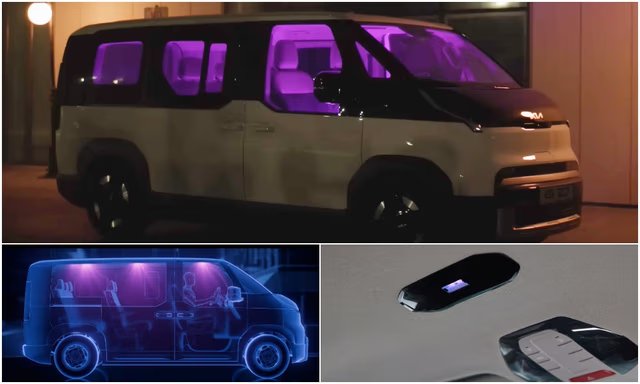 Amaan Ahmed | Jun 27, 2026Future Hyundai, Kia Cars May Feature In-Built UVC SanitiserHyundai Motor Group has unveiled 'Plasma Care UVC' technology, which utilises plasma lamps to safely and effectively destroy bacteria and viruses present inside a car.1 min read
 Seshan Vijayraghvan | Jun 29, 2026Renault Kiger vs Toyota Urban Cruiser Taisor: Which Underdog Deserves Your Money?Both the Kiger and the Taisor promise strong performance, solid features, comfortable cabins and everyday usability, all without breaking the bank. But which of these underrated subcompact SUVs deserves your money? Let's find out.1 min read
 Seshan Vijayraghvan | Jun 29, 2026Skoda Kodiaq RS Review: The Best Kodiaq Yet?The Skoda Kodiaq RS is finally here, and it's every bit as exciting as I expected. But was it worth the wait?7 mins read
 Bilal Firfiray | Jun 28, 2026BMW X6 M60i Review: It’s Back And HOW!The BMW X6 M60i blends a 530bhp twin-turbo V8, with its unmistakable coupe-SUV styling. There’s plenty of character, but is it worth your money?6 mins read
 Janak Sorap | Jun 25, 2026350cc Bajaj Dominar 400 Review: Same Character, Lower PriceA slightly lower displacement engine, a significantly lower price tag and nearly the same performance — the Bajaj Dominar 400 aims to be smarter rather than faster.6 mins read
 Preetam Bora | Jun 25, 20262026 Bajaj Pulsar NS400Z First Ride Review: Smaller Engine, But Should You Buy It?The Bajaj Pulsar NS400Z won our Two-Wheeler Upgrade of the Year. Then new tax slabs happened. Smaller engine, same badge – but does it still deliver?6 mins read