
Toyota Cuts Output Target Amid Chip Crunch As Profit Tumbles 25%

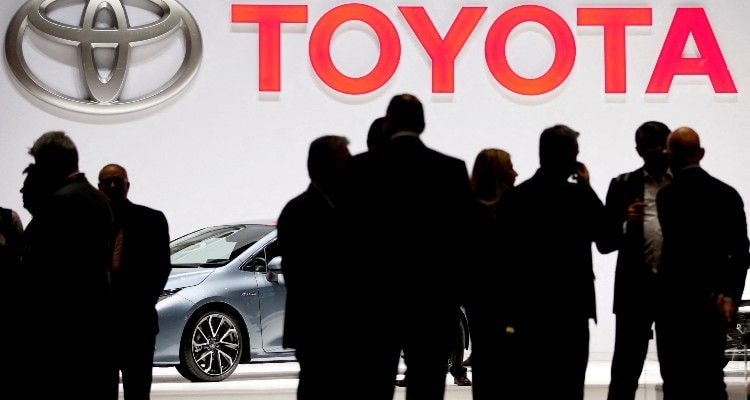
Toyota Motor Corp on Tuesday posted a worse-than-expected 25% drop in quarterly profit and cut its annual output target, as the Japanese firm battles surging material costs and a persistent semiconductor shortage. The world's biggest automaker by sales also warned that it remained difficult to predict the future after posting its fourth consecutive quarterly profit decline, underlining the strength of business headwinds it faces. During the coronavirus pandemic, Toyota fared better than most car makers in managing supply chains, but it fell victim to the prolonged chip shortage this year, cutting monthly production targets repeatedly.
"We're out of the worst phase, but ... it's not necessarily a situation where we're fully supplied," said Kazunari Kumakura, Toyota's purchasing group chief. "I don't know when the chip shortage will be resolved."
Operating profit for the three months ended September fell to 562.7 billion yen ($3.79 billion), well short of an average estimate of 772.2 billion yen in a poll of 12 analysts by Refinitiv. Toyota sales reported a 749.9 billion yen profit a year earlier, and 578.6 billion yen in profit in the first quarter.
Kumakura said the global auto chip shortage continues, as chipmakers have prioritised supplies for electronics goods such as smartphones and computers, while natural disasters, COVID lockdowns and factory disruption have slowed a recovery in auto chip supplies.
He also said the supply of older-type semiconductors, that attract little capital investment currently, would remain tight.
Amid the gloom, shares in Toyota closed down 1.9%, versus a 0.3% rise in the Nikkei average.
'VERY UNIMPRESSIVE'
Some analysts were underwhelmed by the performance, saying other positive factors beyond the chip shortage should have provided a boost.
"The yen is weaker in the second quarter, the volume in the second quarter is much higher than in the first quarter, and the (COVID) lockdown in China does not affect (the volume in the second quarter)," said Koji Endo, an analyst at SBI Securities.
"Considering these points ... the absolute amount of profit in the second quarter has got to be higher than that of the first quarter. It is very unimpressive."
Production rebounded by 30% in the quarter, but the company warned last week shortages of semiconductors and other components would continue to constrain output in coming months.
Toyota said it now expects to produce 9.2 million vehicles this fiscal year, down from the previously forecast 9.7 million but still ahead of last financial year's production of about 8.6 million units.
Reuters reported last month Toyota had told several suppliers it was setting a global target for the current business year to 9.5 million vehicles and signalled that forecast could be lowered, depending on the supply of electromagnetic steel sheets.
MUTED YEN IMPACT
The yen has plunged around 30% this year against the U.S. dollar, but the benefit of the cheap yen - making sales overseas worth more - has been offset by soaring input costs.
The weak yen boosted profit by 565 billion yen in the first half of this financial year, but the gain was more than wiped out by 765 billion yen increase in material costs, with the cheap local currency further inflating import costs, Toyota said.
Toyota retained its conservative profit outlook, sticking to its full-year operating forecast of 2.4 trillion yen for the fiscal year through March 31 - well below analysts' average forecast of 3.0 trillion yen.
By comparison, South Korea's Hyundai Motor raised its revenue and profit margin guidance last month to reflect a foreign exchange lift.
Toyota, once a darling of environmentalists for its hybrid gasoline-electric models, is also under scrutiny from green investors and activists over its slow push into fully electric vehicles (EV).
Just a year into its $38 billion EV plan, Toyota is already considering rebooting it to better compete in a market growing beyond its projections, Reuters reported last month.
In a reputational hit, Toyota had to recall earlier this year its first mass-produced all-electric vehicle after just two months on the market due to safety concerns, and suspend production. It restarted taking leasing orders last month for domestic market.
Toyota reiterated on Tuesday that battery-powered EVs are a powerful weapon for decarbonisation, but that there are various other options to achieve the goal.


Latest News


 car&bike Team | Aug 6, 2026Ola Electric Shifts To Dealer-Led Retail Model After Five Years Of Company-Owned StoresOla Electric has announced a strategic shift to a dealer-led retail model, while retaining its company-owned outlets as brand experience centres.2 mins read
 car&bike Team | Aug 6, 2026E3 Trion Electric Scooter Launched In India At 1 LakhAvailable in three variants, the scooter's biggest talking point is its AI-backed software ecosystem, which promises to monitor the health of the scooter.3 mins read
 car&bike Team | Aug 6, 2026Production-Spec Royal Enfield Himalayan 750 Spotted Testing Ahead Of Global DebutRoyal Enfield's upcoming Himalayan 750 has been spotted testing in near-production form in the UK, ahead of its expected debut at EICMA 2026.2 mins read
 Jafar Rizvi | Aug 6, 2026Audi Confirms New Q3 For India This Year; A5, Q9 To Arrive By 2027Audi has confirmed three new launches for India by 2027. The Q3 is expected to debut around the festive season, followed by the A5 and Q9 in 2027.3 mins read
 Sarthak Mahajan | Aug 6, 2026Tata Nexon Camo Edition Launched At Rs 9.99 LakhAvailable in petrol, diesel, and CNG variants; prices start at Rs 9.99 lakh.2 mins read
 car&bike Team | Aug 6, 2026SIAM Downplays Letter To Govt Citing Chloride-Related Concerns In E20 PetrolThe original letter cited increased cases for part replacements in cars and SUVs due to high chloride-related wear or corrosion while a second letter shared with the public said that the data still required to be authenticated.1 min read
 Bilal Firfiray | Aug 1, 2026Toyota Hilux Review: The InvincibleMarking it as the ninth generation, the Hilux comes with a major cosmetic overhaul. But is it still relevant enough for the current times or is it getting too long in the tooth?5 mins read
 Bilal Firfiray | Jul 30, 2026Kia Syros EV Review: Best EV To Buy Under Rs 20 Lakh?The Kia Syros EV comes into the game with a modern design, spacious cabin, strong performance, decent range and an aggressive pricing. But could it become the new benchmark under Rs 20 lakh?5 mins read
 Jaiveer Mehra | Jul 27, 20262026 Maruti Suzuki Brezza Facelift Review: Bestseller Joins The Turbo ClubWhile Maruti’s facelifts have always tended to bring subtle updates over the outgoing models, the latest Brezza brings some heavy updates under the skin, including a new 6-speed manual gearbox and, for the first time, a turbocharged petrol engine option.1 min read
 Bilal Firfiray | Jul 24, 2026Honda ZR-V Review: Who Is It For?Honda has brought the new ZR-V to India as their current flagship offering. It’s a CBU, it’s a hybrid, and it’s here for a limited few. Who is it for though?1 min read
 Girish Karkera | Jul 29, 2026Mercedes-AMG E53 4MATIC+ PHEV First Drive Review: Just What The Doctor OrderedThere are luxury cars and there are high-performance cars. But what if you want both for the price of one? Mercedes-Benz has a recommendation that promises to tread a fine line between the two – the second generation E53 with a twist.7 mins read