
Toyota Plans To Expand Production, Shrink Cost Of Hydrogen Fuel Cell Vehicles


- Toyota wants to make low-cost, mass-market hydrogen fule cell cars & SUVs
- Toyota believes hydrogen will become a key source of clean energy
- Next-gen Toyota Mirai FCV will come in 2020
Toyota Motor Corp is doubling down on its investment in hydrogen fuel cell vehicles, designing lower-cost, mass-market passenger cars and SUVs and pushing the technology into buses and trucks to build economies of scale.
As Toyota cranks up improvements for the next generation of its Mirai hydrogen fuel cell vehicle (FCV), expected in the early 2020s, it is hoping it can prove wrong rival automakers and industry experts who have mostly dismissed such plans as commercially unviable.
The maker of the Prius, the world's first mass-produced "eco-friendly" gasoline-hybrid car in the 1990s, says it can popularize FCVs in part by making them cheaper.
Also Read: Fuel Cell Powered Toyota Mirai For India, Company Assessing Feasibility
"We're going to shift from limited production to mass production, reduce the amount of expensive materials like platinum used in FCV components, and make the system more compact and powerful," Yoshikazu Tanaka, chief engineer of the Mirai, said in an interview with Reuters.
It is planning a phased introduction of other FCV models, including a range of SUVs, pick-up trucks, and commercial trucks beginning around 2025, a source with knowledge of the automaker's plans said.
The automaker declined to comment on specific future product plans. But it has developed FCV prototypes of small delivery vehicles and large transport trucks based on models already on the road, as Tesla Inc develops a battery-operated commercial semi-truck from the ground up.
"We're going to use as many parts from existing passenger cars and other models as possible in fuel cell trucks," said Ikuo Ota, manager of new business planning for fuel cell projects at Toyota. "Otherwise, we won't see the benefits of mass production."
The company is also betting on improved performance. Toyota wants to push the driving range of the next Mirai to 700-750 kilometers from around 500 kilometers, and to hit 1,000 kilometers by 2025, a separate source said.
Driven by the belief that hydrogen will become a key source of clean energy in the next 100 years, Toyota has been developing FCVs since the early 1990s.
Hydrogen is the most abundant element in the universe and stores more energy than a battery of equivalent weight.
The Mirai was the world's first production FCV when it was launched in 2014. But its high cost, around $60,000 before government incentives, and lack of refueling infrastructure have limited its appeal. Fewer than 6,000 have been sold globally.
LMC Automotive forecasts FCVs to make up only 0.2 percent of global passenger car sales in 2027, compared with 11.7 percent for battery EVs. The International Energy Agency predicts fewer FCVs than battery-powered and plug-in hybrid electric vehicles through 2040.
Many automakers, including Nissan Motor Co and Tesla, see battery-powered cars as a better, zero-emission solution to gasoline engines. Only a handful, including Honda Motor Co and Hyundai Motor Co, produce FCVs.
But people familiar with Toyota's plans said the automaker thinks demand will perk up as more countries, including China, warm to fuel cell technology. The company also sees FCVs as a hedge against a scarcity of key EV battery materials such as cobalt.
HAND BUILT
For now, Mirais are assembled by hand at a plant in Toyota City, where 13 technicians push partially constructed units into assembly bays for detailed inspections. This process yields just 6.5 cars a day, a sliver of Toyota's average domestic daily production of about 13,400 vehicles.
Strategic Analysis Inc, which has analyzed costs of FCVs including the Mirai, estimates that it costs Toyota about $11,000 to produce each of its fuel cell stacks, by far the vehicles' most expensive part.
Toyota has been building up production capacity to change that, as it expects global FCV sales climb to 30,000 units annually after 2020 from about 3,000. Strategic Analysis estimates that would allow Toyota to reduce costs to about $8,000 per stack.
It has already begun to use parts developed for the Mirai in other models, such as the fuel cell stack, which is used in Kenworth freight trucks being tested in California, the Sora FC bus it released in Japan in March and the delivery trucks it will test with Seven-Eleven stores in Japan next year.
"It will be difficult for Toyota to lower FCV production costs if it only produces the Mirai," the first source told Reuters on condition of anonymity as he was not authorized to speak publicly about the issue.
"By using the FCV system in larger models, it is looking to lower costs by mass-producing and using common parts across vehicle classes," he added.
The Mirai's high production costs are largely due to expensive materials including platinum, titanium and carbon fiber used in the fuel cell and hydrogen storage systems.
Engineers have been reducing that by improving the platinum catalyst, a key component in the 370 layered cells in the fuel cell stack, which facilitates the reaction between hydrogen and oxygen that produces electricity.
"We've been able to decrease the platinum loading by 10 percent to 20 percent and deliver the same performance," said Eri Ichikawa, a fuel cell engineer at Cataler Corp, a Toyota subsidiary that specializes in catalytic converters.
Strategic Analysis says using that much less of the precious metal would save up to $300 per fuel cell stack, based on an estimate that Toyota now uses about 30 grams of platinum per unit.
"By consistently focusing on these issues, we will be able to progressively lower the cost of FCVs in the future," Tanaka said.
(This story has not been edited by NDTV staff and is auto-generated from a syndicated feed.)
Related News


Popular Toyota Models


Latest Cars


Upcoming Cars


Latest News


 car&bike Team | Jul 22, 2026Bajaj Pulsar 125-160 cc Range To Be UpdatedOver the next six weeks, Bajaj Auto is planning to introduce 10 “substantially new motorcycles” in the 125 cc and 160 cc Pulsar segments.1 min read
 Amaan Ahmed | Jul 22, 2026Range Rover GT Debuts As All-Electric Fastback Ahead Of World PremiereFifth member of the Range Rover family is JLR's take on a coupe-SUV; will debut in BEV form later this year.1 min read
 car&bike Team | Jul 21, 2026Maruti Suzuki To Hike Prices By Up To Rs 30,000 In August 2026This marks the second price hike in three months for the company, which previously increased prices in June.1 min read
 car&bike Team | Jul 21, 2026Reise Launches Traverse Adventure Touring Suit In India; Prices Start At ₹14,999Reise has introduced the Traverse Adventure Touring Suit, a premium riding gear set designed for long-distance touring and off-road adventures.1 min read
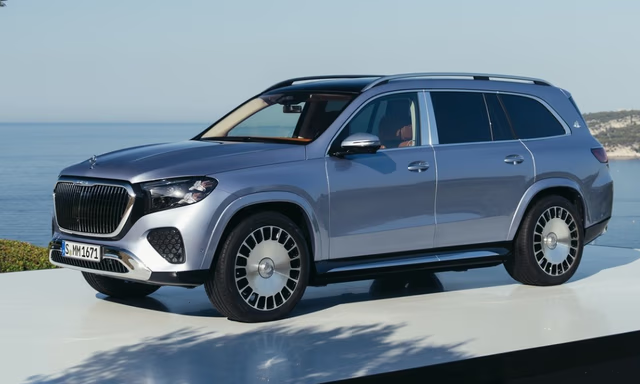 Jaiveer Mehra | Jul 21, 2026Mercedes-Maybach GLS Facelift Revealed With Updated Tech, More Powerful V8Upgrades to the Maybach GLS look to focus on improving the in-cabin experience.1 min read
 car&bike Team | Jul 21, 2026Mahindra Scorpio Classic Prices Hiked By Up To Rs 40,000Mahindra has begun rolling out its latest price revision across the lineup, with the Scorpio Classic becoming up to Rs 40,000 more expensive1 min read
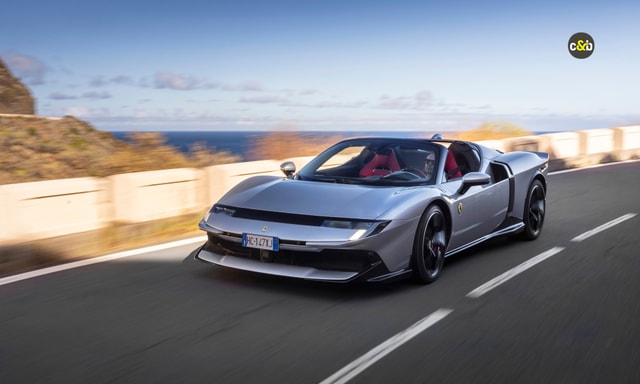 Shams Raza Naqvi | Jul 15, 2026Ferrari 849 Testarossa Spider Driven: Rs. 11.25 Crore Meets 1,000 bhpWe got behind the wheel of the most powerful convertible from Ferrari. What makes the 849 Testarossa Spider Special? We tell you.1 min read
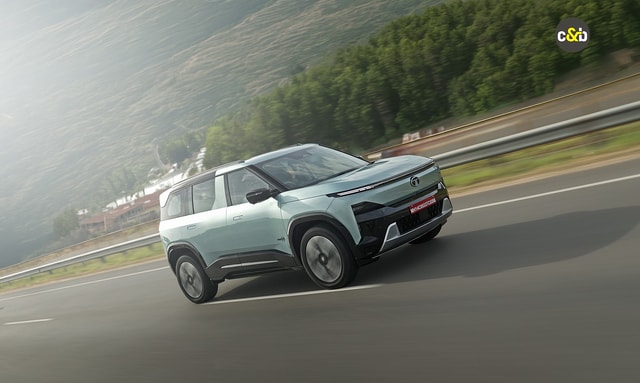 Bilal Firfiray | Jul 12, 2026Tata Sierra EV Review: Reborn In The Electric AgeThe Tata Sierra EV isn’t drastically different from its ICE counterpart when it comes to design. But being the seventh electric offering from the Indian brand, it has gotten a few things right, and very few things wrong. But is it a compelling package to buy?5 mins read
 Jafar Rizvi | Jul 13, 2026TVS Orbiter Long-Term Review (Report 1): Settling In Takes TimeFirst impressions weren't the strongest, but the Orbiter has made a mark in its first month in the car&bike garage.5 mins read
 Seshan Vijayraghvan | Jul 7, 2026Tata Altroz Petrol DCA Long-Term Review: Intercity & Highway Driving ReportWe tested the Tata Altroz Petro DCA’s highway manners, intercity performance, and real-world fuel efficiency.1 min read
 Seshan Vijayraghvan | Jun 29, 2026Renault Kiger vs Toyota Urban Cruiser Taisor: Which Underdog Deserves Your Money?Both the Kiger and the Taisor promise strong performance, solid features, comfortable cabins and everyday usability, all without breaking the bank. But which of these underrated subcompact SUVs deserves your money? Let's find out.1 min read