
The Evolution Of Honda City: How A Mid-Size Sedan Became An Indian Icon

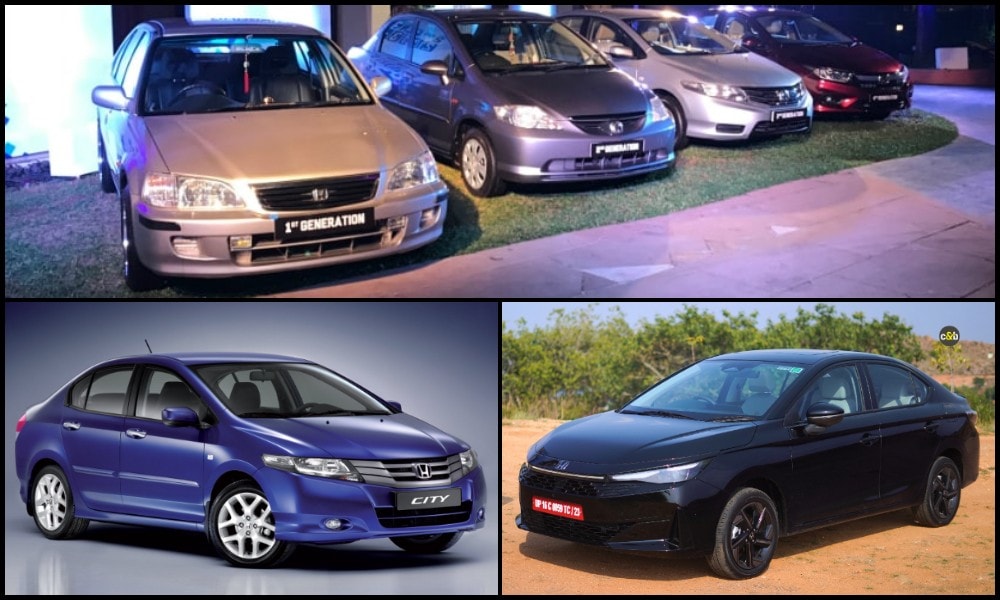
- Honda City has been on sale in India since 1998 and has evolved through five generations
- It introduced iconic engines like VTEC and later brought diesel, hybrid and ADAS technology
- The latest Honda City continues with a significant update introduced in May 2026
Owning a Honda City back in the early 2000s meant something. It was not the priciest sedan, but it provided a smooth petrol engine, premium build quality, and a driving experience that few rivals could beat. It was the first time that many Indian families experienced a premium sedan.
Also Read: Honda City vs Hyundai Verna vs Volkswagen Virtus vs Skoda Slavia
The market has totally changed over the years. Diesel vehicles were popular but fell out of favour, SUVs took over sales charts and consumers began to demand bigger screens, infotainment and safety systems. Today, all of these bits are available in the Honda City, without eliminating the qualities that made the vehicle a success in the first place.
The Honda City has also crossed the 9 lakh sales mark in India, and it is the brand’s most recognised car in the country.
First-Generation Honda City (1998-2003)
The first Honda City came to India in 1998 and was quite different from most sedans available in the country at that time. It was small and light and had a level of refinement that soon became Honda's greatest asset.
This was also the first Honda for many buyers and it helped cement the brand's reputation for quality petrol engines and build quality.
Also Read: The Evolution of the Mahindra Scorpio: The SUV That Redefined Mahindra
The VTEC Era Begins
Initially, the City came with petrol engines, but then in the year 2000, the legendary 1.5-litre VTEC engine was introduced.
| Engine | Output |
| 1.3-litre Petrol | 87 bhp |
| 1.5-litre VTEC Petrol | 106 bhp |
The VTEC engine changed the City's image. It was easy to drive in traffic, but it got increasingly exciting with the revs up. When most budget-friendly sedans were thought to be only about what they could do, the City provided real driving enjoyment.
Type 2 Facelift
The first generation City was updated in 2000 with updated styling, interiors and the new VTEC engine. The Type 2 VTEC continues to be a popular older Honda City for fans today as well.
Second-Generation Honda City (2003-2008):
With the second-generation City, Honda took a completely different stance. The new model was designed to provide more cabin room, fuel efficiency and comfort for everyday driving. It was taller in design and was nicknamed “Dolphin City”.
Built for Everyday Driving
The second-generation City got Honda's new 1.5-litre, i-DSI petrol engine.
| Engine | Output |
| 1.5-litre i-DSI Petrol | 77 bhp |
| 1.5-litre VTEC Petrol (introduced later) | 100 bhp |
In order to achieve better combustion, which would lead to better fuel economy in normal driving conditions, the i-DSI engine had two spark plugs per cylinder.
Eventually, Honda brought back the VTEC engine after lots of buyers demanded a more powerful option, so as to offer its customers a choice between performance and efficiency.
Also Read: AWD vs 4x4: Which Setup Actually Matters For Indian Buyers?
One of the First CVTs in the Segment
This generation also introduced one of the earliest CVT automatic gearboxes in its class.
At a time when most midsize sedans were available only with manual gearboxes, the CVT made the City much easier to drive in growing city traffic. It also helped Honda establish itself as one of the first manufacturers to bring smoother automatic options to mainstream buyers.
Third-Generation Honda City (2008-2014):
The third-generation City helped the nameplate reach an even larger audience. It received a completely new design, a bigger cabin and a petrol engine that would go on to become one of Honda's most popular powertrains in India.
Many buyers still consider this generation one of the best Honda City models because it balanced performance, comfort and reliability so well.
The i-VTEC Everyone Wanted
Honda introduced a new 1.5-litre i-VTEC petrol engine that offered stronger performance without compromise on refinement.
| Engine | Output |
| 1.5-litre i-VTEC Petrol | 116 bhp, 145 Nm |
The engine was smooth throughout the rev range, making it equally comfortable during city commutes and highway drives. Buyers could choose between a 5-speed manual and a 5-speed automatic transmission, both of which became known for their reliability.
Better Looks, Better Features
The third-generation City also brought several upgrades inside the cabin.
Depending on the variant, buyers could get:
- Steering-mounted audio controls
- USB and Bluetooth connectivity
- Paddle shifters on automatic variants
- Improved infotainment system
- Better-quality interior materials
These additions helped the City stay competitive as buyers started expecting more equipment from premium sedans.
Also Read: Panoramic Sunroof vs Regular Sunroof: Understanding the Practical Difference
The 2011 Facelift
Honda refreshed the City in 2011 with a revised grille, updated bumpers, new alloy wheels and small interior improvements.
The changes were subtle, but they helped the City remain one of the strongest contenders in the midsize sedan segment before the arrival of the next generation.
Fourth-Generation Honda City (2014-2020):
By 2014, diesel cars had become the preferred choice for many Indian buyers. Honda had built a strong reputation with its petrol engines, but it still lacked a diesel option. The fourth-generation City finally changed that.
Along with a new diesel engine, Honda also gave the City a bigger cabin, more features and a stronger road presence, helping it stay ahead of newer rivals.
Honda Finally Introduced a Diesel Engine
The biggest addition was the new 1.5-litre i-DTEC diesel engine, developed specifically to meet the growing demand for fuel-efficient diesel cars.
| Engine | Output |
| 1.5-litre i-VTEC Petrol | 117 bhp, 145 Nm |
| 1.5-litre i-DTEC Diesel | 98 bhp, 200 Nm |
The diesel engine quickly became popular among buyers who travelled long distances. It combined strong pulling power with an ARAI-claimed fuel efficiency of 25.6 kmpl, making it one of the most economical sedans in its class.
The petrol version continued unchanged, giving buyers the same smooth driving experience the City had always been known for.
The City Became More Premium
Honda also upgraded the cabin with several convenience features that were becoming popular in this segment.
Depending on the variant, buyers could get:
- Electric sunroof
- Touchscreen infotainment system
- Push-button start
- Automatic climate control
- Rear parking camera
- Cruise control
These additions made the City feel far more modern without changing its familiar layout.
The 2017 Facelift
Honda refreshed the fourth-generation City in 2017 with a revised grille, updated bumpers, LED headlamps on higher variants and additional equipment.
The update helped the City remain competitive against newer rivals without making major mechanical changes.
Also Read: New Maruti Suzuki Swift vs Hyundai i20: Which Hatchback Holds Better Resale Value After Three Years?
Honda's Unique Two-City Strategy (2020-2023)
When Honda introduced the fifth-generation City in 2020, it became larger, better equipped and noticeably more premium.
Instead of replacing the older model immediately, Honda continued selling the fourth-generation City alongside the new one. It was a rare strategy in the Indian market.
The fifth-generation City targeted buyers looking for a premium midsize sedan, while the older model remained available in selected variants as a more affordable option for customers who simply wanted a dependable Honda City.
This approach continued until 2023, when the fourth-generation City was discontinued following the introduction of BS6 Phase 2 emission norms.
Fifth-Generation Honda City (2020-Present):
The fifth-generation City built on everything buyers already liked while adding more space, new technology and improved safety. It also introduced the first strong hybrid powertrain ever offered on a Honda City in India.
More Space for Everyone
Honda increased the City's overall size, making it one of the largest sedans in the segment.
| Dimension | Fifth-Generation Honda City |
| Length | 4,549 mm |
| Wheelbase | 2,600 mm |
| Boot Space | 506 litres |
The longer wheelbase translated into better rear-seat comfort, something the City has always been known for.
Also Read: 5 Best Discontinued Cars You Can Still Buy Used In India
Petrol Continues, Hybrid Joins the Line-up
Honda retained its trusted 1.5-litre petrol engine while introducing the City e:HEV strong hybrid in 2022.
| Engine | Output | Transmission |
| 1.5-litre i-VTEC Petrol | 119 bhp, 145 Nm | 6-speed Manual / CVT |
| 1.5-litre e:HEV Strong Hybrid | 124 bhp (combined) | e-CVT |
The hybrid system can drive on electric power alone at low speeds before automatically switching between the petrol engine and electric motors whenever required. Since the battery charges while driving, owners never have to plug the car in.
For buyers looking for better fuel efficiency without changing their driving habits, the e:HEV became a practical alternative after diesel disappeared from the lineup.
Honda Sensing Arrives
The fifth-generation City also became one of the first cars in its segment to offer Level 2 ADAS through Honda Sensing.
Higher variants include:
- Collision Mitigation Braking System (CMBS)
- Adaptive Cruise Control
- Lane Keep Assist
- Road Departure Mitigation
- Auto High Beam
These features add another layer of safety, particularly during long highway drives.
2026 Facelift Keeps the City Competitive
Instead of introducing an all-new generation, Honda updated the City in May 2026 with a sharper design and more equipment while keeping the existing engines and platform unchanged.
The update focused mainly on features that buyers had been asking for.
Some of the key changes include:
- Connected LED light bar across the front
- Larger honeycomb grille
- Revised front and rear bumpers
- New dual-tone alloy wheels
- Larger 10.1-inch touchscreen infotainment system
- Ventilated front seats
- 360-degree camera
Mechanically, nothing changes. The City continues with the same 1.5-litre i-VTEC petrol engine and the e:HEV strong hybrid.
From VTEC to ADAS (Honda Sensing): Safety Has Come a Long Way
The Honda City has changed just as much in terms of safety as it has in performance and technology.
The earliest models focused mainly on refinement and driving dynamics. As safety standards improved, Honda strengthened the body structure, added more airbags and introduced several active safety features.
The latest Honda City now offers:
- Six airbags
- Vehicle Stability Assist (VSA)
- Hill Start Assist
- ABS with EBD
- ISOFIX child-seat mounts
- Honda Sensing Level 2 ADAS (higher variants)
The current-generation City has also earned a 5-star ASEAN NCAP safety rating, making it the safest Honda City yet.
Also Read: Mahindra XUV Through the Years: From the XUV500 to the XUV700 and XUV 7XO
Why the Honda City Still Stands Out
The midsize sedan segment is smaller than it used to be, but the Honda City continues to attract buyers for the same reasons it always has.
Every generation improved the car without moving away from its biggest strengths. It remains comfortable to drive, spacious for passengers and known for dependable petrol engines.
Even today, buyers continue to choose the City for:
- Refined petrol and hybrid powertrains
- Comfortable rear-seat experience
- Smooth highway performance
- Strong reliability
- Good resale value
- Honda's trusted ownership experience
The City has now crossed 9 lakh cumulative sales in India, making it one of Honda's most successful models in the country.
Honda City: A Sedan That Grew Up With India
The Honda City has changed a lot since it first arrived in India in 1998. Every generation brought something meaningful, whether it was the iconic VTEC engine, the introduction of diesel, the first strong hybrid powertrain or advanced driver assistance features.
The latest model continues that journey with better technology, higher safety standards and the recent 2026 update. Even in today's SUV-dominated market, the Honda City remains one of the most trustworthy nameplates in the midsize sedan segment for everyday driving as well as long highway journeys.
Related News


Learn more about


Popular Models


Latest Cars


Upcoming Cars


Latest News


 Sarthak Mahajan | Sep 27, 2026Tata Aeris CNG vs Hyundai Aura CNG: Engines, Features And Prices ComparedThe Hyundai Aura CNG is available only with a manual transmission, while the Tata Aeris CNG gets both manual and AMT options.3 mins read
 Sarthak Mahajan | Sep 27, 2026Suzuki Presents Technological Strategy, Aims For 4 Million-Unit Annual Capacity in India by FY2030Suzuki Motor Corporation has highlighted its technology strategy for the next decade, with India continuing to play a key role in its global manufacturing and technology plans.1 min read
 Jafar Rizvi | Sep 26, 2026Tata Aeris vs Maruti Suzuki Dzire: Specifications, Features, Prices ComparedThe Tata Aeris undercuts the Maruti Dzire on price while offering more power, a larger touchscreen and several additional features.3 mins read
 Jafar Rizvi | Sep 26, 2026Tigor To Soldier On As Tata Xpres For Fleet BuyersThe Tigor will live on as the Xpres for fleet operators, while Tata reserves the new Aeris exclusively for private buyers.3 mins read
 Jafar Rizvi | Sep 25, 2026Renault Duster Hybrid India Launch On October 17The hybrid will become the third powertrain option in the line-up, joining the existing 1.0-litre and 1.3-litre turbo-petrol engines.2 mins read
 Sarthak Mahajan | Sep 25, 2026Tata Aeris: In PicturesThe Tata Aeris brings a major update to the long-running Tigor as its replacement.4 mins read
 Girish Karkera | Sep 26, 2026Mahindra Thar OG Review: An Ode To The Past But Aimed At The FutureOn the surface, the new Mahindra Thar OG might look like a facelift, but that is more than meets the eye.7 mins read
 Bilal Firfiray | Sep 19, 2026MG Hector Tomahawk EV Review: Play It SafeMG’s new electric SUV has one of the coolest names ever, and the coolest temperament amongst its peers. But is it worth buying?7 mins read
 Preetam Bora | Sep 16, 2026Royal Enfield Himalayan 440 Review: Better Than the 450?The new Himalayan 440 with an upsized engine and gearbox has certainly improved as a touring machine and at an extremely attractive price of Rs. 2.29 Lakh. Is it the better Himalayan to choose for many riders?9 mins read
 Seshan Vijayraghvan | Sep 15, 2026BMW i5 LWB Review: Not The M60, This Is The Proper Electric 5 SeriesThe BMW i5 LWB takes the electric 5 Series formula and puts a stronger focus on rear-seat comfort and long-distance luxury. With a 669 km claimed range, 268 bhp and a more relaxed character, is this the i5 that makes the most sense for India?7 mins read
 Preetam Bora | Sep 14, 2026Ladakh Uncharted: Himalayan Basecamp Off-Road Ride ExperienceA day-long off-road excursion from Royal Enfield’s Himalayan Basecamp event in Ladakh, the Ladakh Uncharted ride by Alpinestars was all about re-discovery!6 mins read