
2020 Lamborghini Huracan Evo Vs 2014 Huracan: What Are The Changes


The 2020 Lamborghini Huracan Evo made its global debut late year and has finally been launched in India at a price of Rs. 3.73 crore (ex-showroom). This is only the second time the car has been showcased globally, after being showcasing the same in Bahrain earlier this year. The Huracan Evo is the facelifted version of the two-door supercar as it reaches the halfway point of its life cycle. On the surface, the Huracan Evo may not appear to get much changes, but the upgrades are extensive and include new styling, more features, improved aerodynamics and more power on the Ferrari 488 GTB rival. Here's a look at all the changes the 2020 Lamborghini Huracan Evo gets over the older Huracan.
Also Read: Lamborghini Huracan Evo Launched In India

The Lamborghini Huracan Evo is the first model from the company to drop LP from its name
First Lamborghini To Drop LP From Its Name
The 2020 Lamborghini Huracan Evo is the first car from the Italian automaker to not wear the LP name in its title. Ardent fans of the supercar maker will know that Lambo has always added LP to the name of its car, and was in fact, seen on the previous model - Huracan LP610-4. The practice of using the designation has been going for decades, but was done in a bid to increase brand recognition and claim international naming rights, especially in newer markets like China. The LP moniker stands for "Longitudinal Posterior", with Longitudinal signifying how the engine has been placed in the car (nose to tail), and Posterior indicates its position which is behind the driver. The numbers that follow is the power output on the car, with 2 or 4 denoting whether the car is All-Wheel Drive or Rear Wheel Drive.

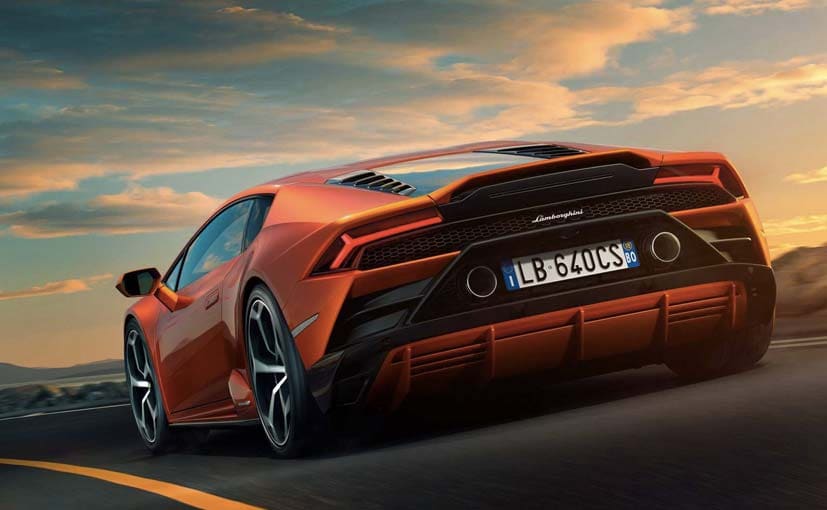
The Huracan Evo gets an updated rear with a new diffuser, dual exhaust ports and rear lip spoiler
Improved Aerodynamics
The Lamborghini Huracan Evo gets several upgrades to ascertain its aerodynamic prowess. The front bumper has been revised with larger air intakes that improves aerodynamic efficiency via the front slitter and integrated wing. The aero competency has been further improved with the underbody, which has been shaped to maximise aerodynamic efficiency. Inspired from the Huracan Performante, the new Evo gets the twin exhaust outlets positioned high up in the car's rear bumper, while the upper end of the tail features an integrated, slotted spoiler providing enhanced air flow. Lamborghini says the revised styling on the Evo has further improved the downforce by seven times and overall aerodynamic efficiency by five times over the previous version of the Huracan. The improved aerodynamics have also helped achieve 16 per cen more engine cooling.
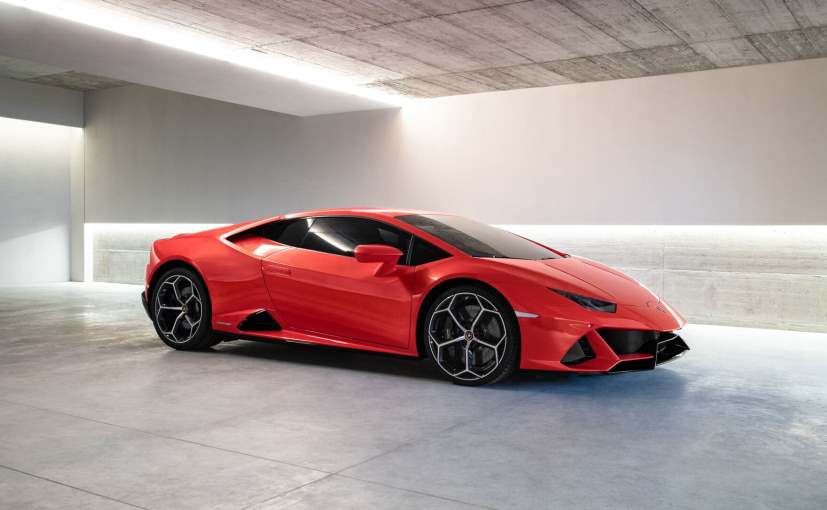
The Lambirghini Huracan Evo gets the new Arancio Xanto paint scheme with 20-inch Aesir alloy wheels
Revised Styling
The styling upgrades on the Lamborghini Huracan Evo are subtle but bring noticeable changes to the two-door coupe. The Evo is showcased in the new Arancio Xanto four-layer paint scheme, while there are new 20-inch Aesir alloy wheels wrapped in Pirelli P Zero tyres. The supercar also comes with new front and rear bumpers, fresh side skirts and new air intakes and an integrated front splitter. The rear diffuser and integrated spoiler better balances the downforce and drag, while the high-mounted exhaust system exist from either side of the number plate. Inside, the Huracan Evo gets new specific Alcantara and leather trim options with the new Arancio Dryope trim matching the new colour option.

The Huracan Evo gets a boost of 29 bhp and 40 Nm of peak torque over the predecessor
Same Engine, More Power
Following on from the Nurburgring record-holding Huracan Performante, the new Lamborghini Huracan Evo now benefits from the same power output. The powertrain remains the saem 5.2-litre naturally-aspirated V10 engine that is now tuned to produce 631 bhp and 600 Nm of peak torque. The motor has received a power boost of 29 bhp and 40 Nm over the predecessor, which means that 0-100 kmph is now achieved in a time of 2.9 seconds, 0.3s lesser than the pre-facelift version. Meanwhile, 0-200 kmph comes up in 9 seconds. The top speed remains unchanged at 323.5 kmph. With a dry weight of 1422 kg, the Huracan Evo reaches a weight-to-power ratio of 2.22 kg/hp.
Lambo's new LDVI processing unit on the Evo allows the chassis to be tailored to the driver's preferences
More Electronic Aids
The Huracan Evo retains its four-wheel drive system, but is complemented by a host of chassis upgrades. There's the new all-wheel steering system and four-wheel torque vectoring, as well as Lamborghini's new Dinamica Veicolo Integrata (LDVI) central processing unit, allowing the chassis to be tailored to the driver's preferences. The Lamborghini Piattaforma Inerziale (LPI), which is a comprehensive set of accelerators and gyroscope sensors placed at the car's centre of gravity, has been updated to version 2.0; and monitors in real-time the dynamic vehicle attitude in lateral, longitudinal and vertical acclerations, as well as roll, pitch and yaw rate.
The magnetorheological suspension has also been upgraded to version 2.0 and adapts the damping following inputs from the LPI. The car also gets enhanced torque vectoring in the all-wheel-drive system that allows traction to be directed through any of the four wheels, while the automaker has also worked on the dynamic steering system to provide higher responsiveness in corners while requiring the lowest steering angles.

The Huracan Evo gets the new 8.4-inch touchscreen infotainment system adding more features to the car
New Features
The new Huracan Evo will be trimmed in a blend of Alcantara and leather. It will also receive a new 8.4-inch infotainment system with Apple CarPlay, sat-nav and internet radio. A more advanced voice command system also makes it to the Huracan Evo, borrowed from the Aventador. New features also include a dual-camera telemetry system with a high-capacity hard disk. Lamborghini has increased the range of personalisation options on the Huracan that include new wheels, colours, upholstery options and style packs. Customers can also opt for lightweight interior materials including forged composits and a patented carbon skin, at an additional cost of course.
Also Read: Lamborghini Huracan Evo: Top 5 Features

The 2020 Lamborghini Huracan Evo is priced at Rs. 3.73 crore (ex-showroom) in India
Price
The Lamborghini Huracan was originally launched in India in 2014 at a price tag of Rs. 3.43 crore. While we've seen several special editions make their way to India over the years, the Huracan Evo is the comprehensively updated version of the supercar and is priced at Rs. 3.73 crore (all prices, ex-showroom).
Related News


Latest Cars


Upcoming Cars


Latest News


 Jaiveer Mehra | Aug 12, 2026Yokohama India Launches New Geolandar X-CV SUV TyresNew variant of the Geolandar series is EV-compatible and offers better grip and longer life compared to conventional tyres.1 min read
 car&bike Team | Aug 12, 2026Mercedes-Benz Introduces India’s First AI-Powered Vehicle Scanner In MumbaiMercedes-Benz has launched India’s first AI-powered vehicle scanner in Mumbai, alongside its largest sales & service facility and Service Select programme for older cars.1 min read
 Sarthak Mahajan | Aug 12, 2026Yamaha R2 Pre-Bookings Commence For Rs.10,000Pre-bookings for the upcoming Yamaha R2 are now open for Rs. 10,000. The highly-anticipated R2 will be launched on August 27, 2026, when prices and specifications will be announced.1 min read
 Sarthak Mahajan | Aug 12, 20262026 Hyundai Exter Knight Edition Launched: Prices Start At Rs 8.13 LakhThe Exter Knight Edition will be available across the HX 6 MT, HX 6 AMT, HX 6 CNG and HX 10 Petrol AMT variants.1 min read
 Sarthak Mahajan | Aug 12, 2026Mahindra Scorpio-N Pick-Up Teased; Unveiling Slated For 14 AugustMahindra has teased the upcoming Scorpio-N Pick-Up, which will be based on the existing Scorpio-N but offered in a pick-up body style.1 min read
 Sarthak Mahajan | Aug 11, 2026PM E-Drive EV Subsidy Extended To March 2028; Incentive For E2Ws Cut To Rs 5,000Even with the extension, incentives for electric two-wheelers have been reduced to Rs 5,000 per vehicle.1 min read
 Preetam Bora | Aug 12, 2026Royal Enfield Himalayan 440 Custom Review: Beating RE to the PunchDelhi-based custom motorcycle shop TNT Motorcycles introduces packages to convert existing Himalayan 411 adventure bikes to Himalayan 440. Is it worth the expense?8 mins read
 Seshan Vijayraghvan | Aug 11, 20262026 Nissan Tekton 700 km Review: Can It Conquer The Himalayas?We drove the newly launched Nissan Tekton from Chandigarh all the way up to Leh, covering over 700 km with the new SUV. From exploring the Tekton’s capabilities in the Himalayas to setting an India Book Record, here’s how the trip unfolded.1 min read
 Preetam Bora | Aug 11, 20262026 Aprilia Tuono 457 Special Edition First Ride Review: Should You Buy It?The 2026 Aprilia Tuono 457 delivers an engaging, everyday riding experience with strong performance. At its price point, the Tuono 457 is a brilliant motorcycle, but not quite the complete package. Why is that, and should you still buy it? Read on.8 mins read
 Bilal Firfiray | Aug 1, 2026Toyota Hilux Review: The InvincibleMarking it as the ninth generation, the Hilux comes with a major cosmetic overhaul. But is it still relevant enough for the current times or is it getting too long in the tooth?5 mins read
 Bilal Firfiray | Jul 30, 2026Kia Syros EV Review: Best EV To Buy Under Rs 20 Lakh?The Kia Syros EV comes into the game with a modern design, spacious cabin, strong performance, decent range and an aggressive pricing. But could it become the new benchmark under Rs 20 lakh?5 mins read