
New Kia Seltos vs Maruti Suzuki Victoris: Dimensions, Engines, Features Compared

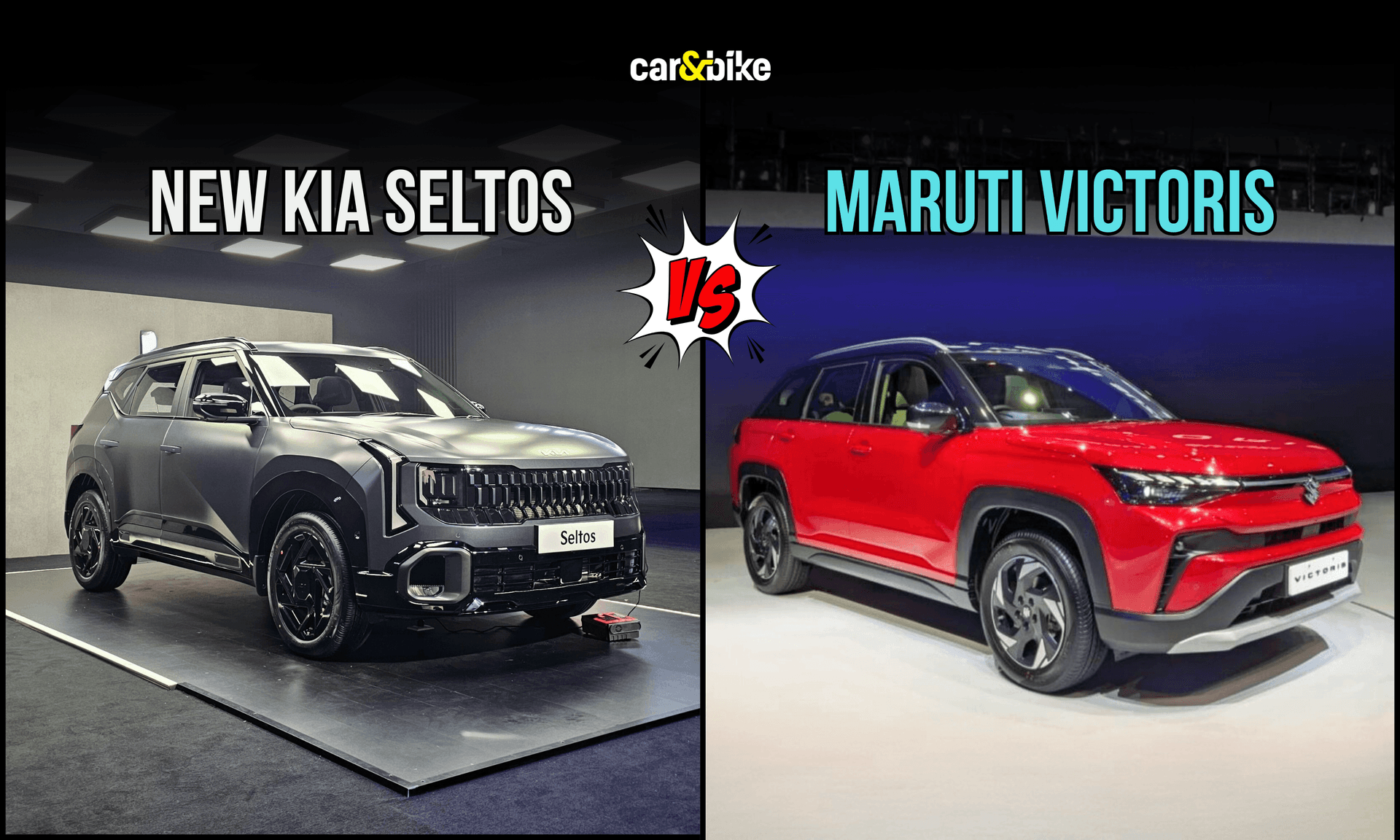
- Seltos is larger overall while the Victoris offers slightly more height
- Kia provides more engine performance; Victoris counters with hybrid efficiency and AWD option
- Both SUVs get Level 2 ADAS but differ in screen layout and cabin tech
The second-generation Kia Seltos is finally here, and it looks quite different from the model it will eventually replace once launched on January 2, 2026. It’s a bit larger, wears Kia’s updated design language, and gets a refreshed cabin layout with a few new touches. Powertrain options remain the same, but the overall look of the compact SUV has undergone a radical change, both inside and out. Here is how it compares to the new contender from Maruti, the Victoris, on paper.
Also Read: 2026 Kia Seltos Makes Global Debut; India Launch On January 2, 2026
New Kia Seltos vs Maruti Suzuki Victoris: Dimensions
| Kia Seltos | Maruti Victoris | |
| Length | 4460 mm | 4360 mm |
| Width | 1830 mm | 1795 mm |
| Height | 1635 mm | 1655 mm |
| Wheelbase | 2690 mm | 2600 mm |
| Boot Space | 447 litres | 439 litres |
The new Kia Seltos is noticeably larger than the Maruti Suzuki Victoris in proportions. At 4,460 mm, the Seltos is 100 mm longer, and its width of 1,830 mm gives it a 35 mm advantage. The Victoris, however, stands slightly taller at 1,655 mm compared to the Seltos’ 1,635 mm. The Kia also offers a longer wheelbase at 2,690 mm – 90 mm more than the Victoris’ 2,600 mm – which should translate to better cabin space. Boot capacity is marginally higher in the Seltos as well, at 447 litres versus the Victoris’ 439 litres.
Also Read: All-New Kia Seltos Unveiled: A Detailed Look In Pictures
New Kia Seltos vs Maruti Suzuki Victoris: Engine, Gearbox & Drivetrain
| Kia Seltos | Maruti Victoris | |
| Engine | 1.5 NA petrol | 1.5 turbo-petrol | 1.5 diesel | 1.5 NA petrol | 1.5 petrol-CNG | 1.5 NA petrol (strong hybrid) |
| Power | 112 bhp | 157 bhp | 114 bhp | 102 bhp | 99 bhp/87 bhp | 91 bhp |
| Torque | 144 Nm | 253 Nm | 250 Nm | 139 Nm | 137/122 Nm | 122 Nm |
| Gearbox | 6 MT/IVT | 6-iMT/7-DCT | 6-MT/6-AT | 5-MT/6-AT | 5-MT | e-CVT |
| Drivetrain | 2WD | 2WD/AWD | 2WD | 2WD |
The Kia Seltos – though it carries forward its engine options – holds a clear lead in outright performance, offering more power and torque than any of the Maruti Suzuki Victoris’ engine options. Its turbo-petrol unit in particular produces noticeably higher output than the Victoris’ naturally aspirated, CNG, and strong-hybrid setups. Even the Seltos’ naturally aspirated petrol and diesel engines punch out stronger figures than the equivalent 1.5-litre petrol units in the Victoris.
The gearbox options offered by both carmakers on their compact SUVs also differ. The Seltos offers a wider mix of manuals, automatics, an iMT, and a 7-speed dual-clutch transmission, while the Victoris sticks to a simpler spread of 5-MT, 6-AT, and e-CVT (hybrid) combinations. Both SUVs use front-wheel drive as standard, though the Victoris additionally offers an all-wheel-drive (Maruti's all-Grip Select) configuration, which is not available on the Seltos.
New Kia Seltos vs Maruti Suzuki Victoris: Features
Looking at the top-spec variants, both SUVs come packed with similar features, though each carmaker follows its own when it comes to screen layout and in-car tech. The Victoris gets a 10.1-inch touchscreen that sits separately from its 10.1-inch digital driver display, giving the dashboard a dual-screen look.
The Seltos is equipped with flush-fitting door handles, while the Victoris gets pull-type door handles. LED lighting is offered on both models.
Also Read: Kia Carens Clavis EV True Range Tested: Claimed vs Real!
The new Seltos, meanwhile, continues with the familiar single-panel setup but steps things up with 12.3-inch displays for both the infotainment system and instrument cluster, along with a small secondary screen for the AC controls, similar to what Kia offers on the Syros.
The Victoris’ features list includes wireless Apple CarPlay and Android Auto, an 8-speaker Dolby Atmos sound system, ventilated front seats, 64-colour ambient lighting, connected car tech, an 8-way powered driver’s seat, and a heads-up display.
The Seltos keeps most of its existing equipment but brings along upgrades of its own, such as a 10-way powered driver’s seat with memory, a head-up display and a relaxation function for the driver’s seat, along with dual-zone climate control. However, it is the Victoris that gets a gesture-operated tailgate, which is missing on the Seltos.
Both SUVs offer Level 2 ADAS in their fully loaded variants. Standard safety equipment on the Victoris includes six airbags, ESP, hill-hold assist, ABS with EBD, rear parking sensors, and three-point seatbelts with reminders for all seats. The Seltos includes all of these as well, while also adding all-wheel disc brakes, a rear-view camera with guidelines, brake assist, and a few other safety aids depending on the variant.
Related News


Latest Cars


Upcoming Cars


Latest News


 car&bike Team | Sep 12, 2026New Hero Dual-Sport Motorcycle Spotted: Impulse 160 Incoming?A production-ready Hero dual-sport motorcycle has been spotted without camouflage.2 mins read
 car&bike Team | Sep 12, 2026Hero Glamour X 125 Gains ABS; Priced At Rs 1.01 LakhABS with integrated IBS is claimed to be segment-first on the Glamour X 125.2 mins read
 car&bike Team | Sep 12, 2026New Maruti Suzuki Wagon R Spotted TestingThe Wagon R was last updated in 2025 with six airbags as standard and has largely remained the same ever since the third-gen model was launched.2 mins read
 car&bike Team | Sep 12, 2026BMW F 450 GS Prices Hiked By Up To Rs 30,000BMW Motorrad has raised F 450 GS prices by Rs 25,000-30,000 in India, with the GS Trophy now costing Rs 5.60 lakh {ex-showroom).2 mins read
 car&bike Team | Sep 11, 2026Royal Enfield Himalayan 440 Accessory Prices AnnouncedPrices for the accessories start at Rs 730 and go up to Rs 29,250.1 min read
 Jafar Rizvi | Sep 11, 2026BMW 7 Series, i7 Facelift Launched In India: Prices Start At Rs 1.95 CroreThe facelifted 7 Series and i7 will be locally assembled at BMW Group’s Chennai plant, making India only the second country after Germany to produce the i7.5 mins read
 Janak Sorap | Sep 12, 2026New Bajaj Pulsar 125 First Ride Review: More Tech, Less Weight, Same Pulsar DNAThe new Bajaj Pulsar 125 retains the familiar Pulsar identity but gets a new engine, lighter construction, more features and a sharper riding experience.5 mins read
 Bilal Firfiray | Sep 10, 2026Mahindra XEV 9S Review: 3 Reasons To Buy It, And 3 Reasons To AvoidEveryone keeps telling me that the Mahindra XEV 9S is not the electric XUV 7XO. I disagree.1 min read
 Abhishek Nigam | Sep 12, 2026New Bajaj Pulsar 150 Review: Is The New Pulsar, Pulsar Enough?The new Pulsar 150 gets a major mechanical and technological makeover, but does it retain the easy-going performance, familiar character and hooligan streak that made the original an icon? We ride the latest iteration to find out.8 mins read
 Shams Raza Naqvi | Sep 8, 20262026 Maruti Suzuki Baleno Review: Heart Matters, Or Does It?The updated Maruti Suzuki Baleno is here and it gets some significant changes some of which have got the opinion divided. We drive it.7 mins read
 Abhishek Nigam | Sep 7, 2026Simple Wave First Ride Review: Space, Pace And More SpaceThe Simple Wave is here to rewrite the rules of the family EV scooter segment. We scoot around to tell you whether it will create waves or not!7 mins read