
U.S. Agency Upgrades Tesla Autopilot Safety Probe, Step Before Possible Recall

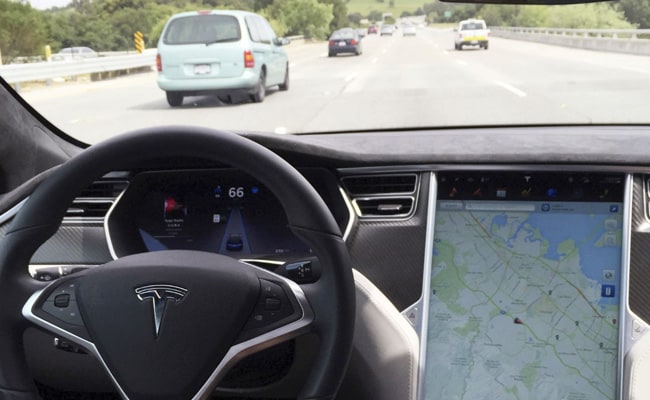
The National Highway Traffic Safety Administration (NHTSA) on Thursday said it was upgrading its probe into 830,000 Tesla vehicles with its advanced driver assistance system Autopilot, a required step before it could seek a recall.
The auto safety agency in August opened a preliminary evaluation to assess the performance of the system in 765,000 vehicles after about a dozen crashes in which Tesla vehicles struck stopped emergency vehicles -- and said Thursday it had identified six additional crashes.
NHTSA is upgrading its probe to an engineering analysis, which it must do before demanding a recall if deemed necessary.
The auto safety regulator is reviewing whether Tesla vehicles adequately ensure drivers are paying attention. The agency added evidence suggested drivers in most crashes under review had complied with Tesla's alert strategy that seeks to compel driver attention, raising questions about its effectiveness.
In 2020, the National Transportation Safety Board criticized Tesla's "ineffective monitoring of driver engagement" after a 2018 fatal Autopilot crash and said NHTSA had provided "scant oversight."
NHTSA said the upgrade is "to extend the existing crash analysis, evaluate additional data sets, perform vehicle evaluations, and to explore the degree to which Autopilot and associated Tesla systems may exacerbate human factors or behavioral safety risks by undermining the effectiveness of the driver's supervision."
Tesla, which has disbanded its press offices, did not respond to a request for comment.
NHTSA said it has reports of 16 crashes, including seven injury incidents and one death, involving Tesla vehicles in Autopilot that had struck stationary first-responder and road maintenance vehicles.
Democratic Senator Ed Markey praised NHTSA's upgrade. "Every day that Tesla disregards safety rules and misleads the public about its 'Autopilot" system, our roads become more dangerous," he wrote on Twitter.
NHTSA said its analysis indicated that Forward Collision Warnings activated in the majority of incidents just prior to impact and that subsequent Automatic Emergency Braking intervened in approximately half of the crashes.
"On average in these crashes, Autopilot aborted vehicle control less than one second prior to the first impact," the agency added.
NHTSA noted that "where incident video was available, the approach to the first responder scene would have been visible to the driver an average of 8 seconds leading up to impact."
The agency also reviewed 106 reported Autopilot crashes and said in approximately half, "indications existed that the driver was insufficiently responsive to the needs of the dynamic driving task."
"A driver's use or misuse of vehicle components, or operation of a vehicle in an unintended manner does not necessarily preclude a system defect," the agency said.
NHTSA also found in about a quarter of the 106 crashes, the primary crash factor appeared to relate to operating the system where Tesla says limitations may exist in places like roadways other than limited-access highways, or while in visibility environments involving factors such as rain, snow, or ice.
Tesla says Autopilot allows the vehicles to brake and steer automatically within their lanes but does not make them capable of driving themselves.
A NHTSA spokesperson said advanced driving assistance features can promote safety "by helping drivers avoid crashes and mitigate the severity of crashes that occur, but as with all technologies and equipment on motor vehicles, drivers must use them correctly and responsibly."
Last week, NHTSA said it asked Tesla to respond to questions by June 20 after it received 758 reports of unexpected brake activation tied to Autopilot in its separate investigation of 416,000 newer vehicles.
Separately, NHTSA has opened 35 special crash investigations into incidents involving Tesla vehicles, in which Autopilot or other advanced systems were suspected of use involving 14 reported deaths since 2016, including a crash that killed three last month in California.
NHTSA asked a dozen other automakers including General Motors Toyota Motor Corp and Volkswagen to answer questions on "driver engagement and attentiveness strategies" using driver assistance systems" during its Tesla probe but has not released their responses.
(This story has not been edited by NDTV staff and is auto-generated from a syndicated feed.)
Related News


Popular Tesla Models

Latest Cars


Upcoming Cars


Latest News


 car&bike Team | Aug 1, 2026India-UK FTA: Aston Martin Announces Revised PricesAlong with the revised pricing, the British marque has refreshed its lineup by replacing the Vantage, DB12 and DBX with more powerful 'S' derivatives.1 min read
 car&bike Team | Aug 1, 2026BMW 7 Series, i7 Facelift Bookings Open In India Ahead Of LaunchThe facelifted models were unveiled globally in April 2026 and are set to arrive in India.3 mins read
 car&bike Team | Aug 1, 2026Auto Sales July 2026: Growth For Tata, Mahindra And Hyundai; Nissan Jumps 218%July 2026 turned out to be a strong month for several carmakers in India. Tata Motors, Mahindra, Hyundai, MG Motor and Nissan all reported healthy year-on-year growth, with new model launches, exports and growing EV demand.4 mins read
 car&bike Team | Jul 31, 2026Hero Vida VX2 Now Available With Fixed 3.1 kWh Battery, Priced At Rs 1.13 LakhUnlike the existing removable-battery variants, the new VX2 variant comes with a fixed battery and direct-plug charging.1 min read
 car&bike Team | Jul 31, 2026Honda Cars India Appoints Toshiyuki Yanagisawa As New President And CEOYanagisawa replaces Takashi Nakajima, who is set to move to Honda's regional headquarters after completing his stint in India.1 min read
 car&bike Team | Jul 31, 2026TVS Raider Doctor Doom Edition Launched At Rs 95,320TVS has expanded its Marvel-inspired Raider 125 Super Squad lineup with a new Doctor Doom Edition.2 mins read
 Bilal Firfiray | Aug 1, 2026Toyota Hilux Review: The InvincibleMarking it as the ninth generation, the Hilux comes with a major cosmetic overhaul. But is it still relevant enough for the current times or is it getting too long in the tooth?1 min read
 Bilal Firfiray | Jul 30, 2026Kia Syros EV Review: Best EV To Buy Under Rs 20 Lakh?The Kia Syros EV comes into the game with a modern design, spacious cabin, strong performance, decent range and an aggressive pricing. But could it become the new benchmark under Rs 20 lakh?5 mins read
 Jaiveer Mehra | Jul 27, 20262026 Maruti Suzuki Brezza Facelift Review: Bestseller Joins The Turbo ClubWhile Maruti’s facelifts have always tended to bring subtle updates over the outgoing models, the latest Brezza brings some heavy updates under the skin, including a new 6-speed manual gearbox and, for the first time, a turbocharged petrol engine option.1 min read
 Bilal Firfiray | Jul 24, 2026Honda ZR-V Review: Who Is It For?Honda has brought the new ZR-V to India as their current flagship offering. It’s a CBU, it’s a hybrid, and it’s here for a limited few. Who is it for though?1 min read
 Girish Karkera | Jul 29, 2026Mercedes-AMG E53 4MATIC+ PHEV First Drive Review: Just What The Doctor OrderedThere are luxury cars and there are high-performance cars. But what if you want both for the price of one? Mercedes-Benz has a recommendation that promises to tread a fine line between the two – the second generation E53 with a twist.7 mins read