
Tata Sierra Review: India’s New Favourite?

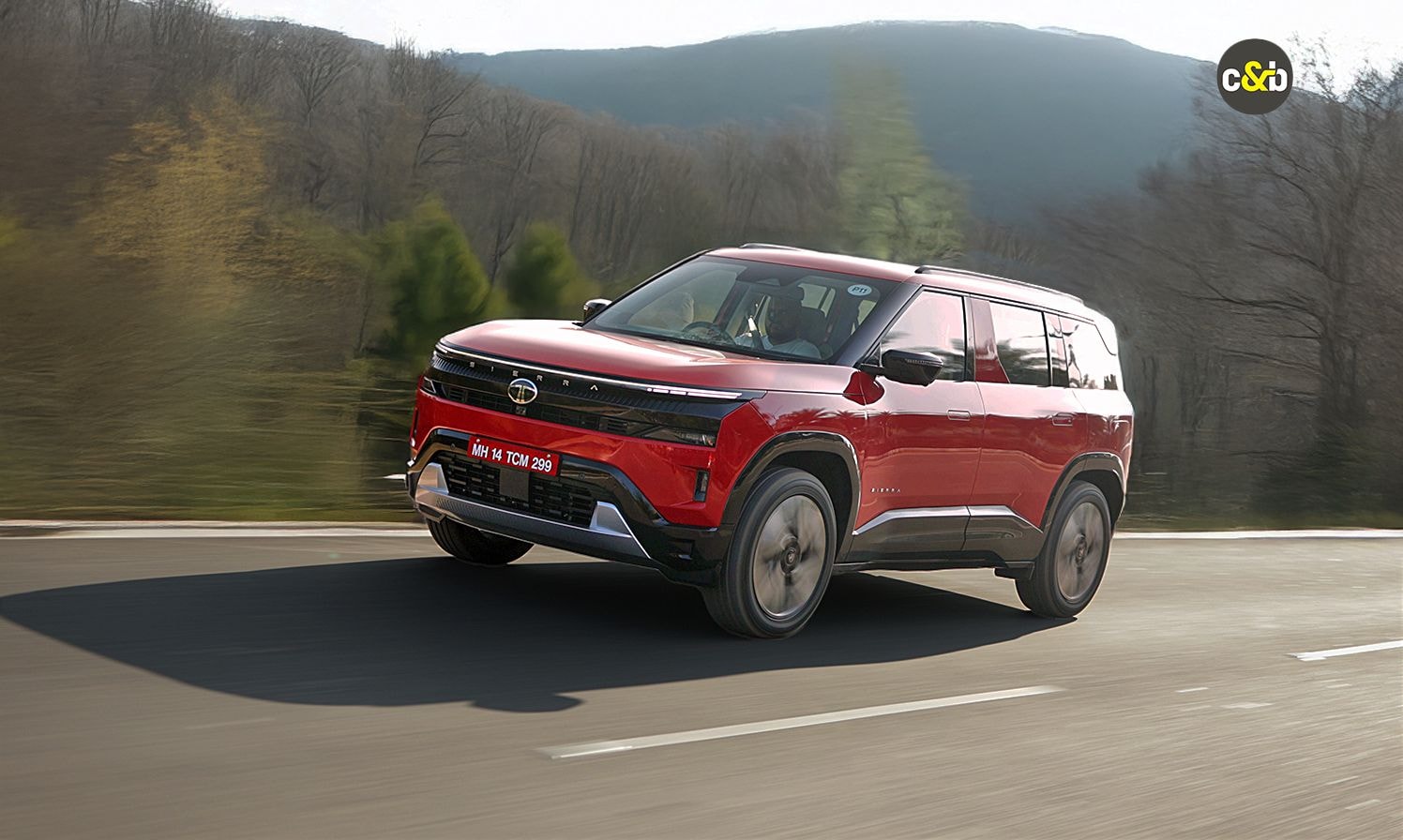
- Available with three engine options, two driven here
- Launched at Rs 11.49 lakh (ex-showroom)
- Enters the C-SUV segment with a lot of competition
Pictures by Pawan Dagia
Every now and then, there comes along a car that makes everyone simply gawk at its arrival. The reborn Tata Sierra is one such car that has taken the internet by storm. People have been waiting for the revival of this iconic nameplate, and now that the cat is out of the bag, it is garnering unwavering attention not just on social media but also on the roads. But the question is, is it worth the hype? Is it good enough to dethrone the Hyundai Creta from its position as the segment’s best-seller? Let’s find out.
Also Read: Tata Sierra Variant-Wise Prices Revealed: Check Out How Much Pure And Adventure Trims Cost
Tata Sierra Powertrain Choices
Now the Sierra enters a highly competitive C-SUV segment, which has a long list of well-established names. And to stand out in this segment, you have to offer everything and more. Which the Sierra does. There are three engine options with multiple choices for their transmissions. First up, there’s a 1.5-litre naturally aspirated four-cylinder which makes 105 bhp and 145 Nm, and it’s available with a six-speed manual and a seven-speed dual-clutch automatic. Surprising, because the 1.5-litre TGDi (turbocharged gasoline direct injection) gets a six-speed torque converter, whereas in the segment we have seen manufacturers offering a DCT only with a turbo-petrol for a sportier driving experience. Why has Tata done this?
Also Read: Tata Sierra Variant-Wise Prices Revealed: Check Out How Much Pure And Adventure Trims Cost
If you think long enough, this is a logical choice. Because the DCA dual-clutch automatic is Tata’s in-house automatic gearbox - and honestly, it’s not the sportiest dual-clutch out there. So, pairing it with a naturally aspirated engine makes sense as people will be buying it more than the TGDi, and it will keep the cost down. I say cost down because the six-speed torque converter, which is usually smoother but less sporty, is sourced from Aisin, and it will cost more, both the engine and the gearbox. And it wouldn't be fuel-efficient either.
PS: We haven’t experienced the 1.5-litre NA Revotron for this review.
Tata Sierra: Driving experience
What we are driving today is the 1.5 T-GDI petrol and the 1.5-litre diesel, both in their automatic avatars. We start with the T-GDI, which makes, on paper, 158 bhp and 255 Nm, but more importantly, at idle, it's very refined. When we started the engine in the morning, going through the cabin and the presentation inside, we had to double-check whether the engine was idling. And that's a huge compliment. There are no vibrations whatsoever that filter inside the cabin, and it's silent, which is a characteristic we usually associate with Japanese engines. Off the mark, too, it's smooth, and there are no vibrations. But before I talk about that, there's a small niggle.
You see, there's an electronic hand brake here, but no way to operate it. Confusing, right? All EPBs usually have a button instead of a lever, and it's essential when, say, you don't want to put it in Park, but in Neutral and pull in the electronic handbrake. This is a safety feature in Tata’s books. But on the downside, it takes a microsecond delay when you put it in D and get on the accelerator, and the system automatically releases the brakes, resulting in a small, unpleasant hind-squat of the Sierra.
Back to the engine, as the revs start to climb, the vibration does not kick in, and it's free revving, but only past 3,000rpm you start to hear the engine. Now, this is a direct injection unit, so it has the right amount of grunt when you put your foot down. It has the punch with strong bottom-end grunt and barely any delays. It has the potential to go fast and hit triple-digit speeds nicely and effortlessly.
When driving in and around the city, you won't have any trouble whatsoever. And when you're out doing highway speeds, there's enough grunt left in the engine because so much of it is already available lower down the rev range. Once you start to climb, it will give you a lot more punch, especially when you want to do some quick overtakes. Only past 5000 rpm, where the peak power is delivered, does it start to run out of breath. However, you don't need to go all the way there to get the best out of the engine.
Also Read: Tata Sierra vs Hyundai Creta: Specs, Features Compared
As for this torque converter, it is smooth shifting. There's barely any lag, and there's barely or non-existent jerk that you'd expect from a gear shift. Even the upshifts are nice and smooth, while the downshifting barely has any noticeable difference. So, this gearbox doesn't feel like a torque converter at all, but more like a dual-clutch transmission. And that's a compliment for this gearbox right now.
Tata Sierra: Ride And Handling
Summing up the ride and handling in one single sentence is that it is a typical Tata product. If you have driven the Harrier, Curvv or even the Nexon, this one doesn't feel out of place. And this I mean as a compliment because Tatas are made for India. The ride quality is genuinely sorted. Now we didn't find a lot of bad roads since morning, and when those occasional speed bumps or potholes come through, it manages to absorb them really well, like a typical Tata product ought to.
But the steering is not so quick, going almost three turns lock-to-lock. You have to put in a lot of input if you are trying to make some quick turn-ins. Sure, the steering is not as heavy, or the controls aren't as heavy as you find in the Harrier, but it's as good as the Nexon and the Curvv. For everyday drivability, it won't tire you out. The visibility is fabulous, too. The long flat bonnet leads the way, the A-pillars aren't very thick, the ORVM is large enough, and even the rear visibility is nice thanks to an upright tailgate.
And credit where the credit is due, to the overall ergonomics. Because of late, every new Tata product has always given me a huge reason to complain, and that complaint was the backrest height, which wasn’t tall enough, causing back pain after spending long hours. Now here, the seat it's genuinely tall and offers the right amount of support in the right places. The width it could be better, but otherwise, it’s a huge improvement, as you also get an adjustable under-thigh extender, which is a feature we usually associate with premium cars. Also, the ergonomic flaws, such as a lack of a cup holder or a lack of a place to keep your phone, have been sorted here in this new cabin.
As for the second row, there are a few things that I need to address. Firstly, getting inside is nice and easy, because of the good, wide door. And once inside, you have a decent amount of space as well. The backrest angle is a bit upright for my liking, and the two or three degrees of recline adjustment is no help. There’s a lot of space to play over here, and for three people, it might have a good shoulder room. It reminds me of older Tatas, which were more spacious on the inside, especially for the second row.
Now, the third thing that I need to point out is this B-pillar. Now, we are not usually used to seeing such a thick B-pillar, but that's done to retain the iconic design of the Sierra. But the visibility from the thick B-pillar is not that bad. The height of the windows is well-positioned – not too low, nor too high. But the thick B-pillar will only be a hindrance if you want to look forward. And the second row passenger, they are not looking forward anyway.
The panoramic sunroof makes the cabin feel more airy. Even the quality of the material used over here. You have soft-touch plastics. Even the height for a tall rear passenger shouldn't be an issue.
Tata Sierra Diesel Review
And now, let's talk about the diesel. Now, this is a 1.5-litre four-cylinder Kryojet, which is very familiar, and it makes around 115 bhp and over 250Nm. This too is a proper Tata diesel. It has good enough torque right from the word go. The low-end grunt is nice and easy. Even under 1500rpm, you can actually pull away from a traffic signal, from a uh stop sign. The load of grunt comes in handy for a quick overtaking manoeuvre. There are a few vibrations, and it's slightly noisier, but it's not as noisy as you'd associate with a 1.5-litre four-cylinder diesel that we have experienced in older cars. And this engine is nice and easy to drive with this automatic gearbox. And it will make for a good combination for long trips, as it will also be more frugal.
More importantly, the Sierra will be offered with an all-wheel drive configuration. Now, it will come in a couple of years. But the trick is that the all-wheel drive might be limited to the EV. The EV will have a QWD like the Harrier EV, as it has the platform and the system in place. But what people are waiting for is an all-wheel drive version of this derivative. Now, in my opinion, if Tata decides to get an all-wheel drive with the Siara, it must be with this engine. It has got the potential. It has got the grunt that's suitable for an all-wheel drive system. And with this gearbox and all-wheel drive would work brilliantly in the Sierra. It would be one of the few choices that will offer this combination in this segment. And that should be an upper hand for the Siara in this tough competition.
Also Read: New Tata Sierra: Variants, Features, Engine Options Explained
Conclusion
As I mentioned earlier, the Tata Sierra comes in a very competitive segment, and while it offers all the positives we come to expect from any new Tata product, it’s not perfect yet. What works for it, firstly, is that it's capitalising on its nameplate and nostalgia. So the Sierra does have a lot of people's aspirations and expectations riding on it. And it delivers that with a very refined turbo petrol engine, which is smooth but not sporty or fuel efficient. We are yet to drive the naturally aspirated version or any of the manuals, but the diesel is torquey, has good grunt and should be frugal for everyday use. Then there's the long list of features, improved ergonomics and the fantastic ride quality that takes it home.
But does the Sierra then become the best C-SUV that you can buy right now? Not yet. We are yet to see the full price list. And the competition is tough. Dethroning the Creta/Seltos as people’s favourite, offering the driving connect as the Taigun/Kushaq, or the reliability of the Elevate are some of the few tasks that might be more than what the Sierra can chew. Does the Sierra have what it takes to do it? A big yes. Will it come close to it? We will have to wait a little longer for that. Until then, it can still enjoy the popularity of its nameplate.
Related News


Research More on Tata Sierra

Popular Tata Models


Latest Cars


Upcoming Cars


Latest News


 car&bike Team | Aug 8, 2026Bugatti Destrier Revealed As One-Off Bolide-Based Hypercar With 1,578 BhpBugatti has revealed the Destrier, a one-off based on the Bolide but with a completely different design brief.3 mins read
 car&bike Team | Aug 8, 2026KTM 160 Duke, RC 160 Prices Hiked By Up To Rs 15,000KTM India has revised the prices of its entry-level motorcycles, with both the 160 Duke and RC 160 getting more expensive.1 min read
 car&bike Team | Aug 8, 2026MG Majestor SUV Prices Hiked By Rs 1.50 LakhAfter the hike, prices for the Majestor now start at Rs 42.49 lakh (ex-showroom) for both 4x2 variants.2 mins read
 car&bike Team | Aug 7, 20262026 Ducati Monster India Launch On August 10; Gets New 890cc EngineDucati is set to launch the 2026 Monster in India on August 10, bringing an updated design, new engine and revised electronics package to the premium streetfighter segment.1 min read
 car&bike Team | Aug 7, 2026New Bajaj Pulsar 150 Spotted Ahead Of LaunchThe updates point to one of the biggest overhauls the nameplate has received in years.2 mins read
 Jaiveer Mehra | Aug 7, 2026FADA Sales July 2026: Auto Sales Up By Over 25 Per Cent; Passenger Vehicle, Two-Wheelers Report Best-Ever Numbers For The MonthFADA reported sales across all segments stood at a new high for July - a first-ever.1 min read
 Bilal Firfiray | Aug 1, 2026Toyota Hilux Review: The InvincibleMarking it as the ninth generation, the Hilux comes with a major cosmetic overhaul. But is it still relevant enough for the current times or is it getting too long in the tooth?5 mins read
 Bilal Firfiray | Jul 30, 2026Kia Syros EV Review: Best EV To Buy Under Rs 20 Lakh?The Kia Syros EV comes into the game with a modern design, spacious cabin, strong performance, decent range and an aggressive pricing. But could it become the new benchmark under Rs 20 lakh?5 mins read
 Jaiveer Mehra | Jul 27, 20262026 Maruti Suzuki Brezza Facelift Review: Bestseller Joins The Turbo ClubWhile Maruti’s facelifts have always tended to bring subtle updates over the outgoing models, the latest Brezza brings some heavy updates under the skin, including a new 6-speed manual gearbox and, for the first time, a turbocharged petrol engine option.1 min read
 Bilal Firfiray | Jul 24, 2026Honda ZR-V Review: Who Is It For?Honda has brought the new ZR-V to India as their current flagship offering. It’s a CBU, it’s a hybrid, and it’s here for a limited few. Who is it for though?1 min read
 Girish Karkera | Jul 29, 2026Mercedes-AMG E53 4MATIC+ PHEV First Drive Review: Just What The Doctor OrderedThere are luxury cars and there are high-performance cars. But what if you want both for the price of one? Mercedes-Benz has a recommendation that promises to tread a fine line between the two – the second generation E53 with a twist.7 mins read