
Maruti Suzuki e-Vitara Review: Worth The Wait?

- Two battery packs – 49kWh and 61kWh
- Will be launched in January
- Competes with Creta EV, Windsor EV and Curvv EV
Some cars take their sweet time; the anticipation and wait make their arrival even sweeter. Some live up to their hype, some fizzle out that easily. And that brings us to the first all-electric car from Maruti Suzuki. It's called the e-Vitara, and we first saw it at the 2025 Bharat Mobility Expo.
With launch set to happen in January, a year after its reveal, the e-Vitara arrives in a space where there are some well-established rivals. So, is the e-Vitara worth the wait, or is it too little, too late? Let’s find out.
Maruti Suzuki E-Vitara Review: Exterior
Also Read: Maruti Suzuki e Vitara Scores 5 Stars In Bharat NCAP Crash Test
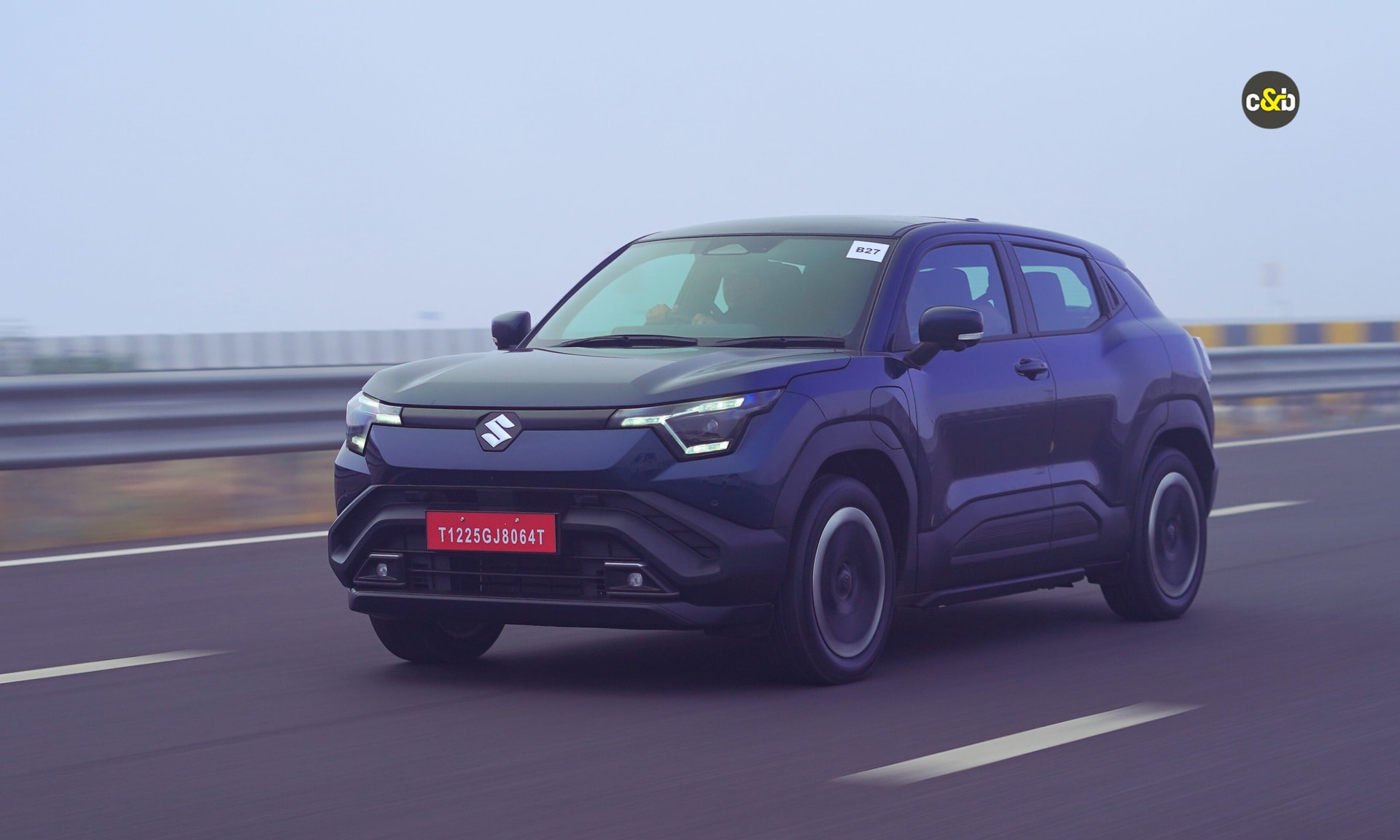
First things first, the dimensions. The e-Vitara is almost as large as the Hyundai Creta Electric, one of its many rivals. The styling is new yet familiar, with Y-shaped LED headlights, strong character lines, heavy body cladding all around, 18-inch alloy wheels, and seductively flared rear wheel arches that look fabulous from the ORVMs. The rear is a bit of an awkward stance to look at – the execution of the tail lamp bars could have been better, and the tight rear window, petite roof-mounted spoiler, and chunky bumpers are all design elements that look great individually, but don’t come together cohesively.
Its road presence might not look as big or imposing as some of its rivals. And that might be owing to this lack of cohesive design.
Well, looks are subjective, but one definitive thing is that the e-Vitara is not chasing after those who enjoy explaining their car to neighbours. It’s after the people who - like billions of us Indians - want their EV to just work right. And in that sense, this design tells you exactly what kind of electric car this is going to be.
Also Read: Maruti WagonR Swivel Front Seat Kit Launched: Check Price, Availability
Maruti Suzuki E-Vitara Review: Interior
Step inside, and the e-Vitara, in a typical Maruti Suzuki style, isn’t trying to overwhelm or impress you in the first five seconds. This cabin is new and nothing that we have ever seen in Maruti’s line-up. But it still somehow feels familiar.
I’d like to start with the steering, which is two-spoke, a first for Maruti. And it is not circular. It’s flattened on top and bottom ends, and this feels good to hold compared to the square-ish steering in the Mahindra BE6, another of e-Vitara’s rivals.
Also Read: India-Spec Maruti Suzuki e-Vitara: All You Need To Know
Now, where the BE6 is the most radical thing you’d experience in terms of cabin, the e-Vitara is the polar opposite. It's conventional. The infotainment and MID binnacle are conventional. The floating centre console is conventional. The cupholders, steering-mounted controls, and the door pad (with the only strip of ambient lighting) are conventional. And the one thing that isn't conventional, is the Human-Machine-Interface or HMI in technical terms, is how you operate this circular gear selector.
One of the comfiest seats comes from Maruti. Take the last-gen Swift’s seats, for instance, which were very well-designed. In the same way, these seats are equally so. Even after spending one and a half days and 770 km in these, it never gave me a reason to complain. If I had to complain, though, it would be the aesthetics - or the lack of - by putting the hazard button here in the centre with such a large bezel. The dashboard plastic could have been better, and I have some complaints about the screens.
The interface of the 10.25-inch infotainment system feels like it belongs to pre-Covid era. It’s configurable, and Maruti’s screen was never the flashiest but more of a form-over-function. But in a time where cars have started giving you a tablet, triple-screen setup and whatnot, this feels like a step back in comparison. The driver’s display, too, isn’t as modern as it should be. It’s configurable but monochromatic.
Also Read: Maruti Suzuki E Vitara Range, Kerb Weight, Performance Figures Revealed
And the complaint continues in the back seat. The knee-up position was the first problem EVs faced when they were mere conversions of the ICE platform into an EV. This e-Vitara makes use of the e-HEARTECT platform, which, on paper, shouldn’t be the same as the standard ICE car but does feel like it over here. Many new EVs have sorted this problem, but it persists over here. The headroom, too, isn’t great for my 5.6' frame. Sitting two at the back would be comfortable, where you get a folding armrest with a cupholder. Three might not be the best bet.
Even the boot at around 306 litres is large enough by hatchback standards, and not by this segment. And that’s only when the seats are pushed ahead. Its loading lip is rather high too, but fold down the seats to liberate over 500 litres.
Maruti Suzuki E-Vitara Review: Driving
Now you know that the e-Vitara production commenced in India, and this one is exported to the UK market. It’s essential to know this because the ride quality is stiffly sprung, like it's meant for European roads. It's not uncomfortable, but it isn't as pliant as some of the other EVs out there. And you do feel that discomfort and unsettledness when you encounter badly repaired roads.
Also Read: Tata Sierra Review: India’s New Favourite?
Then there's the power delivery, which is smooth, very smooth and linear. Not neck-snapping quick, and it doesn’t feel like it has 170-odd horsepower. But be assured that it will never bore you. You do feel it's slightly restrained to focus on efficiency, like any other Maruti. But it's not boring. Its power delivery is addictive. It pulls hard when you floor it. And this is one aspect of EVs that the e-Vitara has got just right.
There are three regen settings, but none of them is a one-pedal setup. And the weird thing is, you don't have paddle shifters like other EVs. You have a button to engage the regen; otherwise, there’s no regen. Also, you cannot change the regeneration setting on the fly. Which means, when you activate this regen, it activates in a single setting - low-medium-high, and you cannot change this on the go. So, every time you want a different regen setting, you must park it first and then change the setting.
There are drive modes too, but there’s no real difference between the Eco and Normal modes. You also get Sport mode, which makes the throttle response sharper but also gets twitchy at times. I have already spoken about the ride, which is stiff, but the steering response is good. It’s light, easy to manoeuvre, but it goes three turns lock-to-lock, which makes it slightly slow when you want to push it. But it's well weighted, comfortable, and easy to live with this steering setup.
The claimed ARAI range of the e-Vitara is 543 km under the ARAI cycle. I clocked 770kms with this one, as part of India Goes Electric, and I did notice a few things. The first charge from 100 per cent took me 330kms, and it had 14 per cent juice left, which was good enough for another 63-64 kms. That means a realistic range of 400 km. But then you also need to consider that it was highway speed through and through, even hitting triple-digit speeds on a few occasions. The next day, on full charge, the indicated range was around 415 km, and it could have achieved most of it if we hadn’t stopped for a top-up. So right now. I would consider a realistic range of 420-440 km in the real-world conditions for this bigger 61kWh battery pack.
Also Read: Tata Harrier EV vs Mahindra XEV 9e: Battle Of India’s Electric Titans.
As for the charging, on our road trip, we charged it with a Nexa e-Charger at the dealership, at a 60kW gun, and the car was sipping in 59.49kW. While at it, let me tell you one of the reasons why Maruti has delayed the launch of their first electric car. The charging infra. The upper hand they have over other manufacturers is the vast sales and service network, and Maruti has leveraged that first.
Conclusion
And talking about delay, the e-Vitara will be launched in India in January, a year after its reveal, when it's already on sale internationally. Because here, they need to get the pricing right to disrupt the establishment of cars like the MG Windsor EV, Hyundai Creta EV and the Tata Curvv EV. And here's where the e-Vitara needs to play its strongest card. Because it's not the most revolutionary, it's the least risky, like any Maruti car ought to be. And cynicism demands we ask the hard question. And the question is - is this too little too late?
Because had it arrived a couple of years earlier, it would have been a game changer, but the rules of the game have now changed. And this one is not moving the goalposts any further. So who is the e-Vitara for? If you want your EV to stand out and turn heads, you will find better options. But if you are someone who trusts Maruti, who wants an EV that behaves like a Maruti, who values reliability over flamboyance. The e-Vitara suddenly makes a lot of sense. It's not without faults, though. But would you buy it depends entirely on how Indian you still are about buying a car. Because sometimes, the last one to arrive is the one that stays the longest.
Pictures by Arvind Salhan
Related News


Learn more about

Popular Models


Latest Cars


Upcoming Cars


Latest News


 Carandbike Team | Sep 4, 2026Royal Enfield Himalayan 440 Launched At Rs 2.29 Lakh; Gets strengthened Chassis, 443cc EngineThe original Himalayan returns with more torque, a six-speed gearbox and strengthened underpinnings while retaining its simple adventure-touring character3 mins read
 Sarthak Mahajan | Sep 4, 2026Kia Sorento: In PicturesKia Sorento stands as the brands’ flagship SUV in India and at Rs 27.99 Lakh. It stands against the Toyota Fortuner and Innova Hycross.3 mins read
 Sarthak Mahajan | Sep 4, 2026Kia Syros Flex-Fuel Concept Showcased; Can Run On Up To E100Kia has taken the wraps off the Syros Flex-Fuel concept. The brand has not yet confirmed whether it will be introduced in India.1 min read
 car&bike Team | Sep 4, 2026Kia Carens, Carens Clavis CNG: All You Need To KnowBoth MPVs gets a 60 litre fuel tank nestled in the boot.2 mins read
 Sarthak Mahajan | Sep 4, 2026Skoda Octavia RS Launched At Rs 56.69 Lakh; Limited To 50 UnitsAfter 1 year, Skoda has opened doors for the Octavia RS in India with a limited run of 50 units at Rs 56.69 Lakh.1 min read
 Jaiveer Mehra | Sep 4, 20262027 Kia Sorento Launched In India At Rs 27.99 LakhThe Sorento is Kia’s first strong hybrid SUV for the Indian market; offered with strong hybrid and diesel powertrain options.3 mins read
 Janak Sorap | Sep 4, 20262026 Ducati Monster V2 Review: Raising The BarWith the fifth iteration, the Ducati Monster gets a lighter chassis, a new 890cc V2 engine, sophisticated electronics and tweaks to the suspension, all to make the 2026 version so compelling.7 mins read
 Shams Raza Naqvi | Sep 4, 20262026 Lexus ES 350h And Lexus ES 500e Review: Luxury Meets CapabilityWe got behind the wheels of the new Lexus ES twins which were launched in India earlier this year. Which one suits you more? Lets find out1 min read
 Amaan Ahmed | Sep 2, 2026Konarc Is The Rizta That Works For Everyone -- Including Ather Energy | FIRST RIDE REVIEWFor the slow-but-sure Ather, the Rizta was the foot in the door -- the similarly-capable Konarc, purpose-built to win over every Indian family, is built to kick that very door down.10 mins read
 Seshan Vijayraghvan | Sep 1, 2026Volvo EX90 Review: Understated Luxury Meets Electric PerformanceThe Volvo EX90 is a massive, fully electric luxury SUV that combines understated design, a tech-heavy cabin, plenty of comfort, and a capable electric powertrain. But does it get everything right?1 min read
 Preetam Bora | Aug 25, 20262026 Hero Xoom 160 Review: Maxi-mum Potential!With styling and proportions that goes into actual maxi-scooter territory, a liquid-cooled engine and large 14-inch wheels, the Hero Xoom 160 holds a lot of promise. But should you buy it?9 mins read