
Tata Motors Takes A Frugal Road Less Travelled


To make its first electric vehicle for the consumer market, India's Tata Motors Ltd repurposed an unused shop floor at its flagship plant. Here, there's no fancy assembly line - Nexon SUV bodies designed for gasoline models are wired and fitted with battery packs by hand.
The area, which could be mistaken for a prototype lab, initially made just eight SUVs a day. But demand has shot up over the two years since the Nexon EV's launch. Tata now makes more than 100 a day though much of that is now handled at another plant nearby.

Even with this humble start, which draws on India's tradition of 'jugaad' - a word referring to frugal DIY innovation and workarounds, Tata dominates the country's fledgling electric car market.
That contrasts sharply with other major automakers which have poured billions of dollars into EV tooling and technology from the get-go, though Tata's success also owes much to government subsidies and high tariffs that keep out imports from rivals like Tesla Inc.
Going into India's untried market for EVs, Tata knew it had to make an affordable car for an extremely cost-conscious population. Instead of building an EV plant or line which would be expensive and take time, it decided to pick an existing successful model and work on outfitting it with a battery pack.

An EV plant for a nascent market would have been "a huge amount of investment sitting on the potential of emerging volumes. We didn't want to do that," Anand Kulkarni, vice president of product line and operations at Tata Passenger Electric Mobility, told Reuters.
Tata also limited upfront investment by relying on Tata group companies for a range of EV components and infrastructure, and by choosing a cheaper battery chemistry type.
That enabled it to price the Nexon EV around $19,000 - not necessarily cheap in India but affordable for the upper-middle class and not much more expensive than the top version of the Nexon gasoline model.
With just the Nexon EV and one other model for fleet sales, Tata commands 90% of India's electric car sales, giving it an all-important first-mover advantage even if EVs account for only 1% of the overall auto market.
Last June, Tata outlined aggressive plans to launch 10 electric models by March 2026. This financial year alone, it wants to quadruple EV production to 80,000 cars, sources have said.
Those ambitions attracted $1 billion in investment from U.S. private equity firm TPG, valuing its EV business at $9 billion - far below some EV startups but equivalent to 40% of Tata Motors' market value.
"This has definitely given us a significant head-start. It now gives us a force multiplier to aggressively move on EVs," said Shailesh Chandra, managing director of Tata Motors Passenger Vehicles and the EV subsidiary.
Tata has also earmarked $1 billion of its own money to fund its EV plans and by 2025 Chandra expects electric models to make up a quarter of its sales.
Longer-term, Tata is working on an EV-specific car platform and wants its first car using that architecture to launch in 2025. The company is also evaluating the need for a dedicated EV plant, Kulkarni said.
In the meantime, it plans to modify combustion engine platforms to build EVs with bigger batteries and longer driving ranges. Those models are likely to hit the market in about two years.

LEANING ON TATA FAMILY
The Nexon EV has a relatively modest real-world driving range of around 200 km per charge.
The range is, however, sufficient for most potential Indian buyers, a Tata survey of consumers showed, prompting it to choose a 30 kilowatt hour iron-based battery from China's Gotion High Tech Co which is cheaper than other lithium-ion batteries. Tata has also judged it safer for India's tropical weather conditions, Kulkarni said.
Gotion is working with Tata AutoComp Systems on assembling the battery packs and on the battery management system.
Tata AutoComp, which sources most of the EV parts, is one of several Tata conglomerate firms that Tata Motors leans on - a huge advantage at a time when many automakers are ploughing funds into becoming more vertically integrated and less reliant on suppliers.

Tata Power Company Ltd is setting up charging stations, Jaguar Land Rover contributes to design while Tata Chemicals Ltd has plans for battery recycling and local cell manufacturing.
When Tata began EV production in 2020, most parts were imported. Today, Tata AutoComp produces around 50% of the components in-house, its CEO, Arvind Goel, told Reuters.
"Our plan is to localise everything," he said.
All of the motor's parts except the magnet are due to be produced locally over the next couple of years. Excluding the cells, the battery will be made in-house and the company is working on its own battery management system, Goel added.

RISKS AHEAD
Tata's EV business is, however, set to face challenges. The government wants 30% of all cars sold in the country to be electric by 2030 and while that goal may look optimistic, competition is on its way.
South Korea's Hyundai Motor and Kia Motors plan to start selling EVs in India this year although their models are set to be bigger and pricier. Expectations are also high for some rivals to launch gasoline-electric hybrids.
"The major threat will come when competitors like Hyundai launch EV models in a similar price band and as Toyota and Suzuki's hybrid cars come into the market," said Gaurav Vangaal, associate director at S&P Global Mobility.
And like other automakers, Tata is struggling to source semiconductors amid a global shortage that has become its biggest challenge in ramping up production and has caused a 5 month backlog in EV orders.
That said, Tata intends to make the most of its enviable lead in India's EV market. It has accrued a trove of data from monitoring the 25,000 EVs it has on the road - particularly relevant for developing electric cars in hot climates, says Kulkarni.
"India has several hotspots which make it a challenge for electrification. Developing EVs in this market provides us with rich data, information which can flow back into our development process. I can't tell you the kind of head start this gives us," he said.
(This story has not been edited by NDTV staff and is auto-generated from a syndicated feed.)
Related News


Popular Tata Models


Latest Cars


Upcoming Cars


Latest News


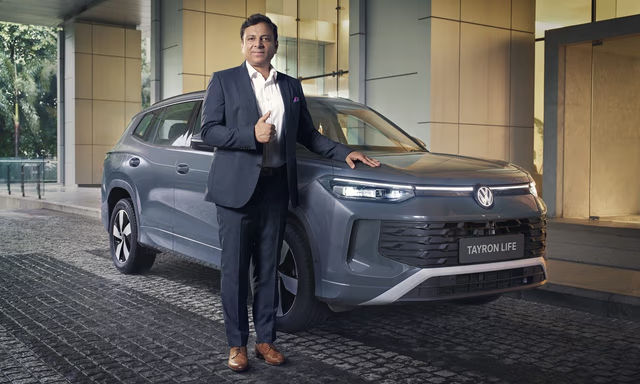 Seshan Vijayraghvan | Jul 10, 2026Volkswagen Tayron Life 5-Seater SUV Launched At Rs. 41.99 LakhThe Tayron Life trim will share most of its features and attributes with the three-row Tayron R-Line, but in a more lucrative package.1 min read
 car&bike Team | Jul 10, 2026Mercedes-AMG E53 PHEV India Launch On July 23The AMG E53 is solely offered as a plug-in hybrid, combining a 3.0-litre inline six engine with an electric motor.2 mins read
 car&bike Team | Jul 10, 20262026 Tata Safari, Harrier Stealth Edition Launched: Prices Start At Rs 23.43 LakhBoth the Safari and Harrier wear a stealthy matte black paint finish, and the darkened theme continues inside as well.2 mins read
 Bilal Firfiray | Jul 10, 2026Nissan Tekton vs Renault Duster: What Are The Key Differences?Same platform or not, there are a few key differences between the Nissan Tekton and Renault Duster. Be it design and features or the positioning. Here’s everything you need to know.3 mins read
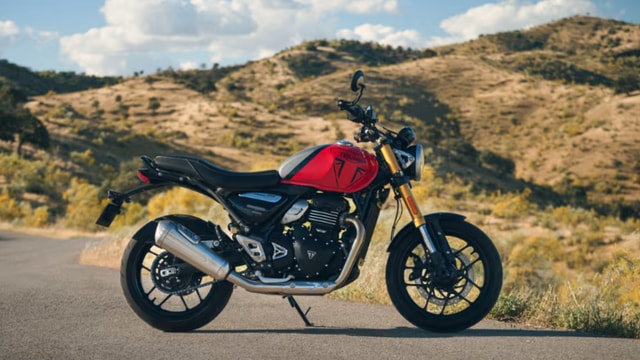 car&bike Team | Jul 10, 20262027 Triumph Speed 400, Scrambler 400 X Revealed in New ColoursTriumph has also revealed new colours for the Speed Triple 1200 RS, Tiger Sport 800, Rocket 3 Storm GT and Rocket 3 Storm R models.1 min read
 car&bike Team | Jul 10, 2026Yamaha FZ Flex-Fuel Launched At Rs. 1.24 LakhNamed the Yamaha FZ Blue Flex, this FZ is flex-fuel compatible that can run on ethanol blends from E20 to E85.1 min read
 Seshan Vijayraghvan | Jul 7, 2026Tata Altroz Petrol DCA Long-Term Review: Intercity & Highway Driving ReportWe tested the Tata Altroz Petro DCA’s highway manners, intercity performance, and real-world fuel efficiency.1 min read
 Seshan Vijayraghvan | Jun 29, 2026Renault Kiger vs Toyota Urban Cruiser Taisor: Which Underdog Deserves Your Money?Both the Kiger and the Taisor promise strong performance, solid features, comfortable cabins and everyday usability, all without breaking the bank. But which of these underrated subcompact SUVs deserves your money? Let's find out.1 min read
 Seshan Vijayraghvan | Jun 29, 2026Skoda Kodiaq RS Review: The Best Kodiaq Yet?The Skoda Kodiaq RS is finally here, and it's every bit as exciting as I expected. But was it worth the wait?7 mins read
 Bilal Firfiray | Jun 28, 2026BMW X6 M60i Review: It’s Back And HOW!The BMW X6 M60i blends a 530bhp twin-turbo V8, with its unmistakable coupe-SUV styling. There’s plenty of character, but is it worth your money?6 mins read
 Janak Sorap | Jun 25, 2026350cc Bajaj Dominar 400 Review: Same Character, Lower PriceA slightly lower displacement engine, a significantly lower price tag and nearly the same performance — the Bajaj Dominar 400 aims to be smarter rather than faster.6 mins read