
Tata Harrier EV: 10 Features That Are First For A Tata

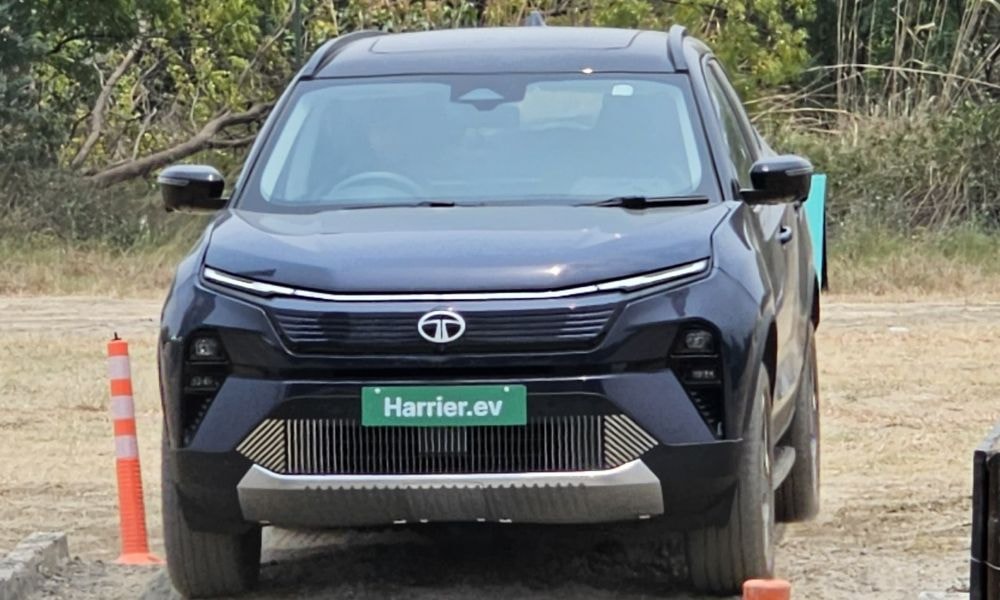
- First Tata EV with Quad-Wheel Drive and six terrain modes
- Autonomous parking and reverse assist are among the first for a Tata
- 14.53-inch infotainment screen is something new for a Tata
Tata Motors recently launched the Harrier EV in the Indian market, with prices beginning at Rs 21.49 lakh (ex-showroom, excluding the charger). With the Harrier EV, Tata has left no stone unturned when it comes to equipment and features on board. The all-electric Harrier model incorporates several features that are a first for a Tata vehicle, and we list some of the key offerings below.
Also Read: Tata Harrier EV Top Speed, Kerb Weight Revealed
1. QWD – dual motors

One of the main talking points of the Harrier EV is its Quad-Wheel Drive (QWD) setup, which is essentially an all-wheel drive system, making it the first Tata EV to get it. While the standard Harrier EV comes with rear-wheel drive, powered by a 235 bhp electric motor, the QWD variant adds a second 156 bhp motor on the front axle. The combined output is rated to be 391 bhp and 504 Nm of torque.
2. QWD terrain modes

Given it gets AWD on the higher variants, the Harrier EV features six terrain modes: Rock Crawl, Snow, Gravel, Sand, Normal, and a customisable sixth mode. These come in addition to the four standard drive modes.
Also Read: Tata Harrier EV vs Mahindra XEV 9e: Specifications, Features, Prices Compared
3. Off-road assist
Another QWD-exclusive feature is an off-road assist or cruise control mode, which allows the vehicle to maintain a low, steady speed over uneven terrain.
4. 14.53-inch Neo QLED display

Tata claims that the 14.53-inch QLED display in the Harrier EV, which manages infotainment duties, is not just a first for the brand but also a first in the automotive space. For reference, the ICE-powered Harrier comes equipped with a 12.3-inch touchscreen.
5. Transparent view mode

The Harrier EV is also the first Tata vehicle to offer a transparent view mode through its 360-degree camera system, allowing drivers to see beneath the vehicle. This is similar to what we have seen on high-end models like the Land Rover Defender and Range Rover.
Also Read: Tata Harrier EV Launched At Rs 21.49 Lakh; Gets Dual Motor Powertrain, Terrain Modes & More
6. Autonomous parking system

The Harrier EV is also equipped with an autonomous parking system, capable of parking the car without the driver inside. A summon function allows the vehicle to be moved from a parking spot using the round key fob, which gets dedicated vehicle-manoeuvring buttons.
7. Reverse assist
The Reverse Assist feature in the Harrier EV helps navigate out of tight parking spots by retracing the last 50 meters driven under 30 kmph, automatically handling steering, acceleration, and braking to return you to your starting point.
8. Digital rearview mirror with DVR

The Harrier EV features a digital inside rearview mirror (IRVM) integrated with a DVR (digital video recorder). This unit displays a real-time feed from the rear camera, offering a clearer view of what's behind the vehicle. In addition, it continuously records footage as well.
Also Read: Tata Harrier EV: In Pictures
9. Biggest Battery Pack

The Harrier EV will be offered with two battery options: 65 kWh and 75 kWh. According to Tata, the 75 kWh versions in rear-wheel-drive form offer an ARAI-certified range of up to 627 km. In real-world conditions (C75 cycle), this is expected to deliver between 480 and 505 km on a single charge.
10. 1.5 C peak charge rate

Thanks to its 1.5 C charging capability, the Harrier EV can charge rapidly. It supports up to 7 kW AC and 120 kW DC fast charging, allowing a 20 to 80 per cent top-up in under 25 minutes. With DC fast charging, Tata claims it can recover 250 km of range in just 15 minutes.
Related News

Learn more about Tata Harrier EV


Popular Tata Models


Latest Cars


Upcoming Cars


Latest News


 car&bike Team | Nov 11, 2026RTI vs Zero Depreciation: Which Car Insurance Cover Pays More?Return to Invoice (RTI) covers the gap between your car's current IDV (Insured Declared Value) and the original invoice value in case of theft or total loss. Zero Depreciation reduces deductions on replaced parts during accident repairs.1 min read
 car&bike Team | Nov 11, 2026Engine Protection vs Zero Depreciation: What's The Difference?Zero Depreciation reduces your share of accident repair costs, while Engine Protection covers certain engine and gearbox damage caused by water ingress or oil leakage.1 min read
 car&bike Team | Nov 11, 20262027 Hyundai Creta Interior Spied For The First TimeThe next-generation Creta's cabin gets a complete overhaul with a larger screen, a new steering wheel and more.2 mins read
 Amaan Ahmed | Nov 11, 2026'Fun' In Focus: How Honda Is Building ADV 160, Rebel 300 At Its Oldest India PlantFrom rolling out the first Activa, Honda's Manesar facility -- which marked its 25th anniversary this year -- is now primed to build the company's most exciting new products in years.1 min read
 car&bike Team | Nov 11, 2026Genesis GV90 SUV Design Patented In IndiaThe Genesis GV90's design has been patented in India just months after its global debut.1 min read
 car&bike Team | Nov 10, 20263.3 kW Vs 7.2 kW Vs 11 kW EV Chargers: Which Do You Need?Choosing a home EV charger depends on your car, daily driving and home power supply. A 3.3 kW charger works for smaller EVs, while 7.2 kW suits most mid-size electric cars. An 11 kW charger is meant for larger EVs that support three-phase charging.1 min read