
Adi Kailash Yatra On Four Wheels And A Battery!

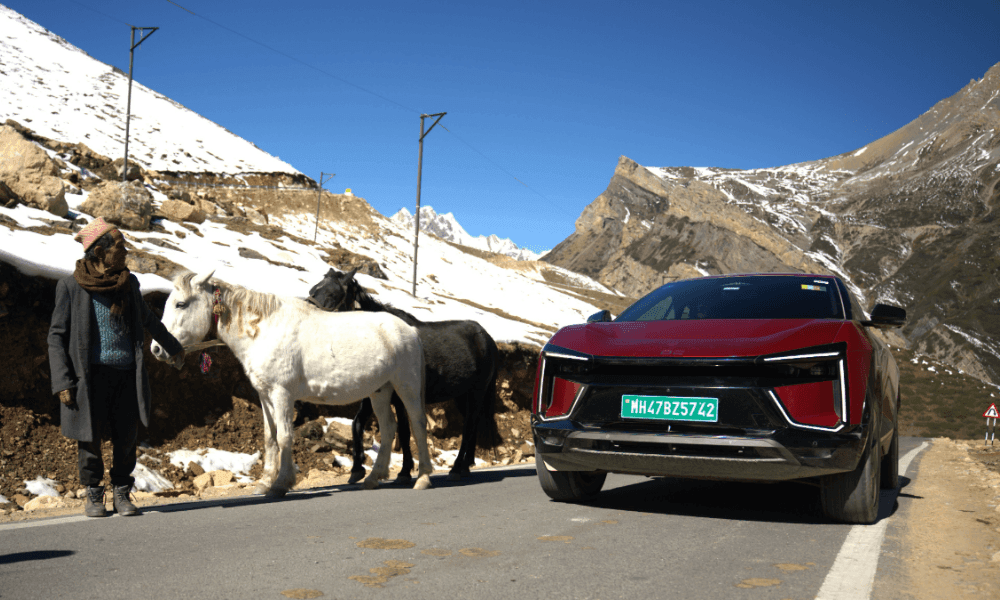
- First ever electric car expedition to Adi Kailash and Om Parvat in Uttarakhand
- Over 350 kms of hilly journey tracing the north-eastern edge of Uttarakhand in a Mahindra BE6 EV
- Made possible by the long-range electric cars from Mahindra & support from the Indian Army
I have been to Uttarakhand several times before, and still come back with unique memories every time I visit it. The region is blessed with natural beauty, with pristine glacial streams giving birth to many a holy river, and is home to magnificent peaks that hold special reverence for devout followers of the Hindu dharma.
Before you assume it to be a pilgrimage trip blog, let me just clarify why we went into one of the remotest regions of our country, and that too on a fleet of electric cars. Yes, you read it right – we drove electric cars into a region where the road infrastructure, being constantly challenged by extremely harsh climatic conditions and frequent landslides, was always at risk. The road journey into this part of the country is not just arduous and full of adventure, but is also unthinkable for an EV road trip, as for hundreds of kilometres there’s no sign of an EV charging station. We drove parallel to the Nepal border for over 350 km to reach our final destination, just short of Lipulekh Pass bordering Tibet.
This drive was an endurance test for our electric cars, and had it not been for the long-range, heavy-duty batteries and powerful motors spinning the rear wheels, it would have been unthinkable to reach these places.
THE BIGGEST CHALLENGE:
We started our journey from Bareilly Cantonment, and were flagged off by senior army officials from the regiment deployed in the Kumaon region of Uttarakhand we planned to visit. While the distance from Bareilly to Adi Kailash and Om Parvat is barely around 500 km, the hilly terrain and plenty of unfavourable road patches on the way made the journey pretty demanding. The hunt for compatible charging points was enough to pace us down, considering electric cars usually need more frequent halts for recharging when compared with their ICE counterparts.
Talking about charging, it’s important to note that once you cross Pilibhit after Bareilly, or Kiccha if you are going by the Nanakmatta route, there’s no fast-charging station available for the next 400 kilometres till Adi Kailash. So, for the next approximately 800 kilometres of to-and-fro journey, we were 100% reliant on the portable slow chargers that came with the electric cars.
Needless to say, but the sharp range drop for EVs during hill ascents is the next big fear you need to come to terms with, if you have already gotten over the range anxiety phenomenon, having experienced electric cars in the plains.
WHAT MADE IT POSSIBLE:
Thankfully, the cars we had for this expedition were the very capable born-electric Mahindra twins – BE 6 & XEV 9e – both equipped with massive 79 kWh batteries, and claiming a 500+ km range in regular city cycles. Even with battery sizes this large, it was still extremely difficult to predict how many miles we’d be able to leave behind at a given State of Charge (SOC). The best way to proceed was to be mindful of the distance to be covered till our next halt, and ensure that the SOC doesn’t fall below a safe 20% mark by the time we reach the location.
Additionally, no matter how big the battery is, when planning such a drive, we often fail to factor in the steepness of inclines encountered en route. The general thumb rule is: the speed of discharge is directly proportional to the degree of gradient; therefore, a steeper climb always means a risk of running out of juice much faster than expected. On the hind side, the BE 6 that we drove beautifully demonstrated how efficiently it recoups the lost energy while plying on a downhill run. Both BE 6 and XEV 9e offer three levels of regeneration, and we drove the majority of the time in L2 mode, and switched to L3 (strong regeneration) on descents.
TRIP HIGHLIGHTS:
A quick lunch halt at Dharchula en route gave me an opportunity to cross over the Kali river through a rope bridge and be in the middle of a busy marketplace, technically a part of Nepal. Just in case you are not aware, the Kali River acts as a natural boundary between India and Nepal. Two small checkposts, one on either side of the bridge, manned by the respective defence forces, let you cross into a different country. And that’s how Nepal became the first country I visited just by showing my Aadhar card, and not my passport.
Tracing the Kali River upstream, we reached Vyas Valley. The Kali Temple situated here marks the origin of the sacred Kali River. This is where we stopped for some tea and light snacks, and it was a pleasant surprise to find a military-run Marathi canteen selling bhajiya & vada pavs alongside an army souvenirs shop, barely 10 km before the Tibet border.
Above all, visiting the sacred Adi Kailash and the beautiful sight of the revered Om Parvat overshadow all the hardships and efforts taken to come this far. The road to Nabidhang barely existed, and it is here on the way to Om Parvat that we truly felt the need for off-road tyres in place of the road-biased OEM set, but the cars climbed up well and never let us feel any dearth of torque. Driving the BE 6 from Gunji to Adi Kailash, on the other hand, was an absolute delight.
The road surface was impeccably smooth, and a complete contrast to the numerous single-lane, rocky and sometimes muddy landslide sites we had to cross to reach the other side. The evening sun simmering through the snow-covered peaks, while you can hear the water gushing through the flawlessly blue rivers along the roadside, were some moments that will never fade away from memory.
USEFUL TIPS:
If you ever happen to plan an EV drive into hilly terrain, please bookmark this page, and the following tips may be of great help:
- Research and plan halts in advance: Never set out on an intercity drive or an expedition into the hills without understanding the terrain well and identifying key fast-charging stations on the planned route.
- Just a 3-pin socket isn’t enough: God forbid, if you run out of charge and it looks impossible to reach the nearest charging station, please ensure the portable home charger is always handy. Look for a 15 Ampere power socket, ideally at a commercial establishment frequently running heavy loads, and with proper earthing and voltage stabilisation measures in place, and less likely to use lower-grade cables. It may appear to be an inconvenience, but please remember modern EVs may refuse to initiate charging if the system senses any safety breach.
- When travelling to regions with no EV fast-charging infrastructure, make an effort to learn about the local power cut schedules and anticipate outages based on news related to landslides or other natural disasters, so you can avoid getting stuck for an additional night or more.
- Don’t just blindly rely on the range as shown on the odometer. It’s calculated based on charge depletion experienced over the most recently covered distance, and if conditions change in the next few kilometres, the displayed range will change too, causing misjudgement. Keeping an eye on the SOC % may still be a better idea.
- Switch off the aircon or set it at a more comfortable temperature like 22–24 degrees C. This is the biggest drain on your battery after the drivetrain, and when in doubt, use other power-saving features in the car, e.g., switching off driver aids like the ADAS system, and activating the battery saver mode. Remember that every small conservation measure will reward you with a few precious extra kilometres on the odometer.
- Lastly, watch the altitude difference: The Onward journey is always more challenging than the return, so always be observant about the topography of the place and anticipate the charge requirement for the return leg.
- Further, a drive into the hills can always throw unknown challenges your way, so please go thoroughly prepared and do leave us a comment below if there’s anything more you wish to know.
THE REAL REASON WE COULD ACCESS THESE HOLY SITES:
Lastly, travelling to the forward regions of our country, sharing a boundary and sometimes disputed territories with hostile neighbours, is full of unnatural risks. Inclement weather and poor road infrastructure not only make it difficult to access these places but also put immense pressure on basic supplies necessary for the survival of the locals as well as for the tourists in the region. We are thankful to the various units of the Indian Armed Forces for securing our borders and supporting us with good roads and safety back-up in case of an untoward event.
This trip wouldn’t have been possible without the backing of our alert, active, and supportive Armed Forces
Written by - Aashish Bhardwaj
Related News


Learn more about


Popular Models


Latest Cars


Upcoming Cars


Latest News


 Seshan Vijayraghvan | Sep 15, 2026Mahindra XUV 7XO Scores 5 Stars In Bharat NCAP Crash TestThe Mahindra XUV 7XO has scored 5 stars for both adult and child occupant protection.1 min read
 Sarthak Mahajan | Sep 15, 2026Honda Amaze Prices Hiked By Up To Rs 15,210: Check Updated Price ListHonda Cars India has hiked the prices of the Amaze for the second time this year, with the mid-spec variant receiving the highest price increase.1 min read
 car&bike Team | Sep 14, 2026Hyundai Bayon SUV Confirmed For India Launch; Coming This DiwaliBrand-new crossover from Hyundai India is expected to slot in between the Venue and Creta in the Korean carmaker's existing portfolio.2 mins read
 Sarthak Mahajan | Sep 13, 2026BMW 7 Series, i7 Facelift: In PicturesThe BMW 7 Series will ditch its diesel powertrain and will now be available with only one petrol variant, while the i7 will be offered in two variants. The i7 M70 xDrive will arrive as a full import (CBU).5 mins read
 car&bike Team | Sep 12, 2026New Hero Dual-Sport Motorcycle Spotted: Impulse 160 Incoming?A production-ready Hero dual-sport motorcycle has been spotted without camouflage.2 mins read
 car&bike Team | Sep 12, 2026Hero Glamour X 125 Gains ABS; Priced At Rs 1.01 LakhABS with integrated IBS is claimed to be segment-first on the Glamour X 125.2 mins read
 Seshan Vijayraghvan | Sep 15, 2026BMW i5 LWB Review: Not The M60, This Is The Proper Electric 5 SeriesThe BMW i5 LWB takes the electric 5 Series formula and puts a stronger focus on rear-seat comfort and long-distance luxury. With a 669 km claimed range, 268 bhp and a more relaxed character, is this the i5 that makes the most sense for India?7 mins read
 Preetam Bora | Sep 14, 2026Ladakh Uncharted: Himalayan Basecamp Off-Road Ride ExperienceA day-long off-road excursion from Royal Enfield’s Himalayan Basecamp event in Ladakh, the Ladakh Uncharted ride by Alpinestars was all about re-discovery!6 mins read
 Janak Sorap | Sep 12, 2026New Bajaj Pulsar 125 First Ride Review: More Tech, Less Weight, Same Pulsar DNAThe new Bajaj Pulsar 125 retains the familiar Pulsar identity but gets a new engine, lighter construction, more features and a sharper riding experience.5 mins read
 Bilal Firfiray | Sep 10, 2026Mahindra XEV 9S Review: 3 Reasons To Buy It, And 3 Reasons To AvoidEveryone keeps telling me that the Mahindra XEV 9S is not the electric XUV 7XO. I disagree.1 min read
 Abhishek Nigam | Sep 12, 2026New Bajaj Pulsar 150 Review: Is The New Pulsar, Pulsar Enough?The new Pulsar 150 gets a major mechanical and technological makeover, but does it retain the easy-going performance, familiar character and hooligan streak that made the original an icon? We ride the latest iteration to find out.8 mins read