
2025 TVS Apache RTR 310 First Ride Review

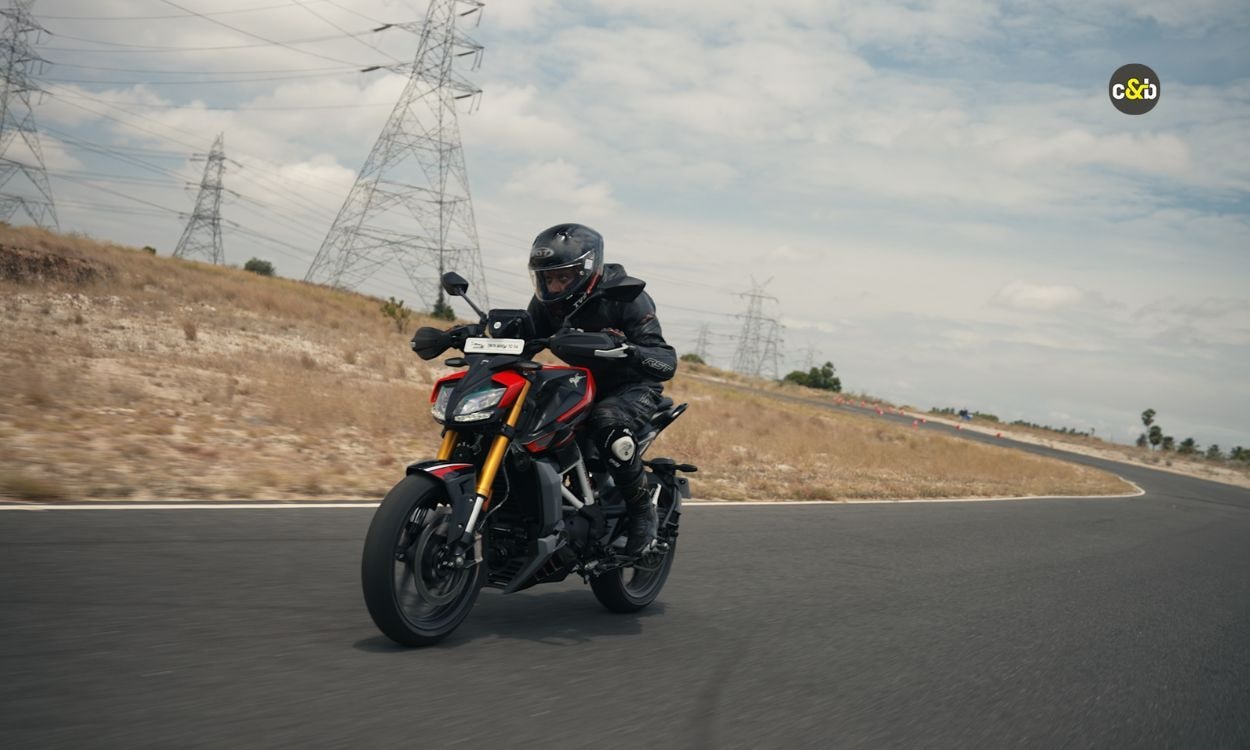
- 2025 TVS Apache RTR 310 gets significant updates
- New electronic throttle, updated fuelling
- Base variant now Rs. 10,000 more affordable
What about vibrations? That is the question many of car&bike’s viewers and readers ask, when we talk about the TVS Apache RTR 310. First launched in 2023, the Apache RTR 310 got a minor update last year, and it’s only now, that the RTR 310 gets its first significant update since its launch. This time around, there are tweaks to the bike’s mechanicals, electronics suite as well as new features to help improve not just overall rideability and engine refinement, but also to make it more aspirational.
Also Read: 2025 TVS Apache RTR 310 Launched At Rs. 2.40 Lakh
When I packed my bags to head down to Coimbatore to ride the Apache RTR 310 at the CoASTT track and on the street, the question playing on my mind was – has TVS managed to make significant improvements to its flagship street naked? The answer, as we found out, is a definite “yes”! But there are still some limitations. To find out what’s good and what could have been better, read on.
Also Read: 2025 TVS Apache RTR 310 - What's New?
Also Read: 2025 TVS Apache RTR 310 Variants Explained
What’s New?
The 2025 TVS Apache RTR 310 retains the same overall silhouette. So, if you look at it in its two existing colour options of Fury Yellow and Sepang Blue, you won’t be able to make out much of a difference, at least from a distance. But come close, and you will notice the new knuckle guards, which are standard fitment across variants, the transparent clutch cover, which was introduced in the RR 310 last year, and new sequential LED turn indicators. The optional cooled seat, a novelty offered earlier, has now been discontinued, to make the rider’s perch more comfortable.
And then, there are two new colours as well. The base trim is available in a new Arsenal Black colour option, and the top trim gets a Fiery Red colour option as well, in addition to Fury Red. Sepang Blue is reserved only for bike equipped with the two optional Built to Order (BTO) kits, which open up several additions, including adjustable suspension and lean-sensitive rider aids. The 5-inch TFT console has been updated as well, with an improved user interface and different layout. As part of the optional Dynamic Pro kit, the RTR 310 now gets keyless ignition, along with launch control.
Under the skin, there are some new features, which TVS R&D just can’t seem to stop talking about. There’s a new intelligent electronic throttle, which in turn helps what has been called the “smart torque filter.” Essentially, it judges how much the rider opens the throttle, and how quickly, and based on the throttle inputs, the fuelling and ignition are calibrated. The idea is to make the updated RTR 310 offer a smooth and linear flow of torque at different revs, with varied throttle inputs. But more on that later.
There’s also “drag torque control” which essentially works with the slip and assist clutch and prevents wheel hopping under hard downshifting and smoothens out the torque delivery. What has also been changed is the rear sprocket which is the same as the RR 310’s now and offers a more relaxed cruising speed.
What’s Not Changed?
The engine continues with the same state of tune, putting out 35.1 bhp at 9,700 rpm and 28.7 Nm at 6,650 rpm. Last year, the RTR 310’s full-faired sibling, the RR 310 got a bigger airbox and intake which resulted in a minor bump in performance. To introduce the bigger airbox would have meant more changes to the overall cosmetic packaging and bodywork of the RTR 310.
TVS maintains that the RR 310 with its marginally more performance will distinguish itself as a more track-ready motorcycle than the street-oriented personality of the RTR 310. The steel trellis frame, the upside-down front fork and the monoshock, as well as the 17-inch cast wheels with Michelin Road 5 tyres have been carried forward to the latest model unchanged. The 5-inch TFT console remains the same, but the layout has been changed with the latest generation display features on the menu.
Engine & Performance
The 312 cc, single-cylinder, liquid-cooled, DOHC engine continues to have the same output. The RTR 310’s full-faired sibling, the RR 310 got a bigger airbox and a bigger intake last year, which resulted in a minor bump in performance, but those changes have not been carried over to the 2025 TVS Apache RTR 310. So, the engine continues to make 35.1 bhp at 9,700 rpm and 28.7 Nm of peak torque at 6,650 rpm. The numbers may be same, but TVS has made some improvements in fuelling and torque delivery.
The new electronic throttle works with sensors on the ride-by-wire system to maintain optimum fuel inflow and control ignition to offer seamless throttle response, a system which TVS calls the “smart torque filter.” Essentially, fuelling has been improved and if the previous generation RTR 310 had a slightly snatchy throttle response, the 2025 model has smooth and linear throttle response. The sensors calculate, how much the throttle has been opened, and how quickly and accordingly adjusts the fuelling and ignition to provide a linear torque curve.
The result is that the 2025 TVS Apache RTR 310 has improved rideability – in everyday riding conditions. There’s plenty of torque available at all speeds, and gears. In sixth gear, the new RTR 310 pulls cleanly from speeds of around 53-55 kmph, without any knocking and overall refinement levels have also improved. The harsh vibrations from the previous model seem to have been largely contained, and overall ride experience in the city and out on the highway offers a relatively more refined experience. The single-cylinder engine is still buzzy, particularly at higher revs, but the vibrations on the handlebar and footpegs seem to have been contained and reduced mostly on the new model.
Then, there’s the drag torque control, which essentially works in conjunction with the slipper clutch to prevent wheel hopping and locking under hard downshifting and helps deliver smooth torque even when ridden aggressively. The system works to make the riding experience seamless, and you can get away with aggressively downshifting and then quickly accelerating through the gears to get to speeds close to 150 kmph. The bi-directional quickshifter works like a charm and is seamless in its operation.
Dynamics & Handling
The TVS Apache RTR 310, and the RR 310, have always been balanced and predictable machines when it comes to dynamics. And I’m happy to report that those qualities have not changed on the latest version of the Apache RTR 310. On the street, its predictable and forgiving nature will not intimidate new riders moving up from smaller displacement machines. On the track, however, it’s no slouch and is willing to be pushed hard, the only downside being lack of footpeg clearance.
My first outing proved to be an exercise in scraping the feeler bolts on the footpegs more than exploring the bike’s capabilities. And it was only during the second session, with the preload bumped up, that I managed to have somewhat of an interesting outing, although time was limited during our first ride, and I was to head back to the pits before the next group could move out in the afternoon. The 2025 TVS Apache RTR 310 is a friendly, and “safe” motorcycle which has predictable handling and dynamics which will be welcomed by many riders.
But more experienced riders may feel the 2025 TVS Apache RTR 310 loses out on “character” and some temperament when you would want to push it harder around a racetrack like the CoASTT circuit. Peg clearance is one area where you will feel like backing down, long before the chassis, the suspension, or the bike will feel like letting go. Nevertheless, it is a friendly machine which will have your back, and with all the electronics slapped on, you will need to do something stupid for you and the bike to get up close and personal with tarmac. In all, it’s a friendly, forgiving and fun bike, if not outright thrilling!
Variants, BTO Kits & Prices
The 2025 TVS Apache RTR 310 is available in two main variants – Base and Top. In the Base trim, you can opt for the bike in only one colour (Arsenal Black), and you will get standard features like cruise control, linear traction control and drag torque control at Rs. 2.40 lakh (Ex-showroom). Just above the Base trim is the Top variant, which adds a bi-directional quickshifter and is priced at Rs. 2.57 lakh (Ex-showroom).
| Variants | Base | Top |
| Price (Ex-showroom) | ₹ 2.40 lakh | ₹ 2.57 lakh |
Then, there are two Built to Order (BTO) kits on offer, each with different equipment and kit that you can opt for. Kit 1, called the Dynamic Kit, is priced at Rs. 18,000. It offers tyre pressure monitoring system (TPMS), a brass coated chain and fully adjustable suspension, with preload, compression and rebound damping adjustability up front, and preload and rebound damping adjustability available on the rear monoshock. With the Dynamic Kit, the top variant prices will go up to Rs. 2.75 lakh (Ex-showroom).
| Built to Order (BTO) Kits | Dynamic | Dynamic Pro |
| Price | ₹ 18,000 | ₹ 28,000 |
Then, there’s the BTO Kit 2, or Dynamic Pro kit, at Rs. 28,000, which opens up the complete cornering enabled electronics suite, called the Race Tuned Dynamic Stability Control (RT-DSC), and keyless function. The RT-DSC essentially uses a 6-axis inertial measurement unit and adjusts braking and power input to control the lean-sensitive ABS and traction control, as well as cornering cruise control and cornering drag torque control.
| 2025 TVS Apache RTR 310 BTO | With Dynamic Kit | With Dynamic Pro Kit | With both kits |
| Price | ₹ 2.75 Lakh | ₹ 2.85 Lakh | ₹ 3.03 Lakh |
The top variant with just the Dynamic Pro kit will push the price of the 2025 TVS Apache RTR 310 to Rs. 2.85 lakh (Ex-showroom). But with both the Dynamic and Dynamic Pro kits slapped on, the price will inch up to Rs. 3.03 lakh (Ex-showroom). The Sepang Blue colour option is only available with the BTO kits and will cost an additional Rs. 10,000.
Verdict
The 2025 TVS Apache RTR 310 is an improved motorcycle which now offers even more features and tech, depending on which variant you decide to choose, and a long list of hi-tech features through the BTO kits. Compared to previous generation models, the Apache RTR 310 offers improved rideability, and overall vibrations have been largely contained to make the ride experience better and is a definite step up.
However, with the BTO kits slapped on, it also becomes quite expensive at Rs. 3.03 lakh (Ex-showroom), where you will end up paying even more than the KTM 390 Duke, which is a segment above with a larger engine and with more performance. Even then, the 2025 TVS Apache RTR 310 base variant offers standard features like cruise control, linear traction control, dual-channel ABS, drag torque control and rear wheel lift-off protection. At Rs. 2.40 lakh (Ex-showroom), the base variant of the Apache RTR 310 offers very good value and is easy to recommend, for anyone looking for a naked street bike at that price point.
2025 TVS Apache RTR 310 Video Review:
2025 TVS Apache RTR 310 Review Image Gallery:
Learn more about


Popular Models


Latest Cars


Upcoming Cars


Latest News


 Jafar Rizvi | Sep 26, 2026Tigor To Soldier On As Tata Xpres For Fleet BuyersThe Tigor will live on as the Xpres for fleet operators, while Tata reserves the new Aeris exclusively for private buyers.3 mins read
 Jafar Rizvi | Sep 25, 2026Renault Duster Hybrid India Launch On October 17The hybrid will become the third powertrain option in the line-up, joining the existing 1.0-litre and 1.3-litre turbo-petrol engines.2 mins read
 Sarthak Mahajan | Sep 25, 2026Tata Aeris: In PicturesThe Tata Aeris brings a major update to the long-running Tigor as its replacement.4 mins read
 car&bike Team | Sep 25, 2026Tata Aeris Colour Options RevealedThar Aeris is offered in six colour schemes with prices starting at Rs 5.29 lakh (ex-showroom).2 mins read
 Sarthak Mahajan | Sep 25, 2026Tata Aeris: Variants ExplainedThe Tata Aeris has been launched at Rs 5.29 lakh (ex-showroom) and tops out at Rs 8.19 lakh for the petrol variant.2 mins read
 Jafar Rizvi | Sep 25, 2026Tata Aeris: 8 Features That Are First In Its SegmentThe Tata Aeris brings segment-first features to the sub-4-metre sedan class, including ventilated front seats, biggest touchscreen and more.2 mins read
 Girish Karkera | Sep 26, 2026Mahindra Thar OG Review: An Ode To The Past But Aimed At The FutureOn the surface, the new Mahindra Thar OG might look like a facelift, but that is more than meets the eye.7 mins read
 Bilal Firfiray | Sep 19, 2026MG Hector Tomahawk EV Review: Play It SafeMG’s new electric SUV has one of the coolest names ever, and the coolest temperament amongst its peers. But is it worth buying?7 mins read
 Preetam Bora | Sep 16, 2026Royal Enfield Himalayan 440 Review: Better Than the 450?The new Himalayan 440 with an upsized engine and gearbox has certainly improved as a touring machine and at an extremely attractive price of Rs. 2.29 Lakh. Is it the better Himalayan to choose for many riders?9 mins read
 Seshan Vijayraghvan | Sep 15, 2026BMW i5 LWB Review: Not The M60, This Is The Proper Electric 5 SeriesThe BMW i5 LWB takes the electric 5 Series formula and puts a stronger focus on rear-seat comfort and long-distance luxury. With a 669 km claimed range, 268 bhp and a more relaxed character, is this the i5 that makes the most sense for India?7 mins read
 Preetam Bora | Sep 14, 2026Ladakh Uncharted: Himalayan Basecamp Off-Road Ride ExperienceA day-long off-road excursion from Royal Enfield’s Himalayan Basecamp event in Ladakh, the Ladakh Uncharted ride by Alpinestars was all about re-discovery!6 mins read