
TVS Young Media Racer Program: Experience
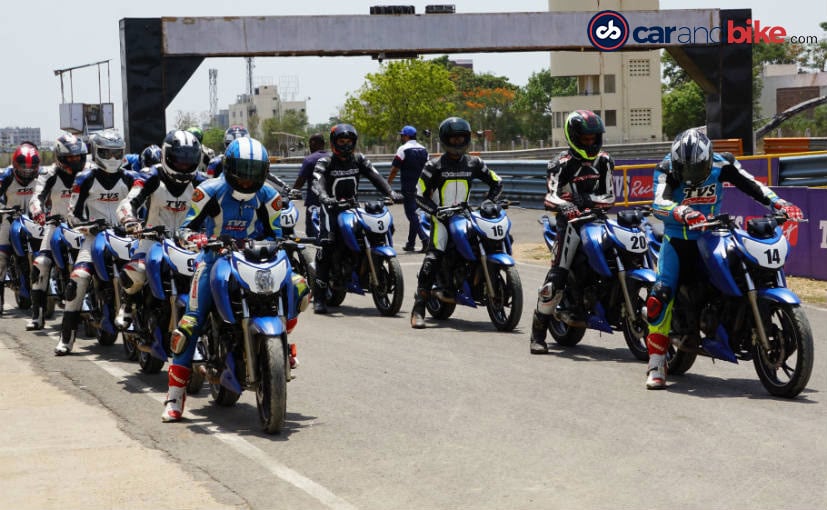
- The TVS programme teaches about the grassroots of motorcycle racing
- It teaches about riding position, braking, cornering & throttle control
- A total of 11 journalists made their way to the MMRT for the programme
Every motorcycle journalist worth his salt would have wanted, at least once in his lifetime, to trade in his desktop/laptop for a full set of racing leathers complete with other racing paraphernalia and get on to racetrack and go racing! Proper racing! But it is easier said than done. One needs proper training in order to hone his/her race-craft and get the basics of motorcycle racing done right, before he/she can actually go on to race. And this is where TVS Racing stepped in. One of the pioneers of motorcycle racing, TVS started something called the Young Media Racer Program, which serves to teach a bunch of journalists about the grassroots of motorcycle racing and give them the experience of a full season of motorcycle racing complete with the excitement, raw energy, nervousness and even a bit of heartbreak.
A total of 11 journalists made their way to the Irungattukottai Racetrack in Chennai, or MMRT with a day full of theory and practical sessions ahead of us. The TVS Team had called in Emmanuel Jebaraj, a multiple time motorcycle racing champion along with the best racers representing TVS Racing, who are Jagan Kumar, Harry Sylvester and K.Y Ahmed. While Jebaraj was to take our theory classes, it was the other three who would be supervising us while we were out on the racetrack. So without further ado, let's begin.
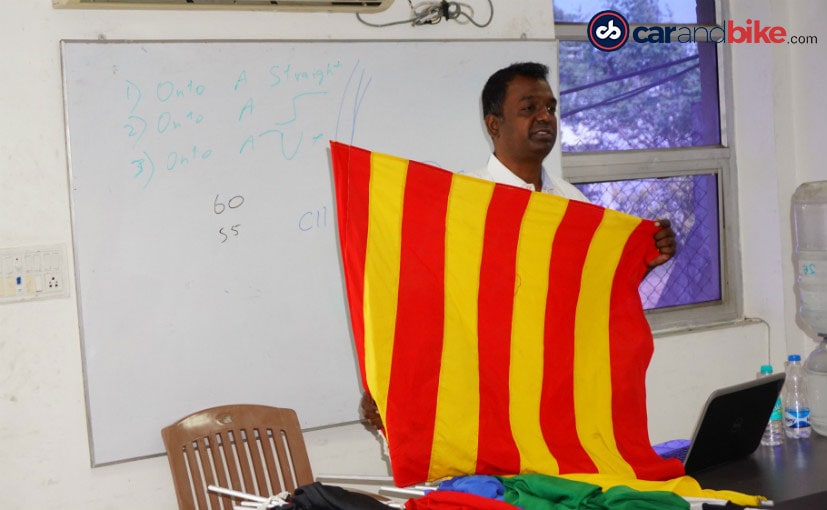
TVS had called in Emmanuel Jebaraj - a multiple time racing champion for theory classes
Session 1:
The first theory session was to know the rules and regulations when on the racetrack. We started off with the Federation of Motor Sports Clubs of India (FMSCI) hierarchy and how it works. After that, we learnt all about the various flags, which are used to communicate information to the riders while they are on the track. Once we were familiar with the different flags, our next lesson was about the safety regulations for when the riders are in the pit-lane and how to safely re-join the racetrack while keeping the motorcycle within the speed limits inside the pit-lane. Then, we were briefed about lining up on the grid and the do's and don'ts to keep in mind when lining up before the race starts and the start procedure as well.
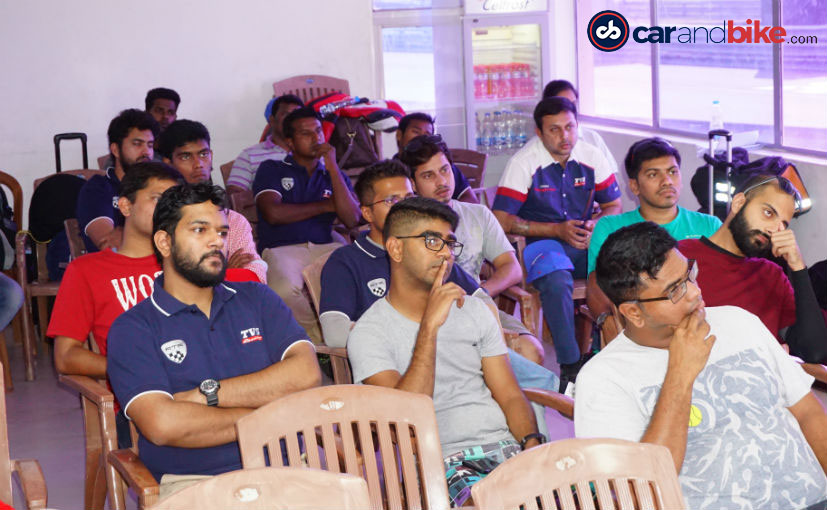
Prepping in theory is as important as the first ride on the track
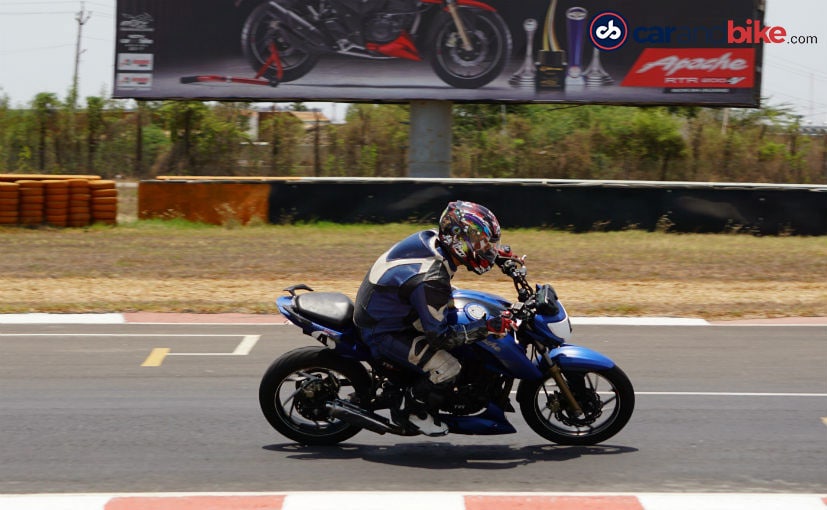
Now was the time to learn about body posture when you are on your race machine. One should always keep the ball of their feet on the footpeg rather than sit flat-footed. This helps to transfer weight easily when cornering, but more on that later. Also, the knees should be gripping the fuel tank. The elbows should be parallel to the ground. The upper body should be free of tension and relaxed at all times. And of course, when you are going for it on a straight, one should be fully crouched on the fuel tank, with the elbows tucked in tightly. With these nuggets of information, we set out on our first practical session, trying to put whatever we learnt so far, into practice.
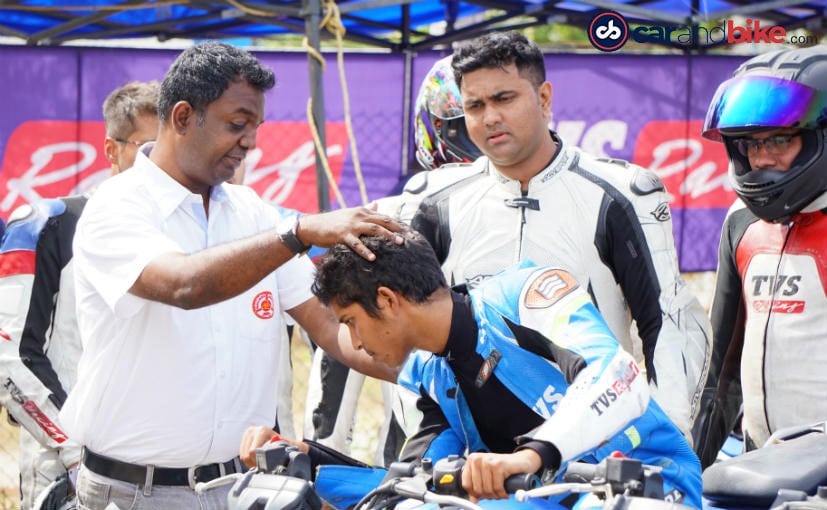
Learning about the right body posture when racing
Session 2:
The second theory session was all about braking references, riding through a corner and throttle modulation. So, we were briefed about how to negotiate a corner while carrying maximum speed. The idea is to find a braking reference, before entering into a corner, see the apex and hit it right, lean in to the side where you are turning. The knees have to come out, and the upper body has to follow suit. In essence, the head, the elbow and the knee should form a straight line. The idea is not to look good while cornering or to scrape your knees on the tarmac, but to get the bike to lean in the right way and in the right direction. One should always keep the throttle open when taking the corner. This is because when you hit the brakes before the corner, the bike dives down in the front. Opening up the throttle, even if a little, helps the bike to remain balanced and makes for a smoother exit. The key to going fast is to be as smooth as possible. The lesser the chassis of the bike is disturbed, the better it is. Choppy throttle inputs are only going to unsettle the bike and make you hesitant as well. Changing gears in the middle of a corner is again a big no-no.
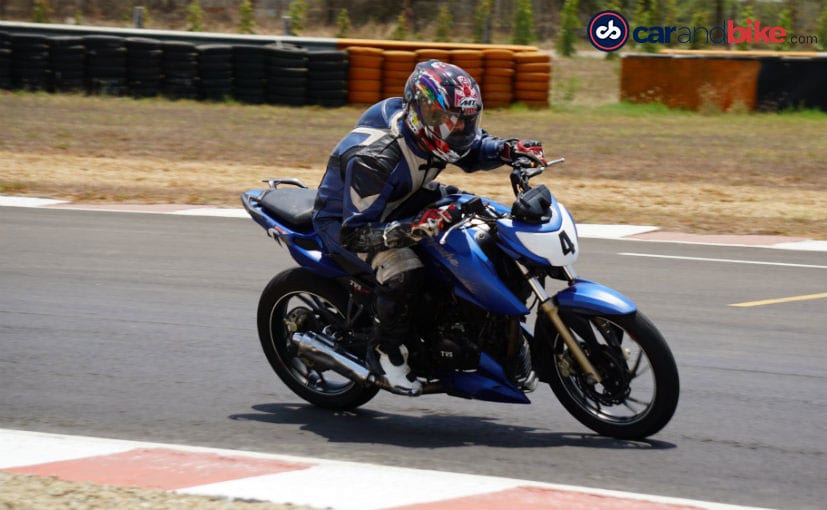
Getting cornering right allows you to carry more speeds
After our second track session, where we tried to practice whatever was taught to us, it was time to get some feedback into my riding style as well. Our lead rider was K.Y Ahmed, who said that I need to be more agile on the saddle. It was a tough task to unlearn the way I rode on regular roads and get more flexible on the seat, trying to get the knee out and negotiating corners, the right way.
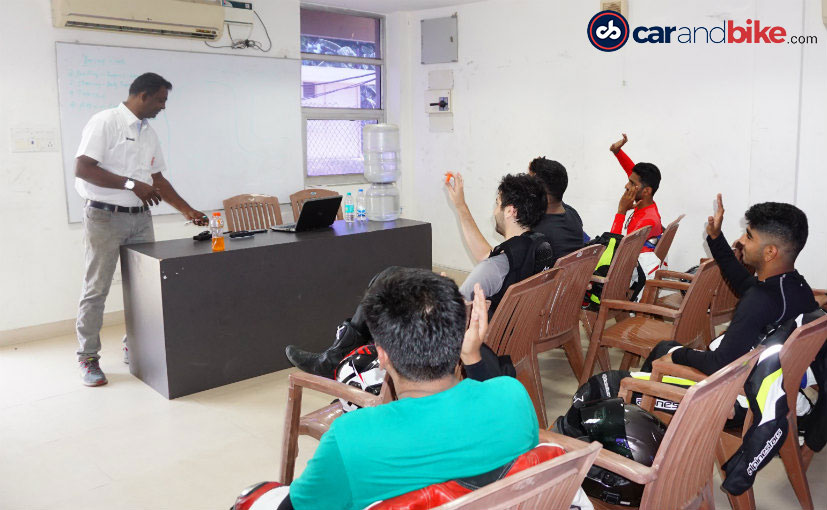
Time for some feedback from the previous sessions
Session 3:
This is where we upped the pace by a bit and looked to refine our cornering technique. Our teacher for the day, Jebaraj, asked us about our experience on the track in session two and then based on our feedback, he suggested on how we could minimise lap times, gave us tips on bettering our throttle control and lean angles. It was time to try and drop the timings and try and put everything that we had learnt, on the racetrack. The braking reference points were now clearer, the corners were being taken smoother than before and the lap times saw an improvement even if ever so slightly.
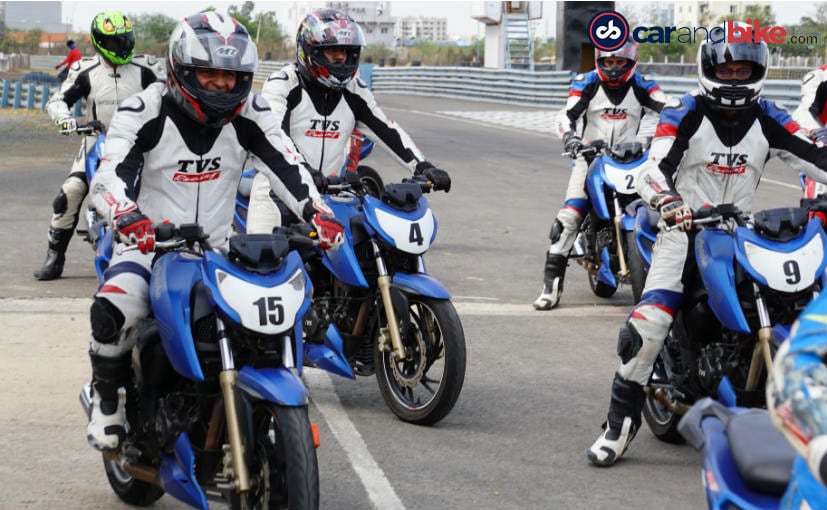
With getting the basics right, it was now time to drop the timings
And that is when the author, which is I, had a crash! The MMRT racetrack has a shorter course, a tight arc that connects C3 to C10 directly. I was on the throttle, nicely managed to lean in, get the knee out and then lost my rear tyre and slipped and went sliding, out of the tarmac. The bike did sustain a few damages and as for myself, I ended up with a bent right wrist, that's all. It is all a part of the game and as they say, if you are on a motorcycle, a crash is inevitable. It is not a question of 'if' but 'when'. Thanks to immediate response from the TVS Team, I was given immediate medical attention but had to sit out the last session, which ironically was about crashes.
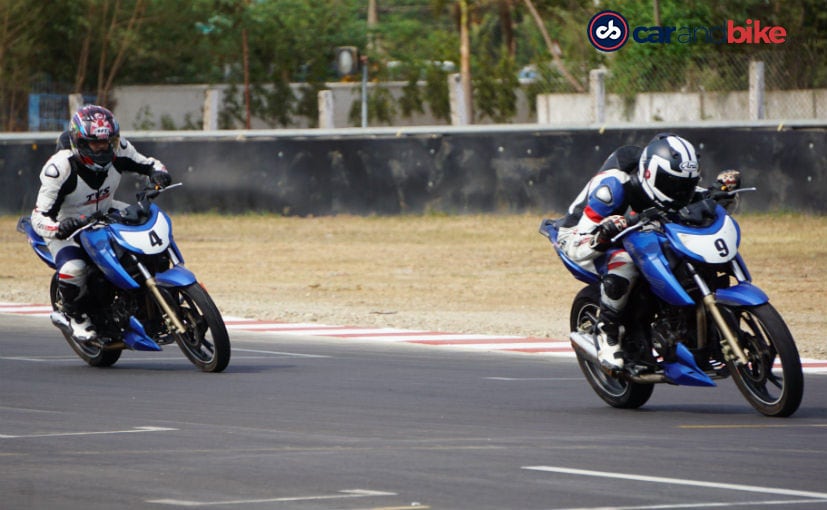
Crashes are inevitable but you can only improve your skills to minimise the damage
Session 4:
It was all about dealing with crashes! Only if I had saved my crash for the last track session! Nonetheless, it is a rather important topic and we rookies (there were a couple more crashes in the last session) needed every bit of it. The first and foremost thing to do is to keep your eyes open in case of a crash. One needs to see what is happening and respond accordingly. Also, it is important that you keep your head raised and your arms crossed over your stomach. One needs to let go of the motorcycle immediately when it goes down. Being dragged by it can only result in serious injuries as there is no way to predict which way the bike is moving. The day ended with a last track session where the remaining journalists tried to hone their racing skills further.
TVS will be organising more media races over the next few months
In due course of time, TVS will also be organising media races over the next few months. Learning about motorcycle racing is one thing, but to implement everything that we have learnt in an actual race, is a different thing altogether.

It has been 10 years since Kingshuk stepped into the interesting world of automotive journalism. From being a part of a team that drove two Mercedes-Benz SUVs from Germany to India to covering the WRC in Australia, along with various international media events he has done it all. He is equally happy behind the wheel of a car or on a motorcycle. All he wishes is to own and adventure touring motorcycle and explore India. In case you would want to help him realise his dream, please drop him a mail. Donations are accepted in cash and kind. Also, he dabbles in automotive photography, Liverpool, Football and Metallica are things close to his heart.
Read all latest news and reviews from Kingshuk Dutta →


Related News


Popular Models


Latest Cars


Upcoming Cars


Latest News


 Amaan Ahmed | Oct 2, 2026BMW F 450 R: Five Important Questions AnsweredReplacing the G 310 R as BMW's entry-level naked motorcycle is the just-unveiled F 450 R, and here are answers to five pressing questions about it.1 min read
 car&bike Team | Oct 2, 2026Honda Rebel 500 Recalled In India To Address Potential Steering IssueLess than 100 units of the motorcycle manufactured in 2025 that were sold in India are affected by this global recall.1 min read
 Amaan Ahmed | Oct 2, 2026BYD's Denza D9 MPV, Z9 GT Shooting Brake India Debut In November 2026BYD's luxury sub-brand Denza has announced its imminent India entry, and car&bike can confirm two strikingly different models from the Chinese carmaker will arrive in the next few weeks.1 min read
 car&bike Team | Oct 2, 2026Mahindra's 'Electric Origin' SUVs Cross 1 Lakh Sales Mark in 18 MonthsMahindra currently sells 3 SUVs under the Electric origin umbrella which include BE 6, XEV 9e and the 3-row XEV 9S1 min read
 car&bike Team | Oct 2, 2026Triumph Bonneville 400 To Debut Alongside 3 New Motorcycles On October 6The wait for the most accessible Bonneville yet will end in the coming weeks; India-spec Bonneville 400 expected to have 349 cc engine.1 min read
 Jafar Rizvi | Oct 1, 2026New Porsche 911 GT3 To Debut In India By Early 2027The 992.2-generation 911 GT3 made its global debut in October 2024.2 mins read
 Abhishek Nigam | Oct 2, 2026MINI Countryman C Review: Has MINI Finally Grown Up Without Losing Its Personality?The new Countryman C is bigger, more practical and packed with technology, but its quirky appeal comes with a few compromises.1 min read
 Janak Sorap | Oct 1, 2026Yamaha YZF-R2 Track Review: New TerritoryYamaha's all-new YZF-R2 brings 200cc performance, lightweight construction and R-series DNA to a new generation of riders, but its true track potential is held back by one crucial component.1 min read
 Bilal Firfiray | Sep 28, 2026Renault Triber 1.0 Turbo Review: Was It Necessary?With the new RGEP platform, the Triber has received a much-awaited turbocharged petrol engine. It makes more power now, but was it necessary for this seven-seater MPV's fitness to purpose?5 mins read
 Girish Karkera | Sep 26, 2026Mahindra Thar OG Review: An Ode To The Past But Aimed At The FutureOn the surface, the new Mahindra Thar OG might look like a facelift, but that is more than meets the eye.7 mins read
 Jafar Rizvi | Sep 28, 2026TVS Orbiter Long-Term Review (Report 2): Slow But SmoothAfter nearly three months with the TVS Orbiter, its relaxed performance remains its biggest weakness, but easy handling, comfort and usable real-world range make it a capable city commuter.1 min read