
2021 Tata Tigor EV Scores 4 Stars In Global NCAP's First Electric Vehicle Crash Test
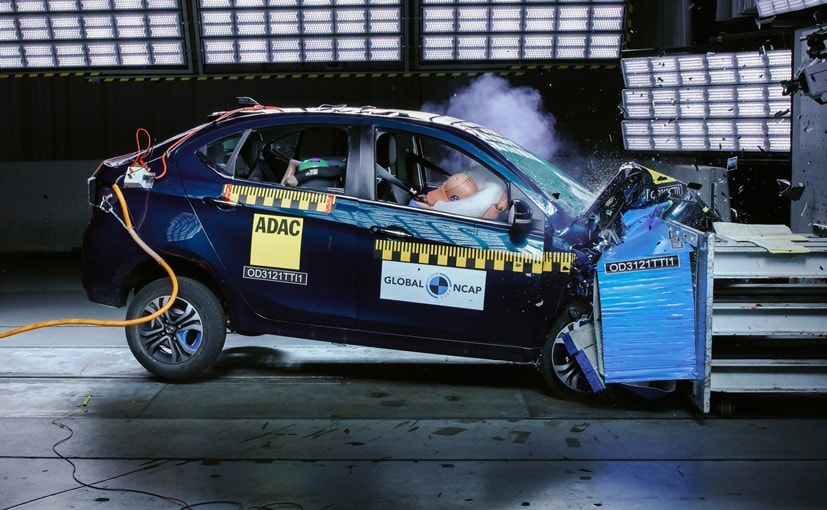
- The Tigor EV has got a 4-star safety rating for both adult & child safety
- The Tigor EV got 4 stars compared to the petrol Tigor which got 3 stars
- Global NCAP tested the base variant of the Tata Tigor EV with 2 airbags
The Global New Car Assessment Programme, or Global NCAP, has released the crash test results for its first-ever electric vehicle, the new Tata Tigor EV, and the electric sedan has scored a 4-star safety rating. The crash test was conducted as part of the safety watchdog's 'Safer Cars For India' initiative. What's worth mentioning here is that the updated Tata Tigor EV, which goes on sale in India on August 31, 2021, scored 4 stars for both adult and child occupant protection, getting a better score compared to the regular petrol engine-powered Tigor that was crash-tested last year.
Also Read: 2021 Tata Tigor EV Unveiled
In early 2020 when Global NCAP tested the Internal Combustion Engine (ICE) version of the Tata Tigor, the subcompact sedan had received 3 stars for child occupant protection, with a score of 34.15 out of 49.00. Whereas, the 2021 Tigor EV has received a score of 37.24, thus receiving a 4-star rating for child occupant protection. However, while both cars might have received a 4-star rating for adult occupant protection, the petrol Tigor had received a better score of 12.52 out of 14, compared to the Tigor EV which has got 12 out of 17. Global NCAP tested the base variant of the Tata Tigor EV which comes fitted with two front airbags and seat belt reminder for driver and passenger as standard.

The petrol Tata Tigor had received 3 stars for child occupant protection, where the Tigor EV has received a 4-star rating
Alejandro Furas, Secretary General of Global NCAP said, "Tata has shown consistent safety improvements throughout its fleet range. The Tigor demonstrates that improvements are also possible with EV models, which can pose a technical challenge because of the electric powertrain system. Tata should be recognised and applauded for this commitment to improving their vehicles in response to Global NCAP's call to democratise vehicle safety."
Also Read: Made-In-India Suzuki Swift Scores Zero Stars In Latin NCAP Crash Test

Global NCAP tested the base variant of the Tata Tigor EV which comes fitted with two front airbags and seat belt reminder for driver and passenger as standard
David Ward, President of the Towards Zero Foundation said, "It is deeply satisfying to see Tata's continuing commitment to safety as they innovate with new power train technologies in order to achieve wider environmental and sustainability goals. Safety and sustainability improvements are possible for all manufacturers operating in the Indian market, and Global NCAP would encourage them to follow Tata's lead."

The protection offered to the driver's head was good, while the same for the front passenger's head was adequate
With regards to adult occupant protection, the report says that the protection offered to the driver's head was good, while the same for the front passenger's head was adequate. Both front occupants' necks showed good protection, however, the protection offered to the driver's chest was rated as adequate, while the same for co-driver was rated as good. Protection for both, the driver and the front passenger's knees, was rated as marginal, as they could be impacted by the structures behind the dashboard supported by the tran fascia tube. At the same time, the driver and front passenger's tibias showed adequate and good protection, respectively.

The 2021 Tata Tigor EV launched in India comes with the company's Ziptron powertrain technology
As for child occupant protection, the Tigor EV tested by Global NCAP did not come with ISOFIX child seat anchorage. This means both the child seats, for the 3-year-old and 1.5 years old, were installed rearwards facing with the adult seatbelts, which were able to prevent excessive forward movement during the impact. Even protection to the chest and head were rated as good. The car only comes with a lap belt in the rear centre position so you cannot keep a child seat there. This, and the lack of ISOFIX mounts are the reasons why the car only received a 4-star rating for child occupant protection.

The Tigor EV could have received an even better rating if it had ESC, side-impact protection, 3-point belts for seats and ISOFIX seat mounts as standard
All that said, the Global NCAP report also mentions that the bodyshell was rated as unstable and was not capable of withstanding further loadings. The footwell area was rated as unstable. In its report, the safety watchdog also says that the Tigor EV could have received an even better rating if it had Electronic Stability Control (ESC), side-impact protection, 3-point belts in all seating positions and ISOFIX seat mounts as part of standard offerings.
Related News


Research More on Tata Tigor EV


Popular Tata Models


Latest Cars


Upcoming Cars


Latest News


 car&bike Team | Aug 4, 2026India Proposes Mandatory V2V Tech On All New Vehicles From October 2028The 5.875 GHz to 5.925 GHz frequency band has been earmarked for V2V and other Intelligent Transportation System applications.1 min read
 car&bike Team | Aug 4, 2026Govt Moves To Regulate Two-Wheeler Road AmbulancesThe Ministry of Road Transport and Highways has proposed new rules for two-wheeled ambulances, including safety checks, operating limits and more.1 min read
 car&bike Team | Aug 4, 2026Hyundai Creta Electric Now Available With Buyback GuaranteeBuyers can now avail up to 60 per cent assured buyback value for the Hyundai Creta Electric for a period of up to 3 years or 45,000 km.3 mins read
 car&bike Team | Aug 4, 2026Honda Rebel 300 Vs Royal Enfield Meteor 350: Specifications ComparisonHow does the upcoming Honda Rebel 300 compare to its main rival, the Royal Enfield Meteor 350? We compare the specifications of both bikes to see how they compare to each other.1 min read
 car&bike Team | Aug 4, 2026Porsche India Launches Buyback Plans For Cayenne, Macan Electric and TaycanThe offer covers an Assured Buy-Back Guarantee for 36 Months (3 Years) from the date of sale of the car.2 mins read
 car&bike Team | Aug 4, 2026Updated Bajaj Pulsar N160 Spotted on TestBajaj is planning to launch as many as 10 updated models over the next few months and one of them is expected to be the new Pulsar N160, which has been spotted on test.1 min read
 Bilal Firfiray | Aug 1, 2026Toyota Hilux Review: The InvincibleMarking it as the ninth generation, the Hilux comes with a major cosmetic overhaul. But is it still relevant enough for the current times or is it getting too long in the tooth?5 mins read
 Bilal Firfiray | Jul 30, 2026Kia Syros EV Review: Best EV To Buy Under Rs 20 Lakh?The Kia Syros EV comes into the game with a modern design, spacious cabin, strong performance, decent range and an aggressive pricing. But could it become the new benchmark under Rs 20 lakh?5 mins read
 Jaiveer Mehra | Jul 27, 20262026 Maruti Suzuki Brezza Facelift Review: Bestseller Joins The Turbo ClubWhile Maruti’s facelifts have always tended to bring subtle updates over the outgoing models, the latest Brezza brings some heavy updates under the skin, including a new 6-speed manual gearbox and, for the first time, a turbocharged petrol engine option.1 min read
 Bilal Firfiray | Jul 24, 2026Honda ZR-V Review: Who Is It For?Honda has brought the new ZR-V to India as their current flagship offering. It’s a CBU, it’s a hybrid, and it’s here for a limited few. Who is it for though?1 min read
 Girish Karkera | Jul 29, 2026Mercedes-AMG E53 4MATIC+ PHEV First Drive Review: Just What The Doctor OrderedThere are luxury cars and there are high-performance cars. But what if you want both for the price of one? Mercedes-Benz has a recommendation that promises to tread a fine line between the two – the second generation E53 with a twist.7 mins read